

Quick answer
Phimosis is difficulty pulling the foreskin back over the glans because of a tight ring in the skin. In young boys, this is usually a normal stage and needs no treatment if there are no symptoms. When there are symptoms, a steroid cream is the first option. Circumcision, which removes the foreskin, is for repeated infections, phimosis that does not improve and lichen sclerosus.
What phimosis is
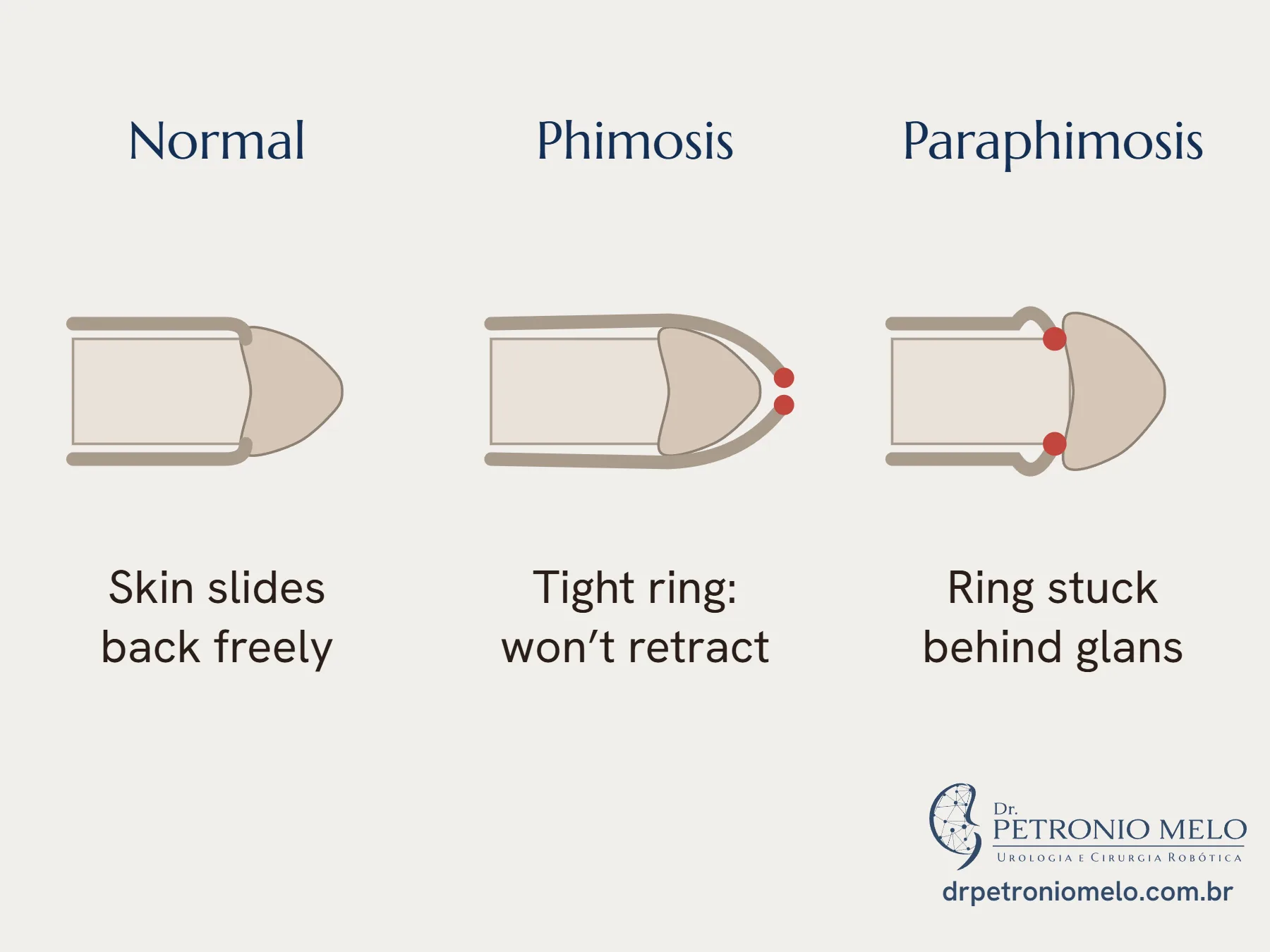
The foreskin is the skin that covers the glans. In phimosis, a tight ring in this skin stops it from pulling back.1 In paraphimosis, the skin pulls back, the ring gets stuck behind the glans and it does not go back.1
What is normal at each age
In children, a foreskin that does not retract is usually a stage of development, and the skin loosens over time.1
Between ages 5 and 13, phimosis appears in 9% to 20% of boys. Between 16 and 18, in 1%.1 Adhesions between the foreskin and the glans are a different situation, and also part of development: they are present in 63% of boys aged 6 to 7 and in 3% of those aged 16 to 17.1
A foreskin that balloons when urinating does not, on its own, call for surgery. Small white lumps under the skin are usually smegma, a build-up of cells that comes out on its own.1
The foreskin should only be pulled back for cleaning when it retracts easily. Forcing it can leave a scar and create true phimosis.1
Phimosis in adults and adolescents
When phimosis continues after childhood or appears later, it is important to check for scarring. In that case, the ring becomes white, thick and fibrous.1 An important cause is lichen sclerosus, a chronic inflammation that can affect the foreskin, the glans and the meatus, the opening of the urethra.1
Phimosis is also associated with invasive penile cancer, because of chronic infections.4 That is why a sore or patch under the foreskin that does not go away deserves examination.
Treatment with a cream
For phimosis with symptoms, a steroid cream is the first option. It is applied twice a day, for four to eight weeks, directly on the tight ring.1 The European guideline cites success above 80%, and phimosis can come back in up to 17% of cases.1
A Cochrane review of 14 studies, with 1,459 boys, showed more complete resolution with the cream than with placebo or no treatment. The certainty of this evidence is low.2 These data come from children. Adhesions do not respond to the cream, and long-term use can thin the skin.1
When to operate
The European guideline recommends surgery in four situations:1
- Repeated infections of the glans and foreskin
- Phimosis with symptoms that does not improve with treatment
- Lichen sclerosus
- The patient's or parents' preference, in phimosis with symptoms
In babies at risk of repeated urinary infections because of a urinary tract abnormality, treatment may also be recommended without symptoms of phimosis.1
There are two operations. Circumcision removes the foreskin. Preputioplasty widens the ring and keeps the skin, with the drawback that phimosis can come back.1 In the same operation, adhesions are released, a short frenulum is corrected and the meatus is checked, when needed.1
Circumcision is not done during an acute infection. It is also not done in some penile conditions, such as hypospadias, because the skin may be needed for a reconstruction.1 The removed foreskin goes to pathology, because lichen sclerosus can only be confirmed that way and it changes the follow-up.1
Risks
A review of 351 studies found complications in 3.84% of operations, and in 7.47% of those done for medical reasons. In that group, the most frequent were adhesions, narrowing of the meatus and infection.3 Bleeding and an unsatisfactory cosmetic result can also occur.1
In boys with lichen sclerosus, narrowing of the meatus was more common: 20%, against 6% in the others. That is why follow-up is longer.1 After any operation on the foreskin, the guideline advises a check-up in four to six weeks.1
How I approach it
In my practice, I examine before talking about surgery. With children, I explain to the parents what is normal for the age and what needs treatment. When there are symptoms, I usually start with the cream. If it does not work, or if there is scarring, we talk about surgery and its risks. The decision is made together with the patient or the parents.
| In my practice | Circumcision |
|---|---|
| Anesthesia | Local with sedation in adults; general in children |
| Discharge | Always on the same day |
| Stitches | Absorbable; how long they take to fall out depends on the thread used |
| Dressing | Elastic bandage for 48 hours; then gauze and antibiotic ointment until the follow-up visit |
| Follow-up | After 7 days |
| Work | After 7 days |
| Sex and masturbation | After 6 to 8 weeks |
Where to start
When to see a urologist
- If the foreskin gets stuck behind the glans
- If there is pain, swelling or infection of the glans or foreskin
- If your urine stream becomes thin or urinating hurts
- If a white, hardened ring appears on the foreskin
- If a sore or patch appears that does not go away
Frequently asked questions
Does every boy whose foreskin does not retract have phimosis?+
No. In childhood, this is usually a normal stage. Without symptoms, it needs no treatment.1
Should I pull back my son's foreskin to clean it?+
Do not force it. The foreskin should only be pulled back for cleaning when it retracts easily, because forcing it can leave a scar and create true phimosis.1
Does a cream cure phimosis?+
Often, yes. A steroid cream, twice a day for four to eight weeks, has a success rate above 80% in the data cited by the European guideline. Phimosis can come back in up to 17% of cases.1
When is circumcision recommended?+
For repeated infections, for phimosis with symptoms that does not improve with treatment and for lichen sclerosus of the foreskin.1
Does circumcision have risks?+
Yes. A review of 351 studies found complications in about 4 out of every 100 operations, and in 7.47% of those done for medical reasons.3 In that group, the most frequent was adhesions, followed by narrowing of the meatus and infection.3
Does circumcision require a hospital stay?+
In my practice, no. Discharge is always on the same day. In adults, I do the operation with local anesthesia and sedation. In children, under general anesthesia.
When can I have sex again after circumcision?+
In my practice, I advise waiting 6 to 8 weeks for sex and masturbation. Work usually resumes after 7 days.
What is paraphimosis?+
It is when the foreskin gets stuck behind the glans and does not go back. It is an emergency, because the tight ring can impair blood flow.1
References
- EAU Guidelines on Paediatric Urology. European Association of Urology; 2026. Phimosis and other abnormalities of the penile skin chapter. EAU
- Moreno G, Ramirez C, Corbalán J, et al. Topical corticosteroids for treating phimosis in boys. Cochrane Database Syst Rev. 2024;1(1):CD008973. PubMed
- Shabanzadeh DM, Clausen S, Maigaard K, Fode M. Male Circumcision Complications: A Systematic Review, Meta-Analysis and Meta-Regression. Urology. 2021;152:25-34. PubMed
- EAU Guidelines on Penile Cancer. European Association of Urology; 2026. Epidemiology, aetiology and pathology chapter. EAU
Would you like to talk about your case?
In the consultation, I go over your tests and your priorities.
Book a consultation