
Quick answer
A kidney stone is formed by substances in the urine that crystallize. It can sit in the kidney without symptoms or move down the ureter and cause colic. Many small stones pass on their own. When a stone does not pass, grows, obstructs or causes infection, it can be treated with laser ureteroscopy or percutaneous surgery. Shock waves are another option.
What it is
A stone forms when substances in the urine crystallize and clump together, and many stones are a mix of more than one material.1 Frequency ranges from 1% to 13% of the population, depending on location, climate, diet and genetics.1
Symptoms
A stone sitting in the kidney may cause no symptoms at all. When it moves into the ureter, it usually causes severe pain in the back or flank and vomiting, sometimes with fever.1 The pain comes from blocked urine stretching the kidney.
Evaluation should also be immediate in people with a single kidney and when the cause of the pain is in doubt.1
How it is diagnosed
Ultrasound is usually the first test, because it is safe and uses no radiation. It has a limit: it finds about 45% of ureteral stones.1 After it, non-contrast CT confirms the diagnosis. It shows where the stone is, its size, its density and the surrounding anatomy, all of which help in choosing the treatment.1
Blood and urine tests complete the evaluation. When the stone is removed or passes, it is worth analyzing what it is made of.1
When a stone passes on its own
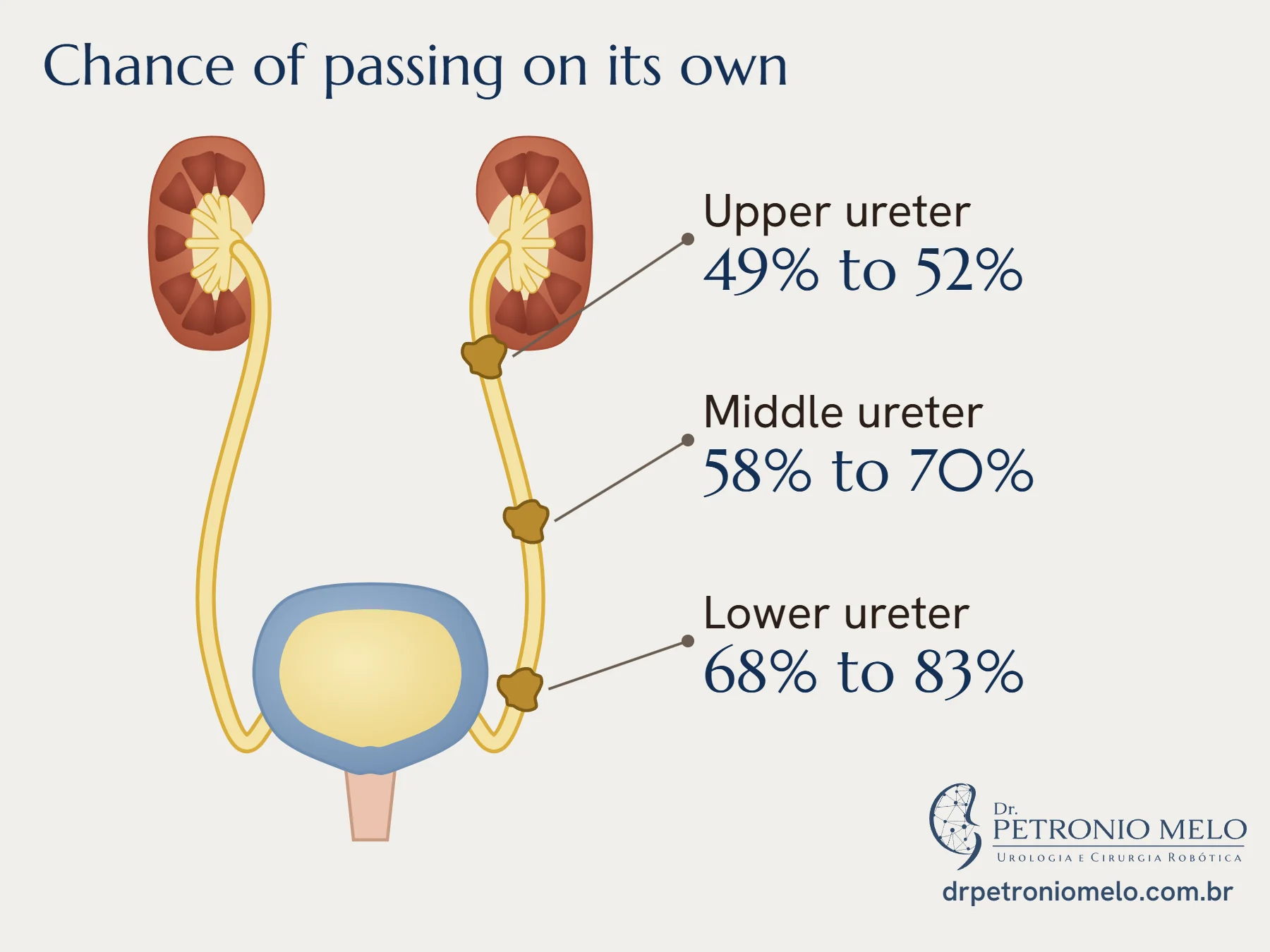
Small stones in the ureter can be monitored when there is no infection, uncontrolled pain or worsening kidney function.1 About 75% of stones smaller than 5 mm pass on their own, and 62% of those measuring 5 mm or more. On average, it takes 17 days.1 Location also matters.
For pain, an anti-inflammatory is the first choice, if there is no contraindication.1 For stones in the lower ureter larger than 5 mm, an alpha-blocker can help the stone pass. This is an off-label use, agreed with the patient.1
When to treat and what the options are
In the ureter, removal is indicated when the chance of passing is low, pain persists despite medication, the obstruction continues or kidney function is at risk.1
In the kidney, treatment comes in when the stone grows, obstructs, or causes infection or pain. The patient's preference, other conditions and routine, such as a job that requires travel, also matter.1 Small stones without symptoms can be monitored. In one review, 7% to 26% of them ended up needing surgery.1
| Option | How it works | Best suited for |
|---|---|---|
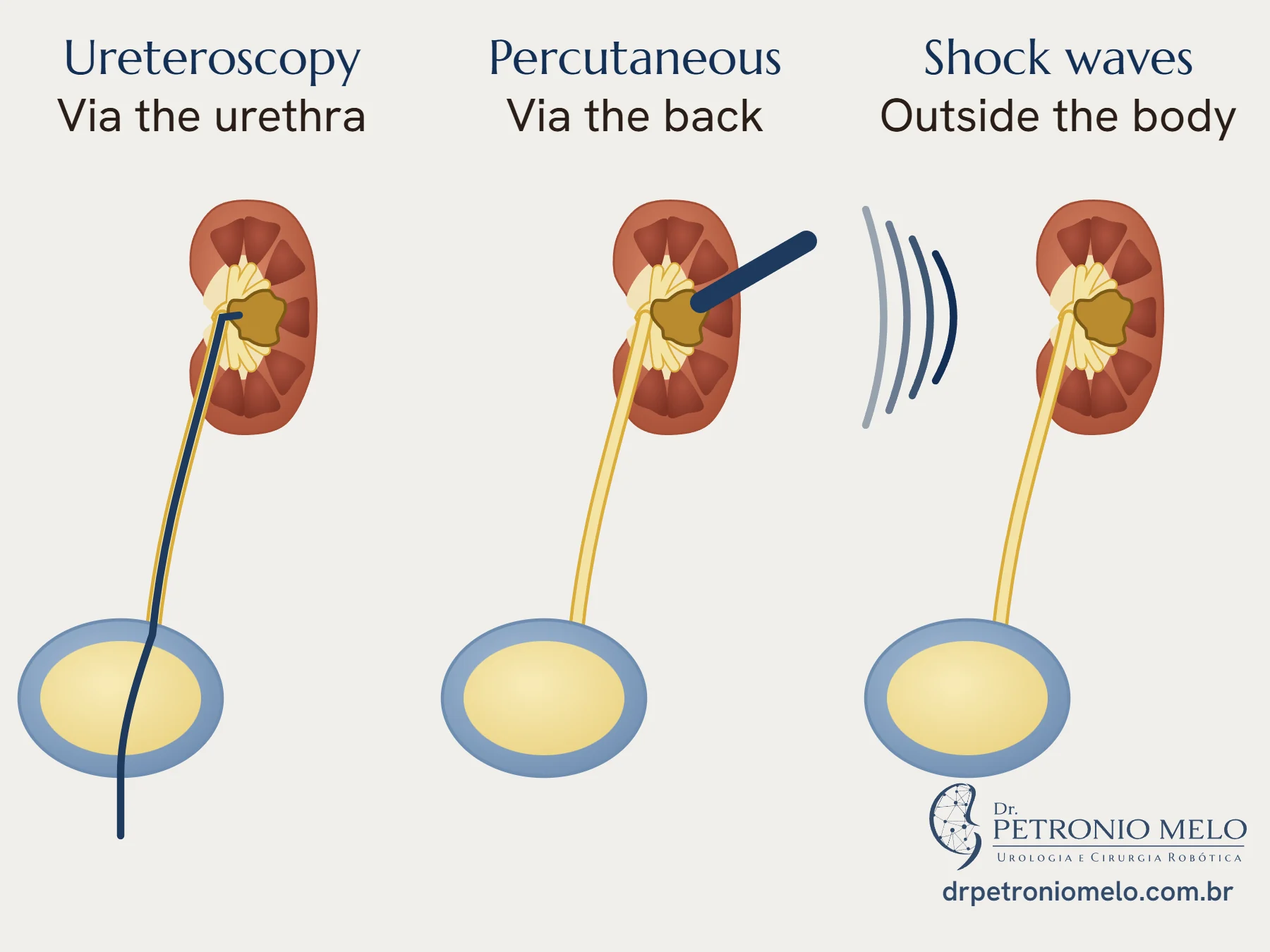
| Laser ureteroscopy | A thin instrument goes in through the urethra and reaches the stone, with no incision | Ureteral and kidney stones; above 2 cm, when percutaneous surgery is not an option1 |
| Percutaneous surgery | A small opening in the back gives access to the kidney, and the stone is broken up and removed | First option for kidney stones above 2 cm1 |
| Shock waves | They fragment the stone from outside the body, and the pieces leave in the urine | Stones up to 2 cm; less effective in the lower pole of the kidney and may need more than one session1 |
In the ureter, ureteroscopy is more likely to solve the problem in a single procedure, with more complications than shock waves.1 Between 1 and 2 cm in the kidney, percutaneous surgery with smaller instruments removes more stone, with a higher risk of bleeding and a longer stay.1 The choice depends on the size, location and density of the stone and on each person's anatomy.
Laparoscopy and open surgery are rarely used today and are reserved for complex cases.1
My research in percutaneous surgery
During my residency, I was the first author of the study that reviewed my residency program's experience: 1,066 percutaneous surgeries in 891 patients, from 2011 to 2016. Complications occurred in 14.9% of cases, and the CT scan on the following day showed that the stone-free rate fell from 87.9% in the simplest cases to 24.3% in the most complex.3 These numbers help us discuss, before surgery, the chance of needing more than one procedure.
In another study from the same program, we compared 393 operations in four patient positions. Success and serious complications were similar, and one of the positions lying on the back had a shorter operating time.4
How to prevent new stones
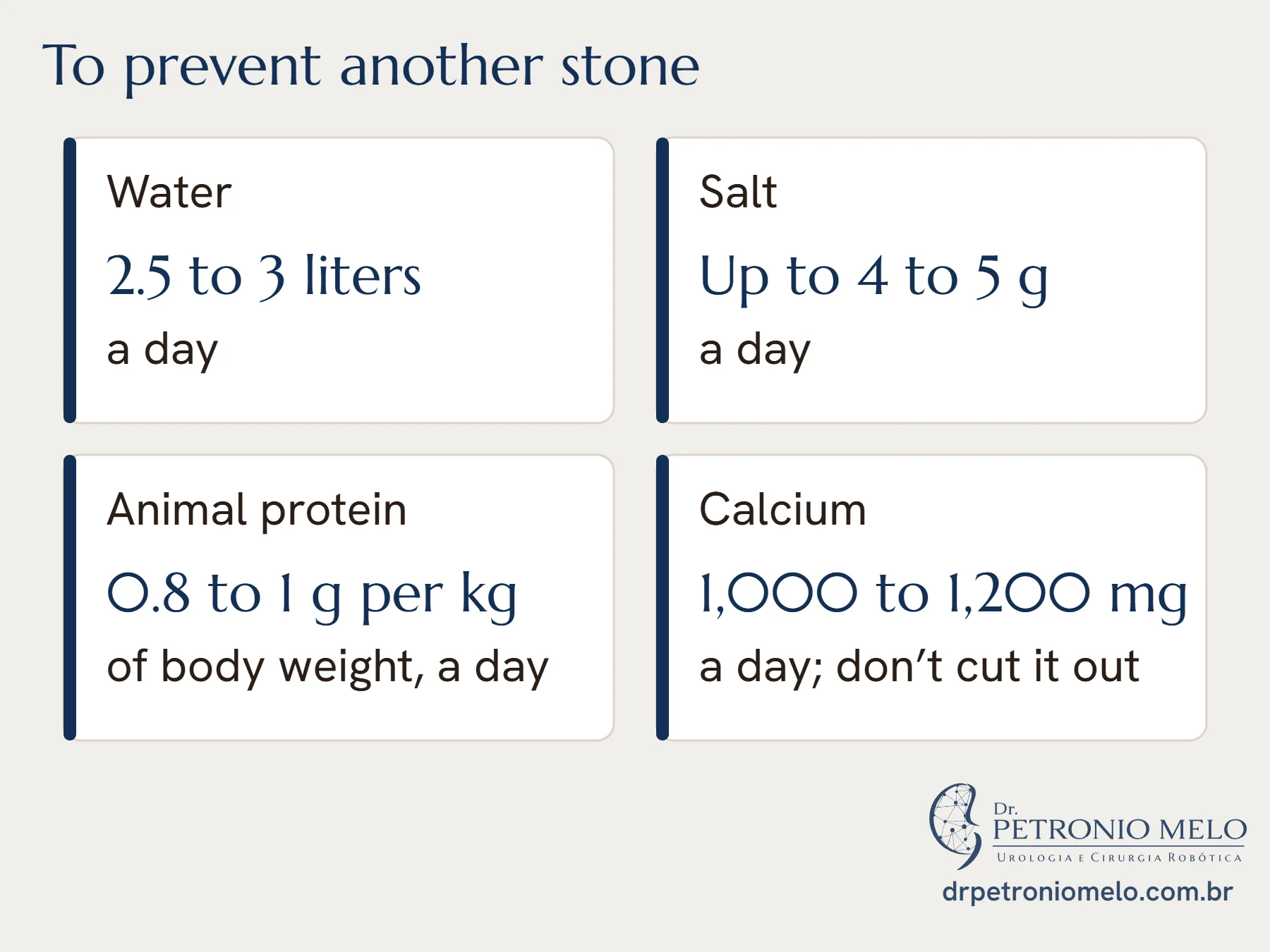
After the first stone, a review calculated a 26% recurrence at five years.1 Some measures apply to almost everyone.2
People at high risk of another stone need a metabolic workup, ideally about three months after the episode.2
How I approach it
In my practice, I start with the pain and the risk of infection. Then I look at the size and location of the stone on the CT scan and explain what can wait and what needs treatment. I present the options with the advantages and limits of each, and the decision is made together with the patient. Today, laser ureteroscopy and percutaneous surgery treat most cases. After treatment, we talk about prevention, because stones can come back.
| Operation | In my practice |
|---|---|
| Laser ureteroscopy | General anesthesia and a hospital stay of less than 12 hours. I usually leave a double J stent: 5 days when the operation goes well, longer if needed. |
| Percutaneous surgery | Always lying on the back, usually in the Barts flank-free position. Hospital stay of 24 hours. Whenever possible, no nephrostomy, only the double J stent. |
Where to start
- Symptoms and renal colicWhat the pain is like, why the kidney swells and what calls for immediate evaluation.
- When to treat a kidney stoneWhen to wait, when to treat and what changes the choice of technique.
- Flexible laser ureteroscopyHow surgery through the urethra works, without cuts.
- Percutaneous nephrolithotomyHow surgery for large kidney stones works.
- Double J stentWhat it is for, how long it stays and what bothers.
- How to prevent kidney stonesWater, diet, tests and the type of stone.
- Bladder stonesWhy they form and the link with the prostate.
When to see a urologist
- If you have colic with fever or chills
- If the pain does not improve with medication
- If a test shows a stone in the kidney or ureter, even without pain
- If you have a single kidney
- If you have had a stone and want to prevent the next one
Frequently asked questions
Do kidney stones pass on their own?+
Many do, especially small ones already in the ureter. About 75% of stones smaller than 5 mm pass on their own, in 17 days on average.1 The chance falls as the stone gets bigger and varies from person to person.
Is renal colic with fever dangerous?+
Yes. An obstructed kidney with signs of infection is a urologic emergency. The urine has to be drained urgently, and antibiotics start right away.1
How much water should I drink to prevent stones?+
The European guideline advises 2.5 to 3 liters of fluid a day, preferably water, to pass more than 2.5 liters of urine in 24 hours.2
Should people with stones cut out calcium?+
In general, no. Dietary calcium should not be restricted without a strong reason, because eating little calcium is associated with more stones. The daily requirement is 1,000 to 1,200 mg.2
Can stones come back after treatment?+
They can. A review cited by the European guideline calculated a 26% recurrence at five years after the first stone.1 Prevention depends on the type of stone and each person's risk.2
Does every kidney stone need surgery?+
No. Small stones that are not moving and cause no symptoms can be monitored. Treatment comes in when the stone grows, obstructs, or causes infection or pain.1
References
- EAU Guidelines on Urolithiasis. European Association of Urology; 2026. Guidelines chapter. EAU
- EAU Guidelines on Urolithiasis. European Association of Urology; 2026. Metabolic evaluation and recurrence prevention chapter. EAU
- de Souza Melo PA, Vicentini FC, Beraldi AA, et al. Outcomes of more than 1 000 percutaneous nephrolithotomies and validation of Guy's stone score. BJU Int. 2018;121(4):640-646. PubMed
- Melo PAS, Vicentini FC, Perrella R, et al. Comparative study of percutaneous nephrolithotomy performed in the traditional prone position and in three different supine positions. Int Braz J Urol. 2019;45(1):108-117. PubMed
Would you like to talk about your case?
In the consultation, I go over your tests and your priorities.
Book a consultation