
Quick answer
Kidney tumors start in the tissue of the organ, and many are found on tests done for another reason. Tumors of the bladder, ureter and renal pelvis start in the layer that lines the urinary tract, and the most common sign is blood in the urine. Treatment depends on the type, the size and how far the tumor has spread.
Where to start
Choose the topic that matches where you are now.
- Kidney cancerHow it is diagnosed, the stages and the treatments.
- Bladder cancerSymptoms, stages and what changes when the tumor invades the muscle.
- Kidney masses and cystsWhat is benign and what needs investigating.
- Blood in the urineCauses and tests.
- CystoscopyHow the test that looks inside the bladder is done.
- Robotic partial nephrectomyHow the operation that preserves the kidney is done.
- TURBTHow the tumor is removed through the urethra.
- CystectomyHow the bladder is removed and what comes next.
Where these tumors start
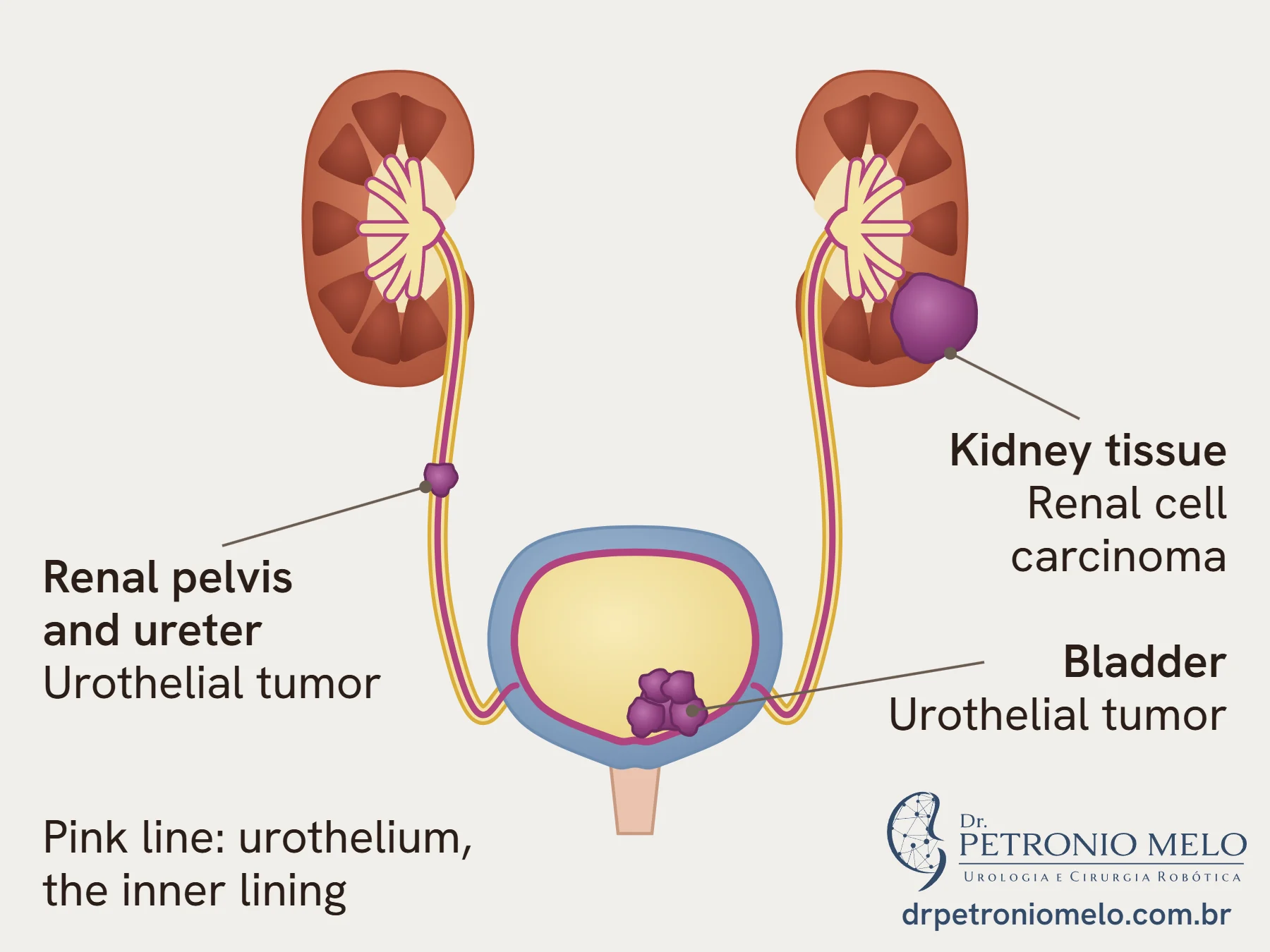
The kidney filters the blood and makes urine, which flows down the ureter to the bladder. The most common kidney tumor, renal cell carcinoma, starts in the tissue of the organ itself.1
The renal pelvis, ureter and bladder share the same inner lining, the urothelium. Tumors of this layer are called urothelial: 90% to 95% are in the bladder, and 5% to 10% in the renal pelvis and ureter.8
In Brazil, the National Cancer Institute (INCA) estimates 13,110 new cases of bladder cancer per year from 2026 to 2028, with 9,040 in men and 4,070 in women.10 Worldwide, kidney cancer had 434,840 new cases in 2022.1
Who is at higher risk
| Tumor | Main risk factors |
|---|---|
| Kidney | Smoking, obesity and high blood pressure1 |
| Bladder | Smoking, which accounts for about half of cases, and exposure at work to products such as paints, dyes, metals and petroleum derivatives3 |
Having a parent, sibling or child with kidney cancer roughly doubles the risk.1 In the bladder, family history seems to have little impact.3
Warning signs
Blood in the urine is the most common finding in bladder cancer, often without pain.4 Burning, frequent urination and urgency can also appear, especially in carcinoma in situ, a type of flat lesion.4
In the kidney, most tumors cause no symptoms. The classic combination of flank pain, blood in the urine and a palpable mass was seen in 0.6% of patients in a study cited by the European guideline.2
How it is diagnosed
- History and physical examWe go over symptoms, smoking, work and family history.4
- ImagingUltrasound or CT, depending on what is suspected.2,4
- CystoscopyWhen a bladder tumor is suspected, we look inside the bladder with a thin scope. No non-invasive test replaces this step.4
- Tissue analysisThe pathologist defines the type and, in the bladder, how deeply the tumor has grown.4
How they are treated
| Situation | What the European guideline advises |
|---|---|
| Localized kidney tumor | Surgery with curative intent. In T1 tumors, partial nephrectomy, which preserves the kidney5 |
| Small kidney tumor that does not need treatment right away | Active surveillance in selected cases5 |
| Bladder tumor that does not invade the muscle | Resection through the urethra, followed by bladder instillations depending on risk6 |
| Bladder tumor that invades the muscle | Systemic treatment and removal of the bladder, or treatment that preserves the bladder7 |
Some of these operations can be done with a robot. The European guideline indicates that the choice of approach should depend on the surgical team's experience and on what best protects the treatment outcome.5,7
How I approach it
In my practice, I start by understanding what the test showed and what that changes in the patient's life. I explain the type of tumor, the stage and the options that make sense for the case. The decision is made together with the patient, and the family takes part if the patient wishes.
When to see a urologist
- If you see blood in your urine, even just once
- If an imaging test shows a nodule or complex cyst in the kidney
- If a urine test shows blood that cannot be seen with the naked eye
- If you pass a clot or cannot urinate, get in touch the same day
Frequently asked questions
Is blood in the urine a sign of cancer?+
It can be, and that is why it needs evaluation. Blood in the urine is the most common finding in bladder cancer.4 It can also have other causes, which tests help to sort out.9
Do kidney tumors cause symptoms?+
Often they do not. In a study cited by the European guideline, 60% of tumors were found by chance on imaging tests.2
Does smoking increase the risk?+
Yes. Smoking is the main risk factor for bladder cancer and accounts for about half of cases.3 It is also a risk factor for kidney cancer.1
Does every kidney or bladder tumor need surgery?+
No. Some small kidney tumors can be followed.5 In the bladder, treatment depends on whether the tumor invades the muscle.6,7
Is there a screening test for these tumors?+
For kidney cancer, the European guideline does not recommend routine screening.1 Evaluation starts when there are symptoms or a finding on a test.
References
- EAU Guidelines on Renal Cell Carcinoma. European Association of Urology; 2026. Epidemiology, aetiology and pathology chapter. EAU
- EAU Guidelines on Renal Cell Carcinoma. European Association of Urology; 2026. Diagnostic evaluation chapter. EAU
- EAU Guidelines on Non-muscle-invasive Bladder Cancer. European Association of Urology; 2026. Epidemiology and aetiology chapter. EAU
- EAU Guidelines on Non-muscle-invasive Bladder Cancer. European Association of Urology; 2026. Diagnosis chapter. EAU
- EAU Guidelines on Renal Cell Carcinoma. European Association of Urology; 2026. Disease management chapter. EAU
- EAU Guidelines on Non-muscle-invasive Bladder Cancer. European Association of Urology; 2026. Disease management chapter. EAU
- EAU Guidelines on Muscle-invasive and Metastatic Bladder Cancer. European Association of Urology; 2026. Disease management chapter. EAU
- EAU Guidelines on Upper Urinary Tract Urothelial Cell Carcinoma. European Association of Urology; 2026. Epidemiology, aetiology and pathology chapter. EAU
- Barocas DA, Lotan Y, Matulewicz RS, et al. Updates to Microhematuria: AUA/SUFU Guideline (2025). J Urol. 2025;213(5):547-557. PubMed
- Instituto Nacional de Câncer. Estimativa 2026-2028: incidência de câncer no Brasil. Síntese de resultados e comentários. Rio de Janeiro: INCA; 2026. INCA
Would you like to talk about your case?
In the consultation, I go over your tests and your priorities.
Book a consultation