

Quick answer
Excluding non-melanoma skin tumors, prostate cancer is the most common cancer among men in Brazil, with an estimated 77,920 new cases per year from 2026 to 2028.1 Early on, it usually causes no symptoms.2 When it is confined to the prostate, it can be cured, and some low-risk tumors are simply monitored closely.3
Where to start
Choose the topic that matches where you are now.
Tests and reports
- PSA: when to investigateWhat the result means and what the next step is.
- Screening and the prostate examWhen to start and how the evaluation works.
- MRI and PI-RADSWhat the scores on the scan mean.
- Transperineal prostate biopsyHow the test is done and what to expect afterward.
- Gleason, ISUP and the biopsy reportHow to read what the result says.
- PSMA PETWhat it is for and when it is ordered.
Treatment
- Surgery or radiotherapyWhat to compare before choosing a treatment.
- Robotic radical prostatectomyHow the surgery works, what the studies show and what recovery is like.
- Active surveillanceWhen to monitor closely without treating right away.
- Preparing for surgeryWhat to do beforehand and what the day of the operation is like.
- Recovery after prostatectomyWhat to expect in the following weeks.
- Continence after surgeryHow bladder control usually comes back.
- Erections and ejaculation after surgeryWhat changes and how follow-up works.
- PSA after prostatectomyHow to follow the test after surgery.
What it is
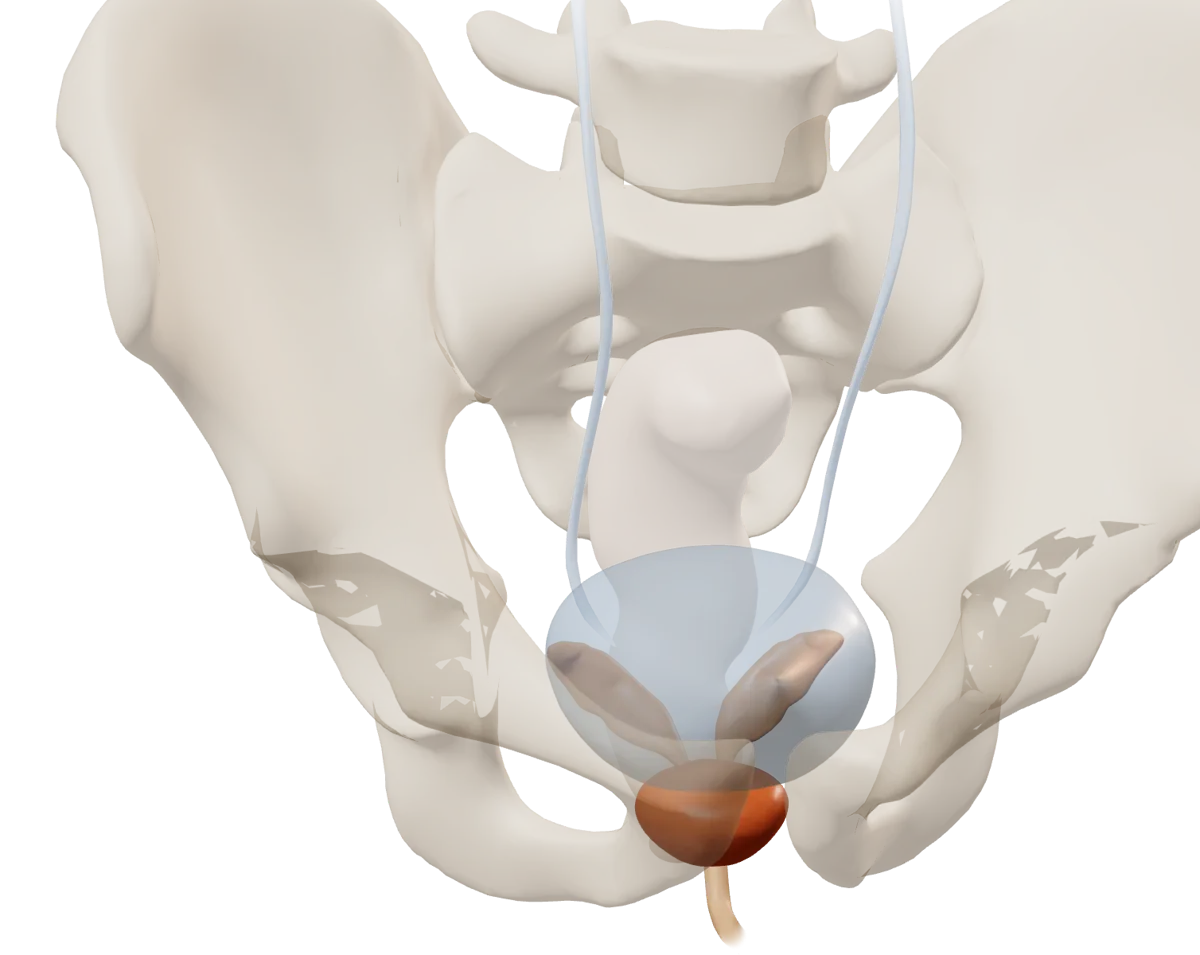
The prostate sits below the bladder, in front of the rectum, around the urethra. Cancer begins when cells of the gland start growing out of control.
Its behavior varies greatly from one man to another. Some tumors would never cause symptoms, and others are aggressive.2 That is why the Gleason score and ISUP grade group, which appear in the biopsy report, weigh so heavily in the decision.
Who is at higher risk
Age, family history, African ancestry and a BRCA2 gene mutation all count. These factors determine when to start evaluation:2,5
| Group | Start evaluation at age |
|---|---|
| Men in general | 50 |
| Black men | 45 |
| First-degree relative with the disease | 45 |
| BRCA2 gene mutation | 40 |
After age 75, the Brazilian Society of Urology advises evaluation only for men with a life expectancy of more than 10 years.5
How it is diagnosed
- PSA and digital rectal examPSA is a blood test. An abnormal value is usually repeated before going further.2
- MRIIt comes before the biopsy and shows whether there is a suspicious area.2
- BiopsyThe biopsy removes small samples of the prostate for the pathologist to examine.
- Pathology reportIf there is cancer, the report gives the Gleason score and ISUP grade group, which show how aggressive the tumor is.
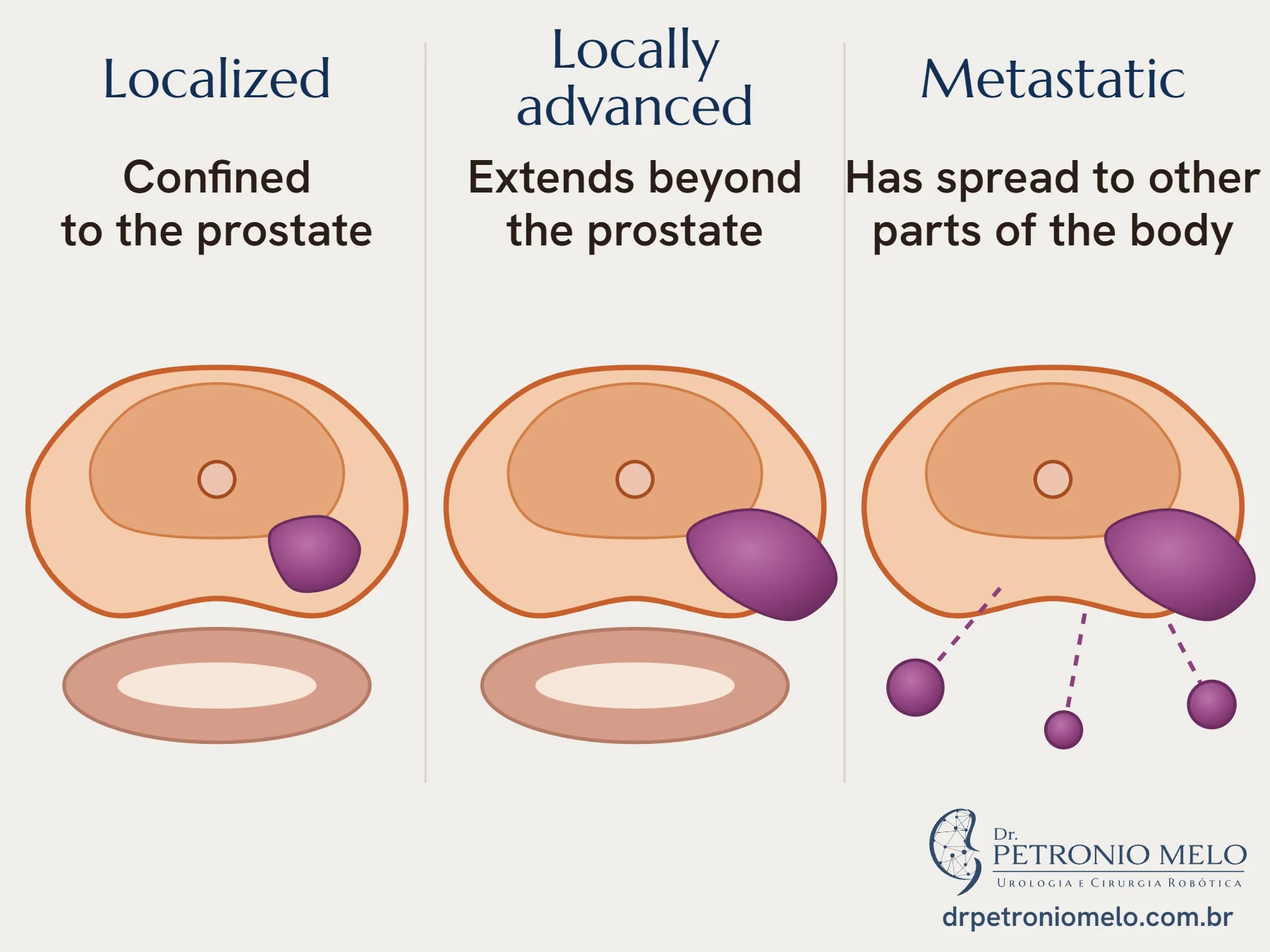
Once the diagnosis is made, we assess whether the disease has left the prostate. PSMA PET is the most sensitive test for this.3
Can it be cured?
When the tumor is confined to the prostate, it can be cured.3
ProtecT, a British study, followed 1,643 men with localized tumors for 15 years. In that period, 2.7% died of the disease, with similar numbers across active monitoring, surgery and radiotherapy.4 This result comes from one study and does not predict what will happen to each person.
When the cancer has already spread, treatment aims to control the disease, with hormone therapy and other medications.6
Treatment options
The choice starts from the risk group, your health and what matters most to you.3
| Situation | What is usually discussed |
|---|---|
| Low risk | Active surveillance |
| Intermediate risk | Surgery or radiotherapy. Active surveillance in selected cases |
| High risk and locally advanced disease | Surgery or radiotherapy, often with hormone therapy |
| Metastatic disease | Hormone therapy and other medications |
Robotic radical prostatectomy has its own guide.
How I approach it
In my practice, I start with each man's risk: age, family history and previous test results. I go through the result calmly and explain the options that make sense for him, including active surveillance when it fits. The decision is made together with the patient, and the family takes part if he wishes.
When to see a urologist
- From age 50, even without symptoms, or earlier if you are in a higher-risk group
- If your PSA or rectal exam is abnormal
- If you already have a biopsy and want to understand the report
- If you have been diagnosed and want to talk about the options
Frequently asked questions
Can prostate cancer be cured?+
When it is confined to the prostate, it can be cured.3 In a British study of 1,643 men with localized tumors, 2.7% died of the disease within 15 years.4 That number does not predict what will happen to each person, because the chance depends on the risk group.
Does prostate cancer cause symptoms?+
Early on, it usually does not. Symptoms generally appear late in the course of the disease.2 That is why evaluation is recommended even for men who feel well.5
At what age should I start testing?+
From age 50. Black men and men with a first-degree relative with the disease start at 45.2,5 Men with a BRCA2 gene mutation start at 40.2
Does every prostate cancer need surgery?+
No. In low-risk disease, active surveillance is the approach recommended by the European guideline.3 In other cases, surgery and radiotherapy are discussed with the patient, along with the effects of each.
Can transgender women have prostate cancer?+
Yes. Cases have been described in transgender women in a series from the United States veterans health system.7 Anyone who has a prostate can talk to a urologist about evaluation.
References
- Instituto Nacional de Câncer. Estimativa 2026-2028: incidência de câncer no Brasil. Síntese de resultados e comentários. Rio de Janeiro: INCA; 2026. INCA
- EAU-EANM-ESTRO-ESUR-ISUP-SIOG Guidelines on Prostate Cancer. European Association of Urology; 2026. EAU
- Cornford P, van den Bergh RCN, Briers E, et al. EAU-EANM-ESTRO-ESUR-ISUP-SIOG Guidelines on Prostate Cancer, 2024 Update. Part I: Screening, Diagnosis, and Local Treatment with Curative Intent. Eur Urol. 2024;86(2):148-163. PubMed
- Hamdy FC, Donovan JL, Lane JA, et al. Fifteen-Year Outcomes after Monitoring, Surgery, or Radiotherapy for Prostate Cancer. N Engl J Med. 2023;388(17):1547-1558. PubMed
- Sociedade Brasileira de Urologia. Aconselhamento para o diagnóstico precoce do câncer de próstata. 2020. SBU
- Tilki D, van den Bergh RCN, Briers E, et al. EAU-EANM-ESTRO-ESUR-ISUP-SIOG Guidelines on Prostate Cancer. Part II, 2024 Update: Treatment of Relapsing and Metastatic Prostate Cancer. Eur Urol. 2024;86(2):164-182. PubMed
- Nik-Ahd F, De Hoedt A, Butler C, et al. Prostate Cancer in Transgender Women in the Veterans Affairs Health System, 2000-2022. JAMA. 2023;329(21):1877-1879. PubMed
3D illustrations: BodyParts3D, © The Database Center for Life Science, licensed under CC Attribution-Share Alike 2.1 Japan.
Would you like to talk about your case?
In the consultation, I go over your tests and your priorities.
Book a consultation