
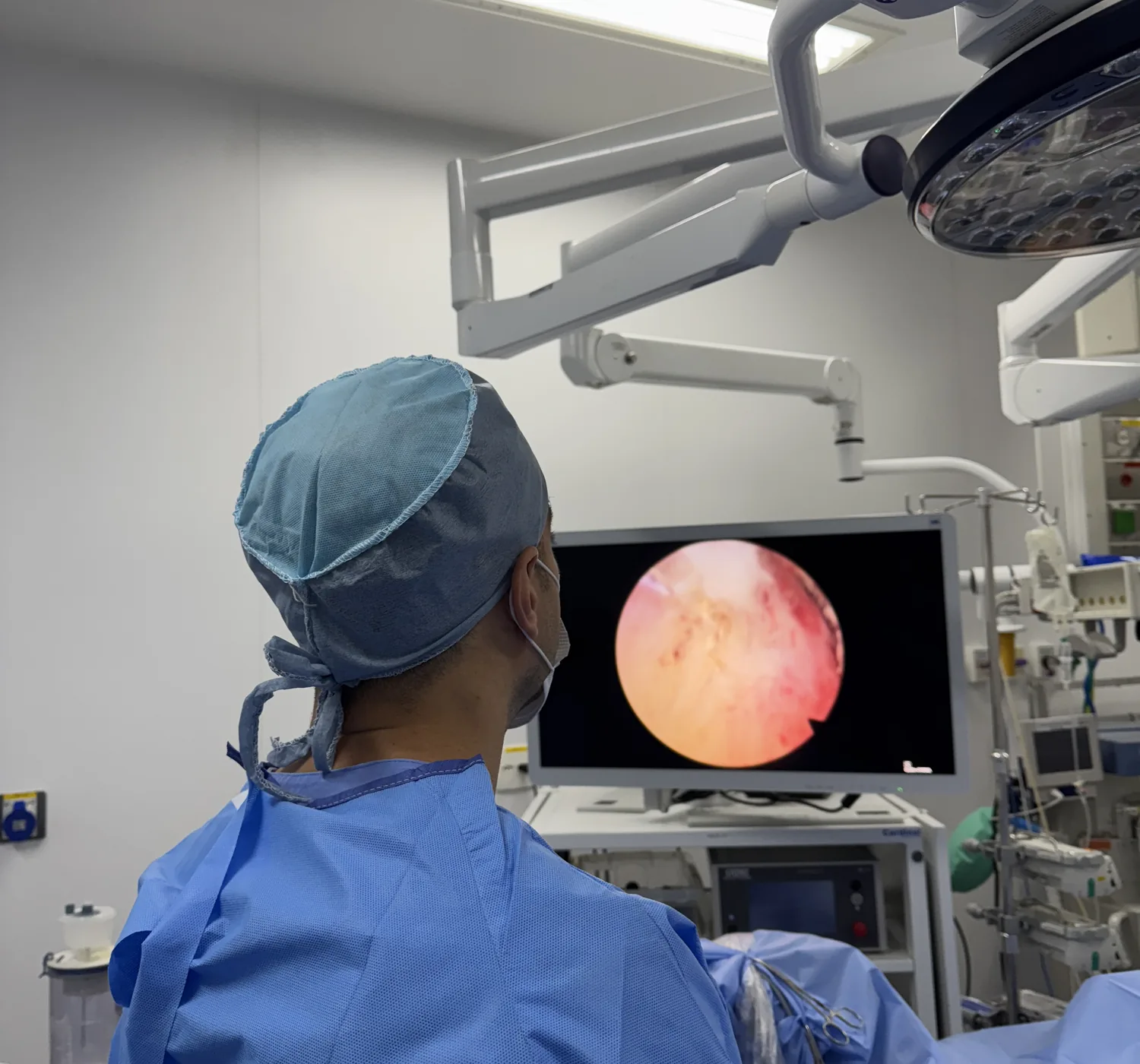
Quick answer
HoLEP is holmium laser enucleation of the prostate. The surgery is done through the urethra, with no cuts in the skin, and removes the tissue that blocks the flow of urine. The European guideline recommends it as an alternative to TURP and open surgery.1 Compared with TURP, it had fewer transfusions, shorter catheter time and hospital stay, and a longer operation.1,2
How it is done
- AccessAn instrument goes in through the urethra, with no cuts in the skin.
- LaserThe laser separates the obstructing tissue from the capsule and controls bleeding.1
- RemovalThe freed tissue goes into the bladder, where it is broken up and removed through the instrument.
- Catheter and dischargeYou leave surgery with a catheter in the bladder. In my practice, it comes out before discharge, and the hospital stay is usually under 24 hours.
The holmium laser is absorbed by the water in the tissue, so it acts on the surface, with 3 to 4 mm of coagulation.1 The surgeon's experience is the factor that weighs most on complications.1
Who it is for
The European guideline recommends HoLEP for men with moderate or severe symptoms caused by obstruction, as an alternative to TURP and open surgery.1 HoLEP is possible even in men who take blood thinners. Laser enucleation has been done safely in men on anticoagulants or antiplatelet drugs, although randomized studies in this group are still lacking.1
In four randomized studies against open surgery in large prostates, relief was similar. Open surgery had longer catheter time and hospital stay and more transfusions, while HoLEP took longer to perform.1 The guideline's recommendation does not name a weight limit.1 In practice, this has to be assessed case by case.
What the studies show
| Source | Patients | Result |
|---|---|---|
| Canadian series, 2011 | 949 men | IPSS from 19 before to 3.8 at ten years5 |
| Review, 2014 | 855 men, against TURP | Fewer transfusions; catheter about 20 hours and hospital stay about 25 hours shorter2 |
| Review, 2025 | Average follow-up of 7.3 years | Second operation in 4.1% of cases, on average4 |
Over the medium and long term, HoLEP worked about as well as TURP in the European guideline.1 The 2011 series comes from a single center, and long-term studies lose some patients along the way.4,5
Risks
| Review of 57 studies, 10,371 operations | Frequency |
|---|---|
| Temporary urine leakage | 7% |
| Blood in the urine with clots | 2.6% |
| Narrowing of the urethra | 2% |
| Permanent urine leakage | 1.3% |
| Narrowing of the bladder neck | 1% |
Burning on urination occurred in 7.5%.3 The most common complications around the time of surgery were not serious.3
Erections and ejaculation
The effect on erections was comparable to other techniques in the European guideline. In a review of randomized studies, scores were slightly higher after enucleation than after TURP in the long term.1,6
In retrograde ejaculation, semen goes into the bladder. It is very common with the conventional techniques, such as TURP, Greenlight and HoLEP, and the rates after HoLEP were similar to TURP.1,6 In my practice, HoLEP almost never preserves ejaculation.
If preserving it matters to you, you can consider Rezum, the water vapor treatment. It tends to preserve ejaculation in 80% to 90% of cases.7,8 In the randomized Rezum study, an analysis done after the trial showed no clinically relevant change in ejaculation at 5 years.9 If this matters to you, we talk it through before choosing the technique.
How I approach it
I have extensive experience with HoLEP. In my practice, I look at the size of the prostate, your medications and what you want to preserve before recommending surgery. I compare HoLEP with the other options and explain what may change in urination and sexual life.
When to see a urologist
- If you have an enlarged prostate and medications do not bring enough relief
- If you have had urinary retention
- If you want to compare HoLEP with other techniques
- After surgery, if you have fever, difficulty urinating or blood with clots
Frequently asked questions
What is HoLEP?+
It is surgery done through the urethra, with no cuts in the skin. The holmium laser separates the tissue that blocks the flow of urine from the capsule.1
Is HoLEP suitable for large prostates?+
Yes. The European guideline recommends it as an alternative to TURP and open surgery, without naming a weight limit. In large prostates, the results were similar to open surgery, with less time with a catheter and in hospital.1 In practice, this has to be assessed case by case.
Will I leak urine after HoLEP?+
It can happen. In a review of 57 studies, leakage was temporary in 7% and permanent in 1.3% of cases.3
Do erections change after HoLEP?+
The European guideline describes an effect comparable to other techniques. In one review, erection scores were slightly higher after enucleation than after TURP in the long term.1,6
Does ejaculation change?+
It usually does. Retrograde ejaculation is very common with the conventional techniques, such as TURP, Greenlight and HoLEP, and in my practice HoLEP almost never preserves ejaculation. If this matters to you, we look at Rezum before deciding.1,6
How long will I stay in hospital?+
In my practice, the stay is usually under 24 hours, and the catheter comes out before discharge.
Can people on blood thinners have HoLEP?+
Yes, it is possible. The European guideline describes laser enucleation done safely in men taking these medications.1
References
- EAU Guidelines on the Management of Non-neurogenic Male LUTS. European Association of Urology; 2026. Disease management chapter. EAU
- Li S, Zeng XT, Ruan XL, et al. Holmium laser enucleation versus transurethral resection in patients with benign prostate hyperplasia: an updated systematic review with meta-analysis and trial sequential analysis. PLoS One. 2014;9(7):e101615. PubMed
- Porreca A, Colicchia M, Tafuri A, et al. Perioperative Outcomes of Holmium Laser Enucleation of the Prostate: A Systematic Review. Urol Int. 2022;106(10):979-991. PubMed
- Yim A, Alberto M, Yan X, et al. Comparing GreenLight PVP and HoLEP beyond 5 years: A systematic review of long-term functional outcomes and reoperation rates. BJUI Compass. 2025;6(2):e483. PubMed
- Elmansy HM, Kotb A, Elhilali MM, et al. Holmium laser enucleation of the prostate: long-term durability of clinical outcomes and complication rates during 10 years of followup. J Urol. 2011;186(5):1972-6. PubMed
- Liu Y, Cheng Y, Zhuo L, et al. Impact on Sexual Function of Endoscopic Enucleation vs Transurethral Resection of the Prostate for Lower Urinary Tract Symptoms Due to Benign Prostatic Hyperplasia: A Systematic Review and Meta-Analysis. J Endourol. 2020;34(10):1064-1074. PubMed
- Destefanis P, Sibona M, Oderda M, et al. Ejaculation-sparing GreenLight anatomical PVP versus REZŪM for benign prostatic obstruction surgery with an ejaculation-sparing purpose: what are the early differences? Minim Invasive Ther Allied Technol. 2026;35(5):383-391. PubMed
- Long Depaquit T, Berchiche W, Uleri A, et al. Two-Year Outcomes of Rezūm Therapy in Real-Life BPH Patients. Prostate. 2026;86(3):314-319. PubMed
- McVary KT, El-Arabi A, Roehrborn C. Preservation of Sexual Function 5 Years After Water Vapor Thermal Therapy for Benign Prostatic Hyperplasia. Sex Med. 2021;9(6):100454. PubMed
Would you like to talk about your case?
In the consultation, I go over your tests and your priorities.
Book a consultation