
Quick answer
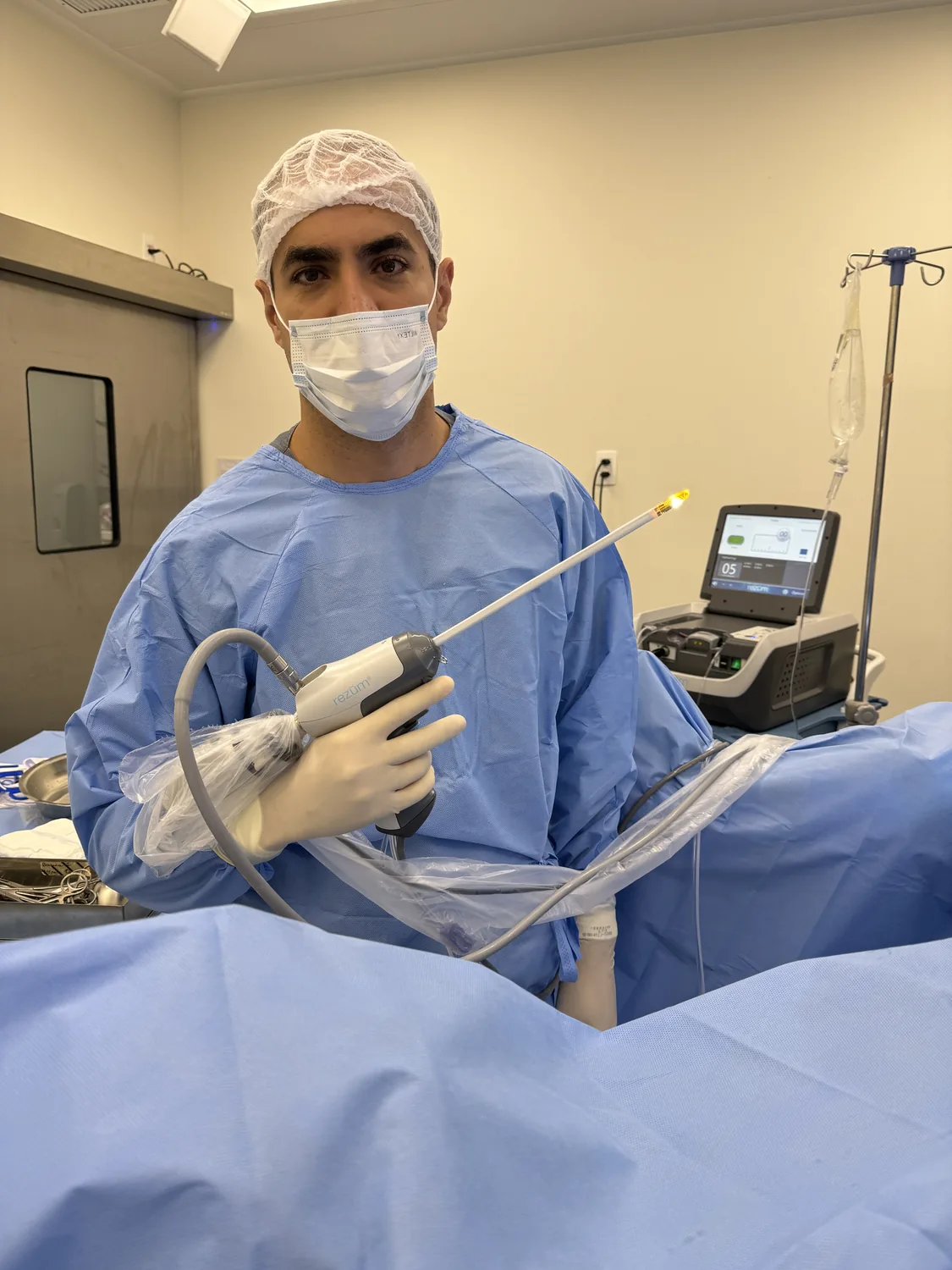
Rezum is a treatment done through the urethra in which a fine needle releases water vapor inside the prostate. The heat destroys the treated tissue, and the body absorbs it over the following weeks.1 It tends to preserve ejaculation in 80% to 90% of cases.4,5 After 5 years in a randomized study, the IPSS stayed 48% below the starting value.2
How it is done
- AnesthesiaIn my practice, the treatment is done under local anesthesia and sedation.
- AccessAn instrument goes in through the urethra, with no cuts in the skin.
- VaporA fine needle releases water vapor inside the prostate. Each lateral lobe gets 1 to 3 injections, and the middle lobe 1 to 2.1
- Catheter and dischargeIn my practice, there is no hospital stay: once it is done, you go home. The catheter stays for 5 to 7 days.
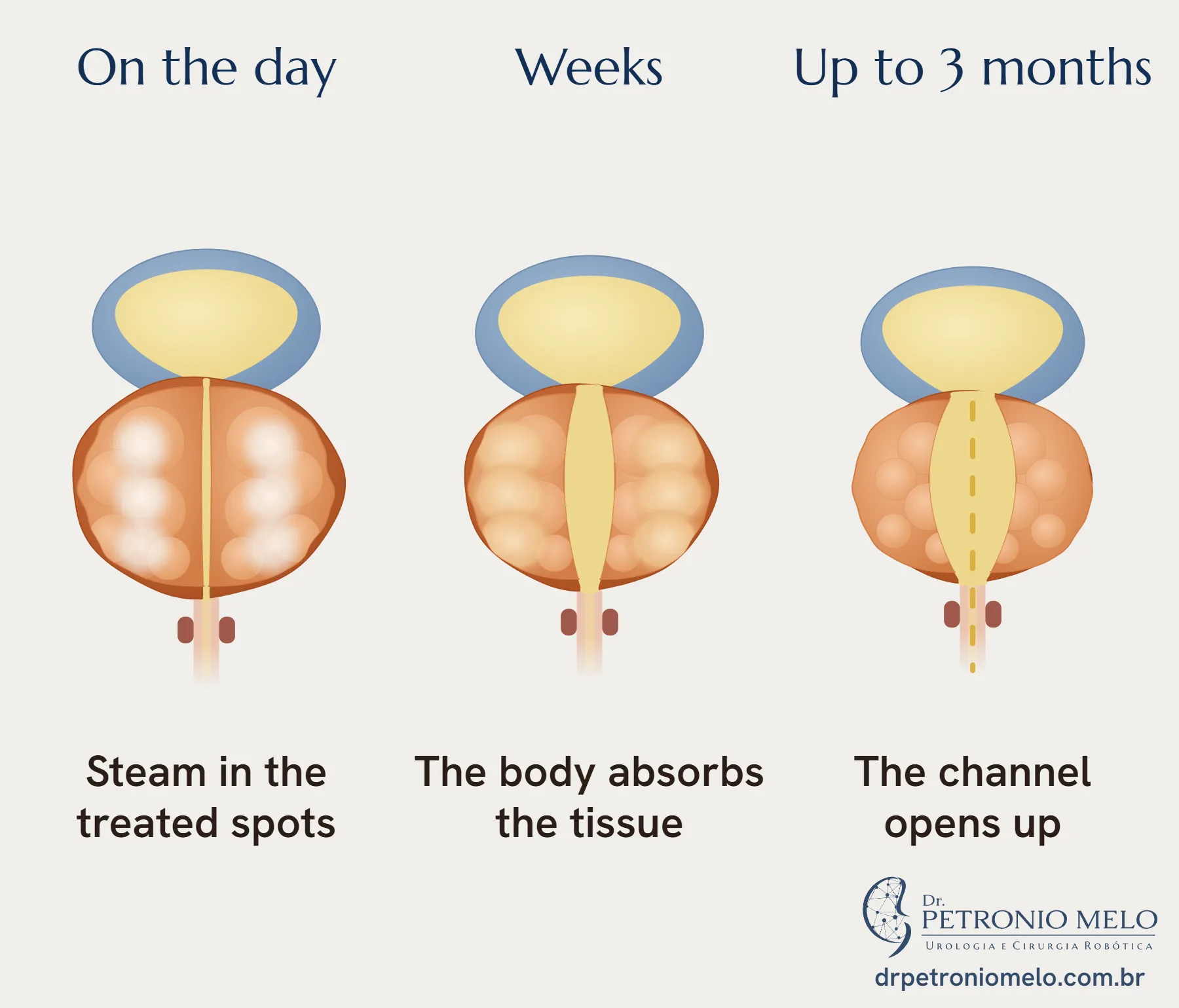
- AbsorptionThe heat destroys the cells of the treated tissue, and the body absorbs this tissue over the following weeks.1
- ImprovementSymptoms improve gradually. In the randomized study, the improvement appeared within 3 months.2
The treatment can be done outside the operating room.1 Because the tissue does not come out right away, the improvement is not immediate.
Who it is for
The randomized study with 5 years of follow-up included prostates of 30 to 80 g.2 An expert consensus accepts prostates above 30 g, with no strict limit at 80 g.6 In the European guideline, a review of prostates above 80 g, up to 150 g, led some countries to widen the indication.1 In practice, this has to be assessed case by case. The European guideline still treats Rezum as a technique under evaluation, and describes the evidence in the reviews as moderate to very low.1
It usually comes up when a man wants to preserve ejaculation. It has also been studied in men who depend on a catheter: the catheter was removed in 68% to 100% of cases, mostly in non-randomized studies.7
What the studies show
| Source | Patients | Result |
|---|---|---|
| McVary, 2021 | Randomized study, 5 years | IPSS 48% lower, stream 44% stronger and another operation in 4.4%2 |
| Samir, 2024 | Prostates of 50 to 120 g, against bipolar TURP | IPSS 55.3% lower at 2 years; smaller effect than TURP, with fewer complications and a shorter hospital stay3 |
| Long Depaquit, 2026 | 110 men, real world | Ejaculation preserved in more than 90%; retreatment in 23% at 2 years5 |
The European guideline also cites 15.8% retreatment at 4 years, counting both another operation and a return to medication.1 Rezum shrinks the prostate less than TURP. At 2 years, its size fell by 28.1%.3
Risks
The European guideline describes mild to moderate side effects that pass quickly.1 In the study against bipolar TURP, complications around the time of treatment were less frequent with Rezum.1,3
The point to weigh is the chance of needing another treatment, which is higher in some series.1,5
Erections and ejaculation
Rezum tends to preserve ejaculation in 80% to 90% of cases.4,5 In a randomized study against bipolar TURP, ejaculation was preserved in 98% of men at 12 months.1 In the 5-year randomized study, there were no reports of treatment-related sexual problems or of new, lasting erectile dysfunction.2 An analysis done after the trial showed no clinically relevant change in ejaculation.8
How I approach it
I have treated more than 100 men with Rezum. In my practice, I look at the size and shape of the prostate and what you want to preserve. I explain that the improvement comes gradually and that the chance of needing another treatment is higher than with operations that remove more tissue.
When to see a urologist
- If you have an enlarged prostate and medications do not bring enough relief
- If preserving ejaculation weighs on your decision
- If you want to compare Rezum with other techniques
- After treatment, if you have fever, difficulty urinating or blood with clots
Frequently asked questions
What is Rezum?+
It is a treatment done through the urethra. A fine needle releases water vapor inside the prostate, and the heat destroys the cells of the treated tissue.1
Does Rezum preserve ejaculation?+
It tends to preserve ejaculation in 80% to 90% of cases.4,5 In a randomized study against bipolar TURP, ejaculation was preserved in 98% at 12 months.1
How soon will I feel better?+
The improvement comes gradually. In the randomized study, it appeared within 3 months and lasted up to 5 years.2
How long do the results last?+
At 5 years, the IPSS stayed 48% below the starting value, and 4.4% of men had another operation.2 In real-world data, retreatment was higher in a 2-year series, at 23%.5
Is it suitable for large prostates?+
The randomized study with 5 years of follow-up included prostates of 30 to 80 g.2 An expert consensus accepts prostates above 30 g, with no strict limit at 80 g.6 Another randomized study included prostates of 50 to 120 g.3 In practice, this has to be assessed case by case.
Will I need a catheter?+
In my practice, the catheter stays for 5 to 7 days. The catheter and the type of anesthesia still vary between centers, according to an expert consensus.6
Will I need to stay in hospital?+
Not in my practice. Rezum is done under local anesthesia and sedation, and you go home when the procedure is over.
Can Rezum help men who depend on a catheter?+
It can. In studies of men who depended on a catheter, the catheter was removed in 68% to 100% of cases.7 Most of these studies were not randomized.
References
- EAU Guidelines on the Management of Non-neurogenic Male LUTS. European Association of Urology; 2026. Disease management chapter. EAU
- McVary KT, Gittelman MC, Goldberg KA, et al. Final 5-Year Outcomes of the Multicenter Randomized Sham-Controlled Trial of a Water Vapor Thermal Therapy for Treatment of Moderate to Severe Lower Urinary Tract Symptoms Secondary to Benign Prostatic Hyperplasia. J Urol. 2021;206(3):715-724. PubMed
- Samir M, Elaal AAA, Gad KAS, et al. Two-year follow-up comparing Rezūm therapy versus bipolar transurethral resection of the prostate for treating benign prostatic hyperplasia. A prospective randomized study. Int J Urol. 2024;31(5):545-550. PubMed
- Destefanis P, Sibona M, Oderda M, et al. Ejaculation-sparing GreenLight anatomical PVP versus REZŪM for benign prostatic obstruction surgery with an ejaculation-sparing purpose: what are the early differences? Minim Invasive Ther Allied Technol. 2026;35(5):383-391. PubMed
- Long Depaquit T, Berchiche W, Uleri A, et al. Two-Year Outcomes of Rezūm Therapy in Real-Life BPH Patients. Prostate. 2026;86(3):314-319. PubMed
- Alcina EL, Arjona MF, Guzmán EF, et al. Expert consensus on Rezūm™: Indications, surgical technique and postoperative care. BJUI Compass. 2025;6(2):e491. PubMed
- Scilipoti P, Chicaud M, Abdallah MA, et al. Minimally Invasive Surgical Therapies in Patients with Catheter-Dependent Urinary Retention: A Collaborative Mini-review. Eur Urol Focus. 2026. PubMed
- McVary KT, El-Arabi A, Roehrborn C. Preservation of Sexual Function 5 Years After Water Vapor Thermal Therapy for Benign Prostatic Hyperplasia. Sex Med. 2021;9(6):100454. PubMed
Would you like to talk about your case?
In the consultation, I go over your tests and your priorities.
Book a consultation