

Quick answer
The size of the prostate helps choose the technique, but it does not decide on its own. The literature gives weight ranges for several techniques, and above 80 g there are fewer studies.1 In practice, this has to be assessed case by case. The choice also depends on your other conditions, anesthesia, your preferences and the surgeon's experience.1
What size changes
The prostate grows with age, and ultrasound or MRI measure how much. The result is usually given in grams; some reports give mL or cm³, with very similar values. The European guideline uses these numbers to organize its recommendations, and there are few randomized studies above 80 g.1
What the literature says about each technique
- TURP: the European guideline recommends it for 30 to 80 g.1
- Greenlight: the European guideline recommends it for 30 to 80 g, and there are no randomized studies above 100 g.1
- Rezum: the randomized study with 5 years of follow-up included 30 to 80 g.4 A consensus accepts prostates above 30 g, with no strict limit at 80 g.2
- Urolift: the European guideline recommends it below 70 g, without a middle lobe.1
- Aquablation: the European guideline recommends it for 30 to 80 g and considers it possible above 80 g, with more studies still needed.1
- HoLEP: the European guideline recommends it as an alternative to TURP and open surgery, without naming a weight limit.1
- Simple prostatectomy: the European guideline recommends open surgery above 80 g when endoscopic enucleation is not available, and considers the robotic approach possible above 80 g.1
- Incision of the prostate: the European guideline recommends it below 30 g, without a middle lobe.1
In practice, all of this has to be assessed case by case. See also iTind and Optilume and EchoLaser. The 2026 American guideline also organizes surgical treatment by technique.3
What weighs beyond size
If preserving ejaculation matters to you, the list of techniques changes. For men on anticoagulants, some techniques have more studies than others, and some treatments are done with less anesthesia.1
The shape of the prostate also counts: a middle lobe limits Urolift, for example.1 And the European guideline includes the surgeon's experience among the factors in the choice.1
How I approach it
I have experience with all of today's techniques. Size varies a lot, and the choice is made case by case. In my practice, I look at your symptoms, tests, medications and what you want to preserve. Then I compare the options that make sense for your case, with the advantages and risks of each.
When to see a urologist
- If your symptoms disrupt your day or your sleep
- If medications do not bring enough relief
- If surgery has been recommended and you want to compare techniques
- If you have had urinary retention
Frequently asked questions
What is the best surgery for an enlarged prostate?+
There is no single answer. The choice depends on the size of the prostate, your other conditions, anesthesia, what you prefer and the surgeon's experience.1
How is prostate size measured?+
By ultrasound or MRI. The result is usually given in grams. Some reports give mL or cm³, with very similar values.
Is there a size limit for each technique?+
The literature gives ranges for several techniques, but in practice this has to be assessed case by case.
Which technique is suitable for prostates of 30 to 80 g?+
This is the range with the most studies. The European guideline recommends TURP, Greenlight and Aquablation for 30 to 80 g.1 In practice, this has to be assessed case by case.
And above 80 g?+
Fewer options have been studied. HoLEP and simple prostatectomy, open or robotic, are the most used in this range.1 In practice, this has to be assessed case by case.
If my prostate is small, can I have surgery?+
It may be needed. In prostates under 30 g without a middle lobe, incision of the prostate is one of the options.1 In practice, this is assessed case by case.
Does a large prostate always need surgery?+
No. Size alone does not call for surgery. What counts are the symptoms, the complications and the response to medications.1
References
- EAU Guidelines on the Management of Non-neurogenic Male LUTS. European Association of Urology; 2026. Disease management chapter. EAU
- Alcina EL, Arjona MF, Guzmán EF, et al. Expert consensus on Rezūm™: Indications, surgical technique and postoperative care. BJUI Compass. 2025;6(2):e491. PubMed
- Goueli R, Badlani GH, Welliver C, et al. Management of Lower Urinary Tract Symptoms Attributed to Benign Prostatic Hyperplasia: AUA Guideline (2026) Part III: Procedural/Surgical Management. J Urol. 2026;216(2):161-170. PubMed
- McVary KT, Gittelman MC, Goldberg KA, et al. Final 5-Year Outcomes of the Multicenter Randomized Sham-Controlled Trial of a Water Vapor Thermal Therapy for Treatment of Moderate to Severe Lower Urinary Tract Symptoms Secondary to Benign Prostatic Hyperplasia. J Urol. 2021;206(3):715-724. PubMed
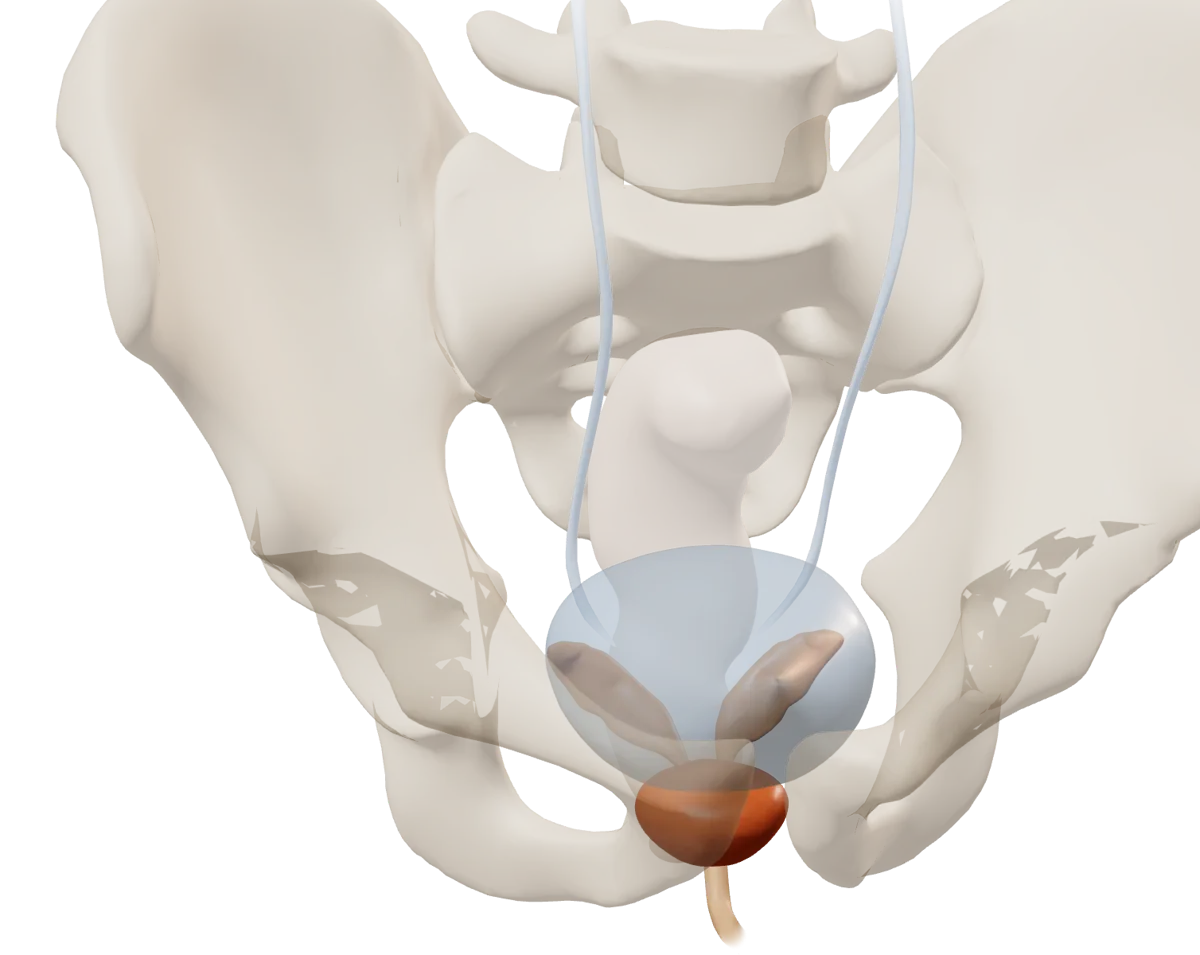
3D illustrations: BodyParts3D, © The Database Center for Life Science, licensed under CC Attribution-Share Alike 2.1 Japan.
Would you like to talk about your case?
In the consultation, I go over your tests and your priorities.
Book a consultation