

Quick answer
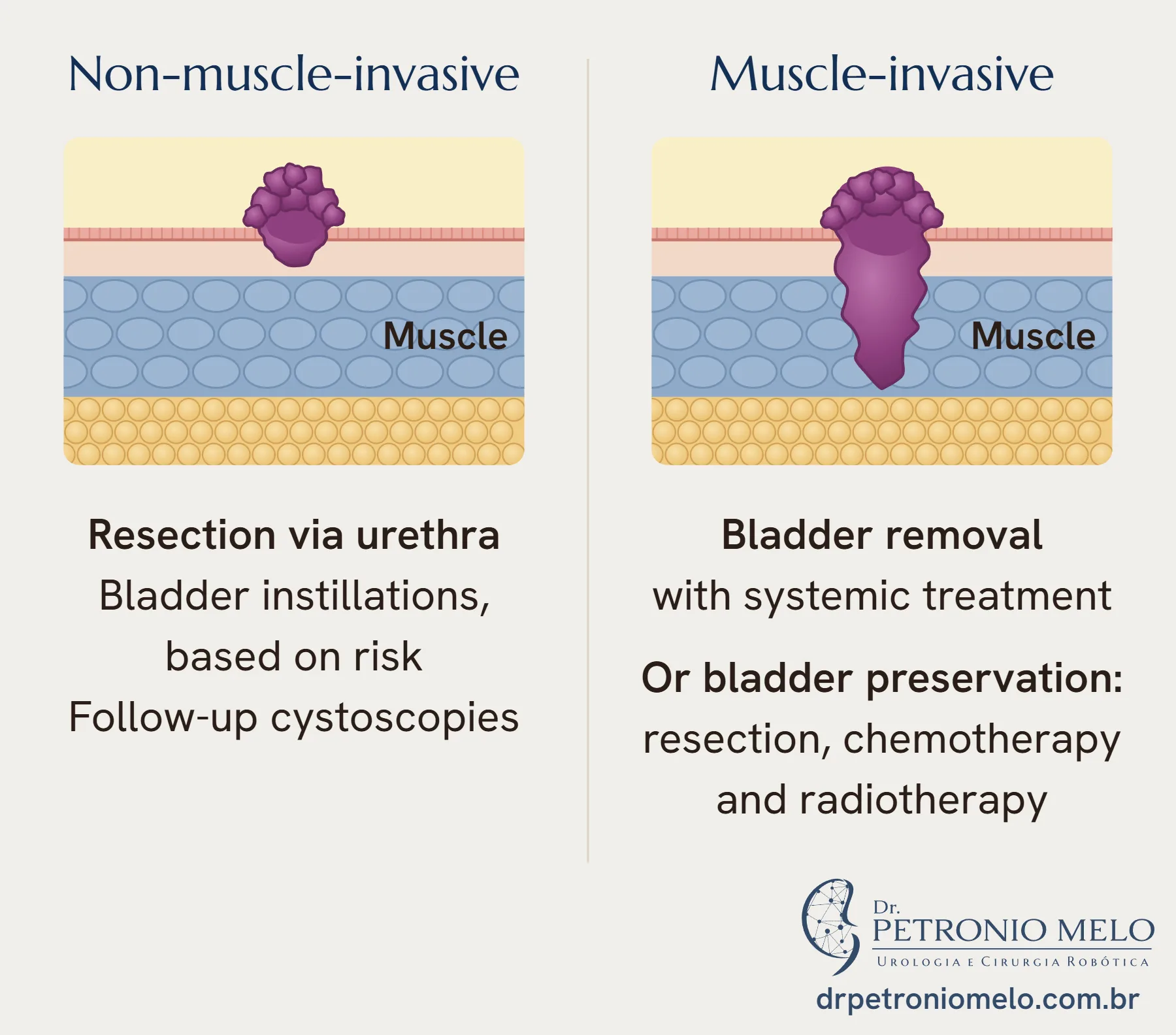
Bladder cancer begins in the layer that lines the inside of the bladder, and the most common sign is blood in the urine. About 75% of tumors do not invade the muscle at diagnosis: they are removed through the urethra and may need instillations into the bladder. When the tumor invades the muscle, treatment changes and may include removing the bladder.
What it is
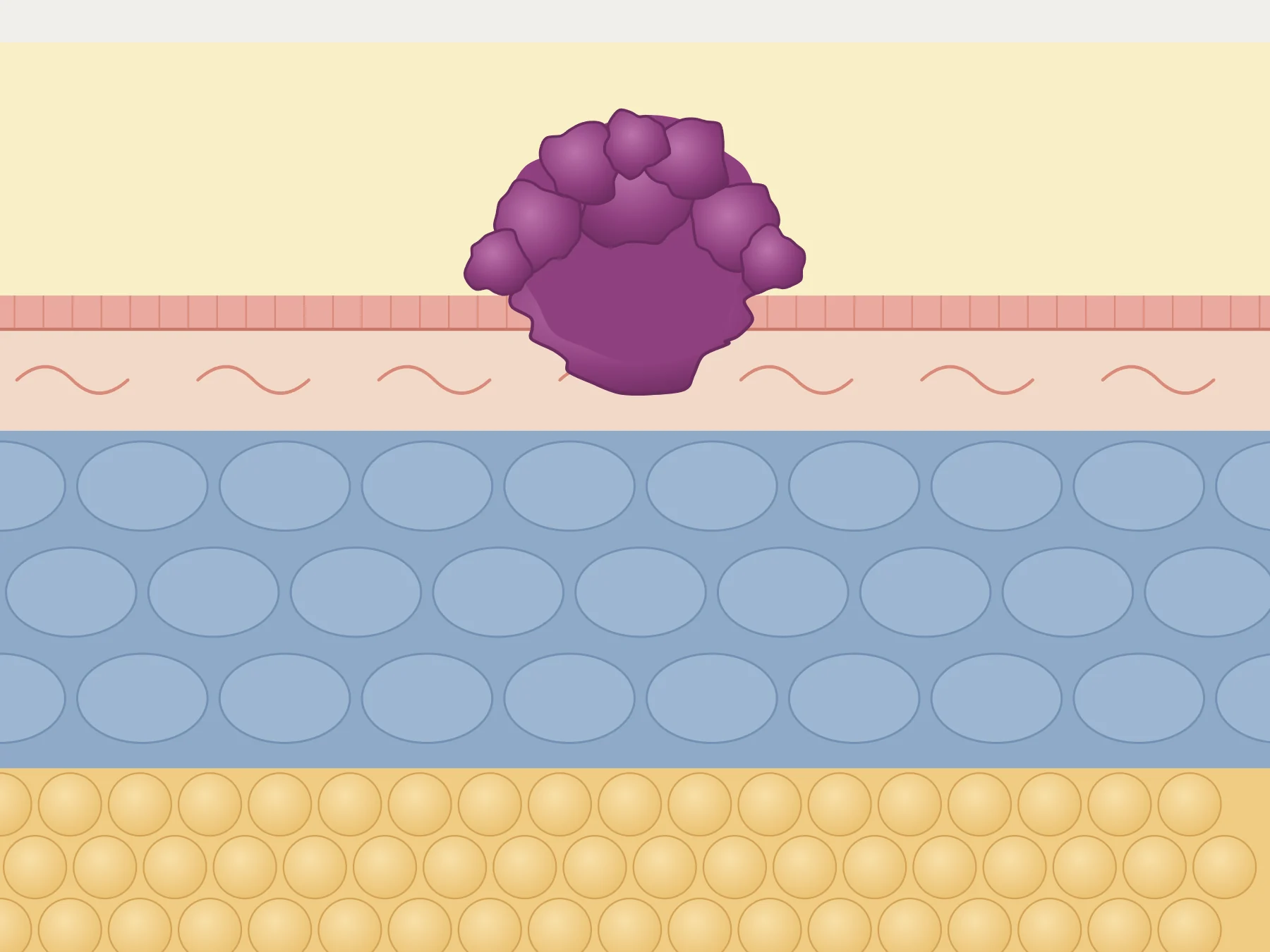
The bladder stores urine, and the urothelium lines its wall on the inside. Most tumors begin in this layer.1
INCA, Brazil's national cancer institute, estimates 13,110 new cases a year in Brazil from 2026 to 2028, 9,040 in men and 4,070 in women. Excluding non-melanoma skin cancer, it is the tenth most common cancer in the country.1
Who is at higher risk
Smoking is the main risk factor and accounts for about half of cases. The risk rises with time and amount: compared with non-smokers, it is about 2.5 times higher with 10 cigarettes a day and 3.3 times higher with 20.2
Exposure at work comes second, with about 10% of cases, in the paint, dye, metal and petroleum industries.2 Radiotherapy to the pelvis can also raise the risk.2
Symptoms
Blood in the urine is the most common sign, often without pain.3,4 It can appear once and go away, and that does not rule out the need for evaluation. Urgency, burning and frequent trips to the bathroom can also happen, especially with carcinoma in situ.3
How it is diagnosed
- ImagingUltrasound of the kidneys and bladder, CT of the urinary tract, or both.3
- CystoscopyA thin scope goes in through the urethra and shows the inside of the bladder. No urine test replaces this step.3
- CytologyIt looks for tumor cells in the urine and helps find high-grade tumors.3
- Resection through the urethraTURBT removes the tumor and sends the tissue for analysis. It is both the diagnosis and the first treatment.3
Stages
What matters most is how deep the tumor goes into the bladder wall.
| Stage | What it means |
|---|---|
| Ta | Papillary tumor, attached to the inner layer11 |
| Carcinoma in situ | Flat, high-grade lesion in the inner layer11 |
| T1 | Reaches the lamina propria, the supporting layer just below11 |
| T2 | Invades the muscle11 |
| T3 and T4 | Reaches the surrounding fat or nearby organs11 |
About 75% of patients have disease without muscle invasion, and about 25% with invasion.2,4
Tumor that does not invade the muscle
After TURBT, treatment follows the risk group, which takes into account size, number of tumors, grade and stage.5
| Risk | Chance of progression | What the European guideline advises |
|---|---|---|
| Low | Negligible | Follow-up with cystoscopies10 |
| Intermediate | 7.4% to 8.5% at 10 years | Chemotherapy in the bladder for up to a year, or BCG for one year5 |
| High | 14% at 10 years | BCG for one to three years, with a conversation about removing the bladder5 |
| Very high | 53.1% to 58.6% at 10 years | Removal of the bladder, or BCG for those who do not want or cannot have surgery5 |
BCG is an immunotherapy placed in the bladder through a catheter. The full regimen has six weekly instillations and boosters of three weekly instillations at 3, 6, 12, 18, 24, 30 and 36 months.5
A second TURBT, two to six weeks after the first, is recommended for T1 tumors, when the first was incomplete or when no muscle came in the sample, with exceptions.3 For T1 tumors, reviews found tumor in this second resection in 31% to 51% of cases.3
The first follow-up cystoscopy is done three months after TURBT, and the pace after that depends on the risk.10 Smoking raises the risk of the tumor coming back and progressing, and stopping is part of the treatment.5
Tumor that invades the muscle
The 2026 European guideline recommends systemic treatment before and after surgery for those who can receive it. For patients who can take cisplatin, the recommended option is chemotherapy with durvalumab. For those who cannot, enfortumab vedotin with pembrolizumab.6 In the NIAGARA study, two-year survival was 82.2% with durvalumab and 75.2% without it.7
Radical cystectomy removes the bladder and the pelvic lymph nodes, and urine then leaves the body by a new route, usually made with a segment of bowel.6 Surgery should not be delayed more than three months, unless the patient is receiving chemotherapy beforehand.6
Robotic and open cystectomy have similar 90-day complications, margins and medium-term results. The robotic approach takes 1 to 1.5 hours longer and causes less bleeding.6 In a British study, patients who had robotic surgery spent 82 of the first 90 days alive and out of hospital, against 80 with open surgery, with less thrombosis and fewer wound problems.8 The team's experience matters more than the technique.6
Bladder-preserving treatment combines resection, chemotherapy and radiotherapy. In well-selected patients, long-term survival is comparable to surgery, and the bladder needs follow-up afterward.6
How I approach it
In my practice, I explain the pathology result calmly, because the next step comes from it. The decision is made together with you, and your family takes part if you wish. On the second resection, I published a literature review in 2017 with the results from one center.
When to see a urologist
- If blood appears in your urine, even if only once
- If a urine test shows blood that cannot be seen with the naked eye
- If burning or urgency to urinate does not improve after an infection is treated
- If you pass clots or cannot urinate, contact me the same day
Frequently asked questions
What is the first symptom of bladder cancer?+
The most common is blood in the urine, often without pain.4 Urgency, burning and frequent trips to the bathroom can also appear.4
Is blood in the urine always cancer?+
No, but it needs evaluation. Visible blood is linked to higher stages at diagnosis than blood seen only on a urine test.3
Can bladder cancer be cured?+
It depends on the stage. For tumors that do not invade the muscle, survival is favorable for most people, but the tumor can come back and requires follow-up.9 For tumors that do invade, treatment is given with curative intent to those who can receive it.6
Will I need to have my bladder removed?+
Not always. About 75% of tumors do not invade the muscle at diagnosis and are first treated by resection through the urethra.2 When they do invade, removing the bladder or bladder-preserving treatment are the options with curative intent.6
What is BCG in the bladder?+
It is an immunotherapy placed inside the bladder through a catheter. It reduces the risk of the tumor coming back in intermediate- and high-risk cases.5
Does stopping smoking help after diagnosis?+
Yes. Smoking raises the risk of the tumor coming back and progressing, and the European guideline asks that every smoker be advised to stop.5
References
- Instituto Nacional de Câncer. Estimativa 2026-2028: incidência de câncer no Brasil. Síntese de resultados e comentários. Rio de Janeiro: INCA; 2026. INCA
- EAU Guidelines on Non-muscle-invasive Bladder Cancer. European Association of Urology; 2026. Epidemiology and aetiology chapter. EAU
- EAU Guidelines on Non-muscle-invasive Bladder Cancer. European Association of Urology; 2026. Diagnosis chapter. EAU
- EAU Guidelines on Muscle-invasive and Metastatic Bladder Cancer. European Association of Urology; 2026. Epidemiology and aetiology chapter. EAU
- EAU Guidelines on Non-muscle-invasive Bladder Cancer. European Association of Urology; 2026. Disease management chapter. EAU
- EAU Guidelines on Muscle-invasive and Metastatic Bladder Cancer. European Association of Urology; 2026. Disease management chapter. EAU
- Powles T, Catto JWF, Galsky MD, et al. Perioperative Durvalumab with Neoadjuvant Chemotherapy in Operable Bladder Cancer. N Engl J Med. 2024;391(19):1773-1786. PubMed
- Catto JWF, Khetrapal P, Ricciardi F, et al. Effect of Robot-Assisted Radical Cystectomy With Intracorporeal Urinary Diversion vs Open Radical Cystectomy on 90-Day Morbidity and Mortality Among Patients With Bladder Cancer. JAMA. 2022;327(21):2092-2103. PubMed
- Clark PE, Holzbeierlein J, Chang SS, et al. 2026 Updates to the Diagnosis and Treatment of Non-muscle Invasive Bladder Cancer: AUA/SUO Guideline. J Urol. 2026. PubMed
- EAU Guidelines on Non-muscle-invasive Bladder Cancer. European Association of Urology; 2026. Follow-up chapter. EAU
- EAU Guidelines on Non-muscle-invasive Bladder Cancer. European Association of Urology; 2026. Staging and classification chapter. EAU
Would you like to talk about your case?
In the consultation, I go over your tests and your priorities.
Book a consultation