

Quick answer
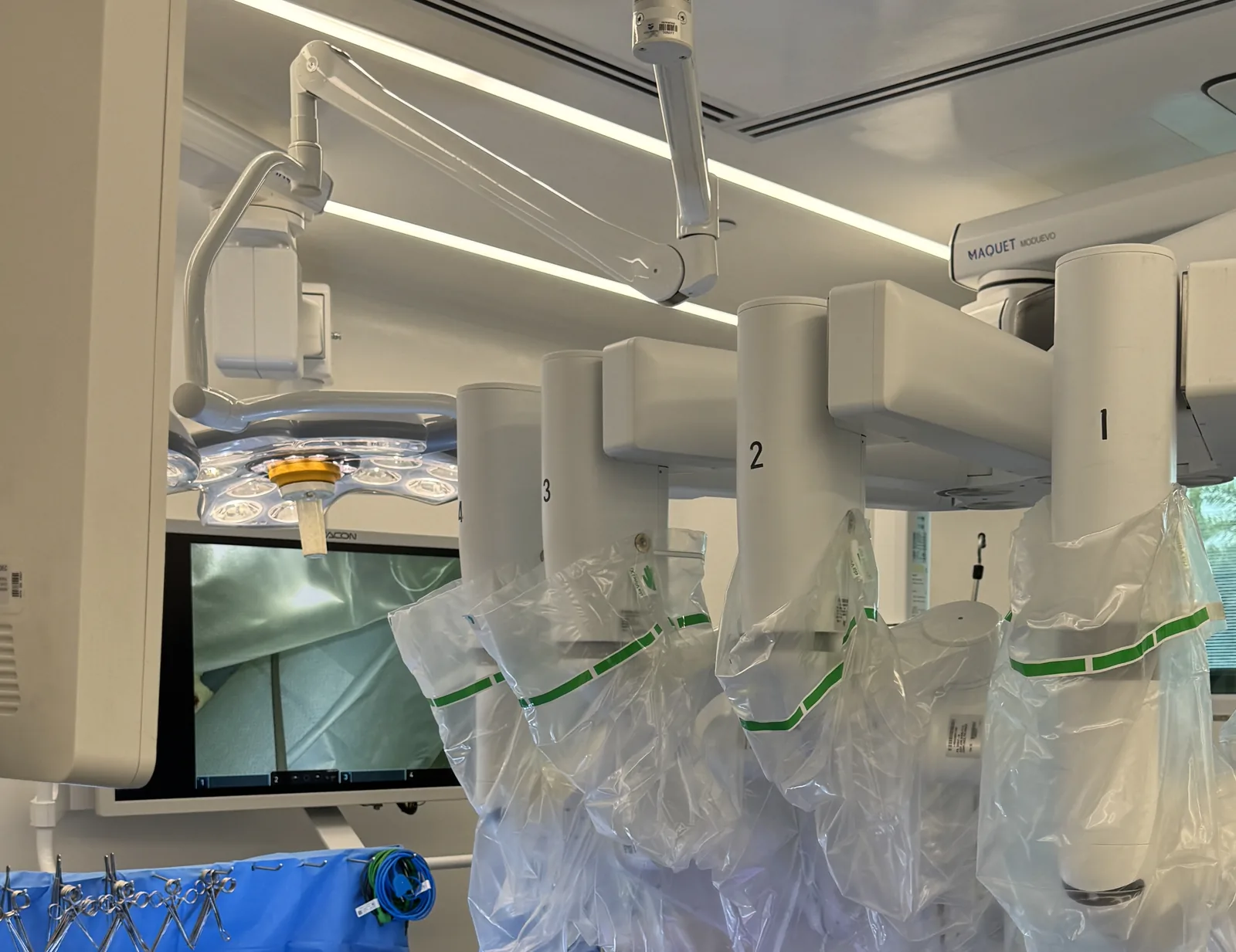
The most common kidney cancer is renal cell carcinoma. Many cases are found by chance on imaging, while still small. For tumors up to 7 cm, the European guideline recommends removing the tumor and preserving the rest of the kidney. Some tumors up to 4 cm can be monitored, without immediate treatment.
What it is
Renal cell carcinoma begins in the tissue of the kidney and accounts for about 2% of all cancers.1 The most frequent subtype is clear cell, with 75% to 80% of cases.4
People who smoke, have obesity or high blood pressure are at higher risk.1 Stopping smoking, losing weight and being physically active are the prevention measures recommended by the European guideline.1 An estimated 5% to 8% of cases are hereditary. Genetic evaluation is recommended for people aged 46 or younger, with tumors in both kidneys or in several places, or with relatives who had the disease.2
Symptoms
Most tumors cause no symptoms until advanced stages.2 In a study cited by the European guideline, 60% of tumors were found by chance.2 Among T1a tumors, the figure was 87%.2
Blood in the urine, flank pain and a palpable mass can appear, but all three together are rare, in 0.6% of cases.2
How it is diagnosed
- CT with contrastThe main test for diagnosis and staging, of the abdomen and chest.2
- MRIIt helps assess the veins, avoid radiation or CT contrast and clarify uncertain lesions.2
- Biopsy, when it changes the planIn a 2026 review, it changed the plan in 39% of patients and avoided active treatment in 28%.6
The sensitivity of biopsy for cancer was 99%, with complications in 3% of cases.6 It is not needed when surgery is already planned, whatever the result.2
The European guideline does not recommend routine screening for kidney cancer.1
Stages
The stage takes into account the size of the tumor and how far it has spread.
| Stage | What it means |
|---|---|
| T1a | Up to 4 cm, within the kidney5 |
| T1b | 4 to 7 cm, within the kidney5 |
| T2 | Larger than 7 cm, within the kidney5 |
| T3 | Reaches the fat around the kidney or the veins5 |
| T4 | Goes beyond Gerota's fascia, which surrounds the kidney, or reaches the adrenal gland5 |
About 70% of patients have stage I at diagnosis, and 11% stage IV.4
Can it be cured?
When the tumor is localized, surgery is done with curative intent.3 For tumors under 4 cm, five-year cancer-specific survival after partial nephrectomy can exceed 94%.4 That number comes from groups of patients and does not predict each person's case.
What the treatments are
| Option | When the European guideline recommends it |
|---|---|
| Partial nephrectomy | T1 tumors. For T2, with a single kidney or chronic kidney disease, if feasible3 |
| Radical nephrectomy | T2 tumors and localized masses that cannot be treated with a partial nephrectomy3 |
| Active surveillance | Tumors up to 4 cm with no indication for immediate treatment, when later surgery would be appropriate3 |
| Ablation or stereotactic radiotherapy | T1 tumors needing treatment in patients who cannot have surgery3 |
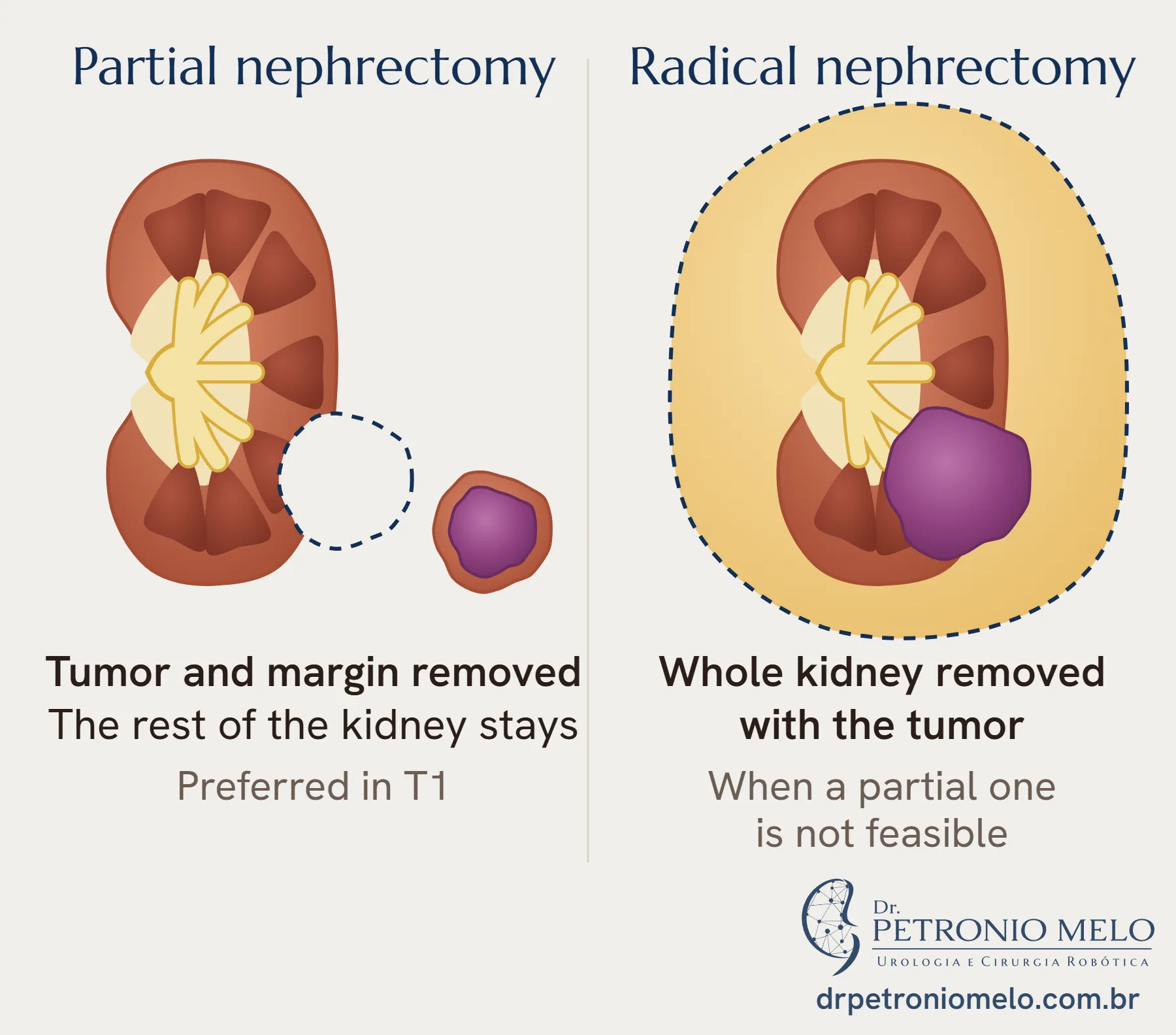
Partial nephrectomy can be open, laparoscopic or robotic, depending on the surgeon's experience. The robotic and laparoscopic approaches have a shorter hospital stay and less bleeding than the open approach.3
After surgery, people with clear cell carcinoma at higher risk of recurrence may receive pembrolizumab. In the KEYNOTE-564 study, estimated five-year survival was 87.7% with the drug and 82.3% with placebo.7 The European guideline asks that the benefits and effects of the treatment be discussed with the patient.3
In metastatic disease, combinations of immunotherapy, or of immunotherapy with targeted drugs, are the basis of treatment.4
Tumor of the renal pelvis and ureter
This tumor begins in the inner lining, like bladder cancer, and is treated differently. In low-risk cases, the European guideline recommends preserving the kidney. In high-risk cases without metastasis, it recommends radical nephroureterectomy, which removes the kidney and ureter, by open, laparoscopic or robotic surgery.8
In my practice, the hospital stay after nephroureterectomy is 1 to 2 days, and the catheter stays for 3 to 5 days.
Follow-up
The interval between tests depends on the risk of each tumor.9 Follow-up looks for the return of the disease and also looks after kidney function.9
How I approach it
In my practice, I start with the imaging: the size of the tumor, where it sits and the state of the other kidney. When the kidney can be preserved safely, I assess partial nephrectomy with you, and this operation can be done with the robot. The decision is made together with you, and your family takes part if you wish.
When to see a urologist
- If an imaging test shows a kidney nodule or a complex cyst
- If blood appears in your urine
- If you have flank pain that does not go away
- If you have relatives with kidney cancer and questions about your risk
Frequently asked questions
Can kidney cancer be cured?+
When it is localized, surgery is done with curative intent.3 For tumors under 4 cm, five-year cancer-specific survival after partial nephrectomy can exceed 94%.4 That number does not predict each person's case.
Does kidney cancer cause symptoms?+
Often it does not. In a study cited by the European guideline, 60% of tumors were found by chance. Among tumors up to 4 cm, it was 87%.2
Will I need to have the whole kidney removed?+
Not always. For T1 tumors, up to 7 cm, the European guideline recommends partial nephrectomy, which removes the tumor and preserves the rest of the kidney.3
Do I need a biopsy before surgery?+
Not always. A biopsy is not needed when surgery is already planned, whatever the result. It is recommended before ablation or systemic treatment without a diagnosis, and for some people considering active surveillance.2
Does every kidney tumor need treatment right away?+
No. Tumors up to 4 cm with no indication for immediate treatment can go on active surveillance. In these series, progression to metastasis is rare, 1% to 2%.3
References
- EAU Guidelines on Renal Cell Carcinoma. European Association of Urology; 2026. Epidemiology, aetiology and pathology chapter. EAU
- EAU Guidelines on Renal Cell Carcinoma. European Association of Urology; 2026. Diagnostic evaluation chapter. EAU
- EAU Guidelines on Renal Cell Carcinoma. European Association of Urology; 2026. Disease management chapter. EAU
- Rose TL, Kim WY. Renal Cell Carcinoma: A Review. JAMA. 2024;332(12):1001-1010. PubMed
- EAU Guidelines on Renal Cell Carcinoma. European Association of Urology; 2026. Staging and classification systems chapter. EAU
- Mjaess G, Nicolazzini M, Amparore D, et al. Systematic Review and Meta-analysis on Renal Tumor Biopsy: Accuracy, Safety, and Impact on Clinical Decision-making. Eur Urol. 2026;90(5):503-514. PubMed
- Haas NB, Powles TB, Tomczak P, et al. Adjuvant pembrolizumab for the treatment of clear cell renal cell carcinoma: five-year results from the phase III KEYNOTE-564 study. Ann Oncol. 2026;37(11):1564-1571. PubMed
- EAU Guidelines on Upper Urinary Tract Urothelial Cell Carcinoma. European Association of Urology; 2026. Disease management chapter. EAU
- EAU Guidelines on Renal Cell Carcinoma. European Association of Urology; 2026. Follow-up chapter. EAU
Would you like to talk about your case?
In the consultation, I go over your tests and your priorities.
Book a consultation