

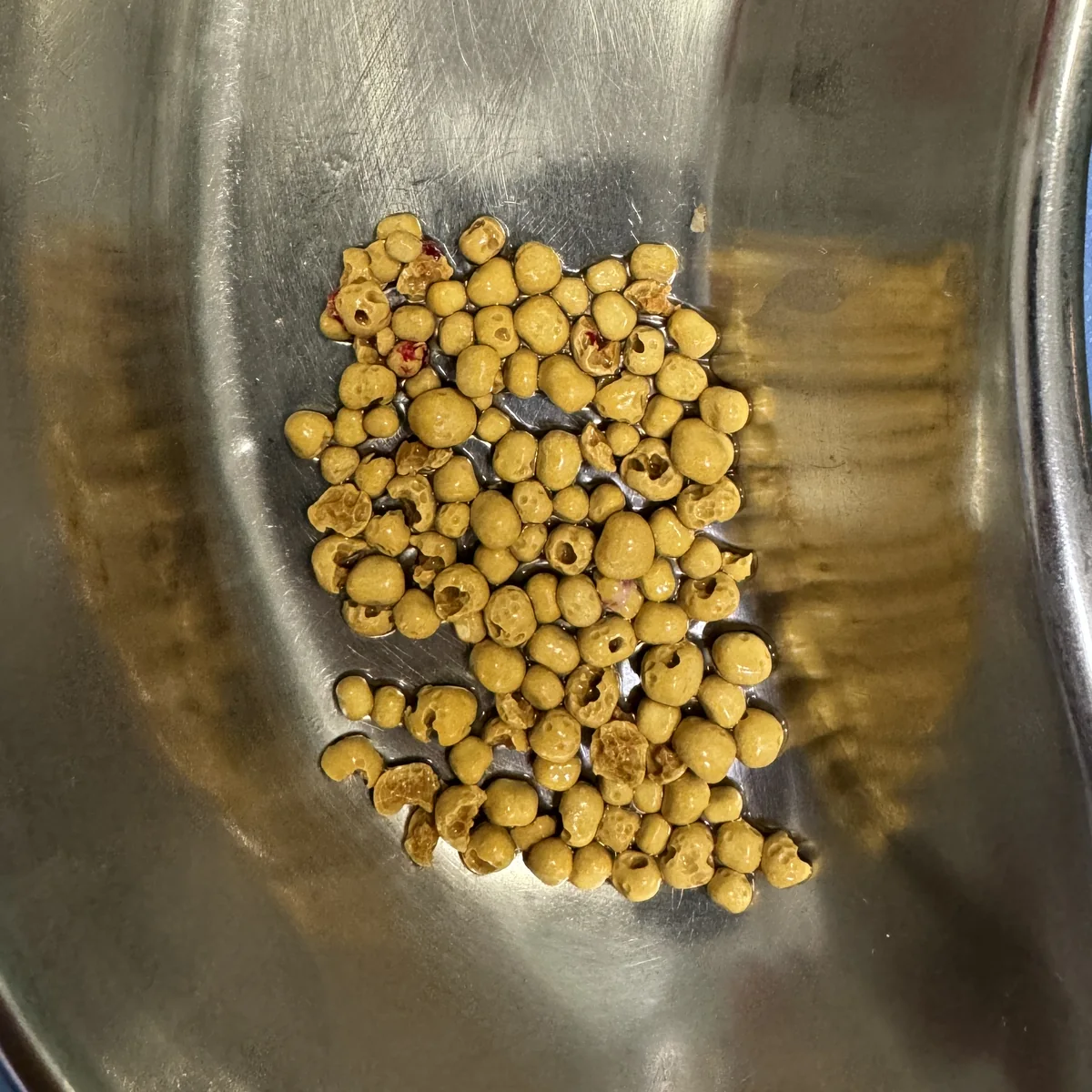
Quick answer
Bladder stones account for about 5% of urinary stones and are more common in men.1 In adults, the most frequent cause is difficulty emptying the bladder, often because of an enlarged prostate.1 Typical symptoms are a frequent need to urinate, blood at the end of urination and pain that gets worse at the end of urination.1 Treatment through the urethra, with no cut in the skin, has a high rate of complete removal and a low risk.1 In my practice, I usually do endoscopic cystolithotripsy. When the cause is an enlarged prostate, I treat the prostate at the same time.
Why they form
The European guideline divides bladder stones into three groups.1
| Type | Where it comes from |
|---|---|
| Secondary | Arises from a problem in the urinary tract: difficulty emptying the bladder, neurogenic bladder, chronic infection, a catheter, a diverticulum or reconstructive bladder surgery |
| Migrant | Forms in the kidney, moves down and may grow in the bladder |
| Primary | Arises with no other urinary problem, mostly in children in regions with poor hydration, repeated diarrhea and a diet low in animal protein |
Blockage of the bladder outlet accounts for 45% to 79% of stones in adults.1 Stones appear in 3% to 4.7% of men operated on for an enlarged prostate.1 In people with a long-term catheter, the rate is 2.2%.1
Symptoms
- A frequent need to urinate
- Blood in the urine, usually at the end of urination
- Pain above the pubic bone or when urinating, worse at the end
- Worse with sudden movements and exercise
- Repeated urinary infections, sometimes as the only sign
These data come from the European guideline.1 Children may pull at the penis, have difficulty urinating, retain urine or wet the bed. In about 10% of cases, the stone is found on a test.1
How it is diagnosed
X-ray and ultrasound can miss the stone. CT and cystoscopy detect it better. Cystoscopy has the advantage of showing other causes of the symptoms, such as a bladder tumor, and CT also assesses the kidneys.1
Before treatment, it is worth looking for the cause, because correcting it lowers the chance of the stone coming back.1 The evaluation includes a physical exam, measurement of the urine stream and of the urine left in the bladder, a urine test, blood tests and analysis of the stone.1
Treatment
Stones that formed in the bladder rarely pass on their own, so they are usually treated. Small stones that came down from the kidney can be monitored, especially those without symptoms.1
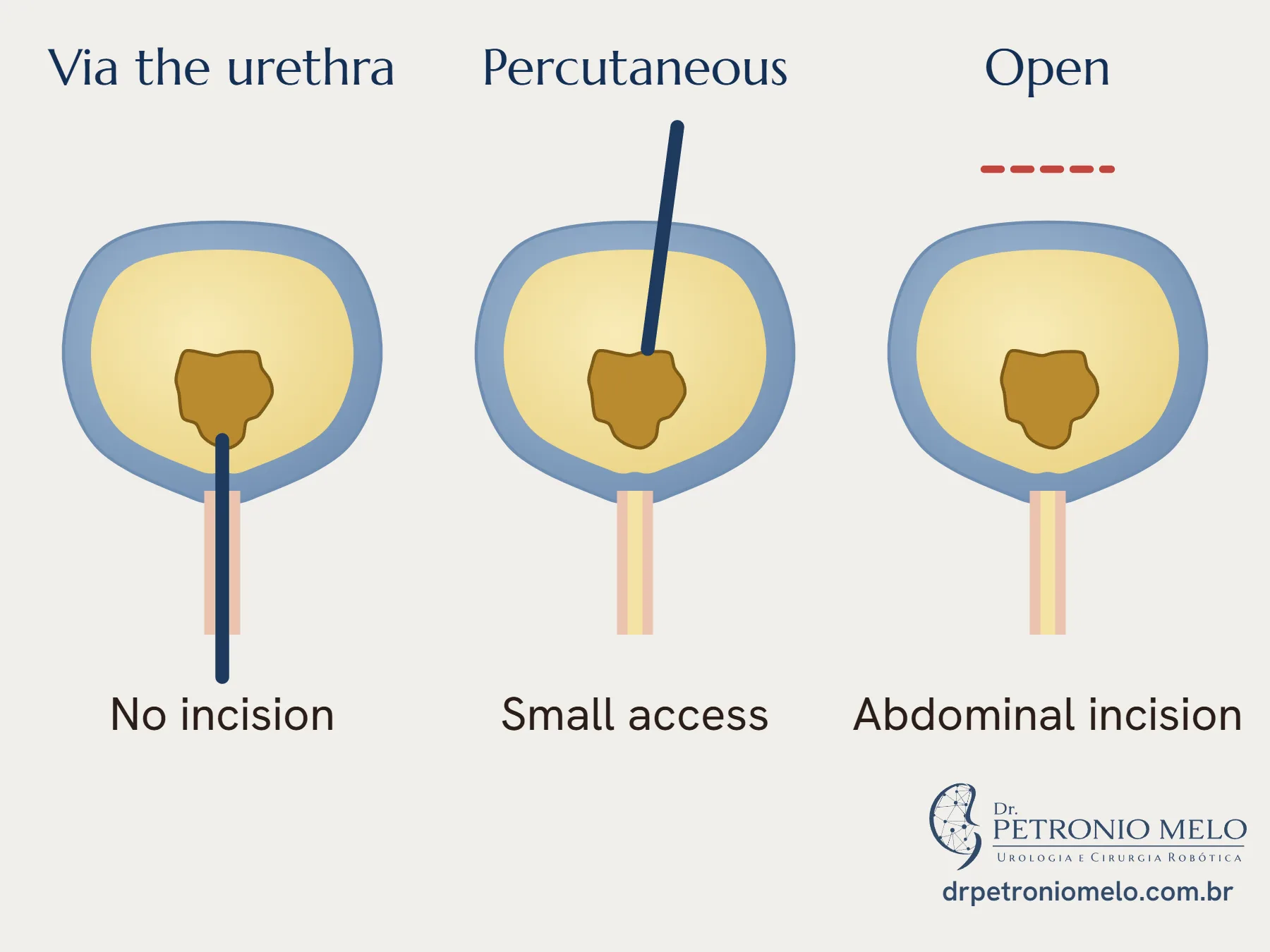
| Technique | What the guideline shows |
|---|---|
| Through the urethra (endoscopic cystolithotripsy) | High rate of complete removal and low risk. Compared with the percutaneous approach, a shorter hospital stay and less pain, with similar results1 |
| Percutaneous | A small access above the pubic bone. Useful when the urethra is narrow or in reconstructed bladders1 |
| Open | Very effective, with longer catheter time and hospital stay1 |
| Shock waves | The least invasive, with a lower single-session rate and a possible need to repeat1 |
| Robotic or laparoscopic | Usually done together with surgery for a large prostate1 |
Uric acid stones can be dissolved with medicine that makes the urine less acidic, with follow-up.1 Narrowing of the urethra after surgery has been reported in 2.9% to 19.6%, in studies with little standardization.1
And the prostate?
In men over 40, a bladder stone may come from an enlarged prostate, which also needs to be assessed.1 For a long time, a stone meant operating on the prostate, and recent studies question this rule. In a study of 46 men over 60, only 51% actually had a blockage.1 In another, of 64 men, none of those who stayed on medicine had a new stone in 28 months, but 34% ended up having prostate surgery.1
Doing both operations at the same time is safe in large studies, with no more serious complications.1 In my practice, when the cause is an enlarged prostate, I treat the prostate at the same time. The options for the prostate are on the enlarged prostate page.
How I approach it
In my practice, a bladder stone is usually treated with endoscopic cystolithotripsy: the scope goes in through the urethra and breaks up the stone, with no cut in the skin. Beforehand, I assess the prostate, the urethra, the urine left in the bladder and whether the stone may have come from the kidney. When the cause is an enlarged prostate, I treat the prostate at the same time.
When to see a urologist
- If you notice blood at the end of urination
- If pain when urinating gets worse at the end
- If the discomfort gets worse with movement
- If you have repeated urinary infections
- If you have used a catheter for a long time
- If you have an enlarged prostate and difficulty urinating
Frequently asked questions
Why do bladder stones form?+
In adults, the most common cause is difficulty emptying the bladder, responsible for 45% to 79% of cases. Catheters, chronic infection, diverticula, neurogenic bladder and stones that come down from the kidney also play a part.1
What are the symptoms?+
A frequent need to urinate, blood at the end of urination and pain above the pubic bone or when urinating, worse at the end. Sudden movements and exercise can make it worse. Sometimes repeated urinary infection is the only sign.1
Can a bladder stone pass on its own?+
Small stones that came down from the kidney can pass, especially those under 1 cm, if the bladder empties well. Stones that form in the bladder itself rarely pass and need treatment.1
What is the operation like?+
I usually do endoscopic cystolithotripsy: a scope goes in through the urethra, reaches the stone and breaks it up, with no cut in the skin. There are also a percutaneous approach above the pubic bone, open surgery and shock waves.1
Do I need prostate surgery at the same time?+
In men over 40, the prostate may be the cause and needs to be assessed. When the cause is an enlarged prostate, I treat the prostate at the same time. Studies show that treating both in the same operation is safe.1
References
- EAU Guidelines on Urolithiasis. European Association of Urology; 2026. Bladder stones chapter. EAU
Would you like to talk about your case?
In the consultation, I go over your tests and your priorities.
Book a consultation