

Quick answer
Blood in the urine is called hematuria. It can be visible or show up only on testing, with 3 or more red blood cells per field. The causes range from infection and stones to kidney and bladder tumors. Visible blood should be evaluated even if it has gone away. The investigation usually combines an imaging test, for the kidneys and ureters, and cystoscopy, for the bladder.
Visible or only on testing
In visible hematuria, urine turns pink, red or cola-colored. In microscopic hematuria, it looks normal, and blood appears only on microscopy. The American guideline defines microscopic hematuria as 3 or more red blood cells per high-power field.2
A dipstick alone is not enough to confirm it. The diagnosis depends on microscopy.2
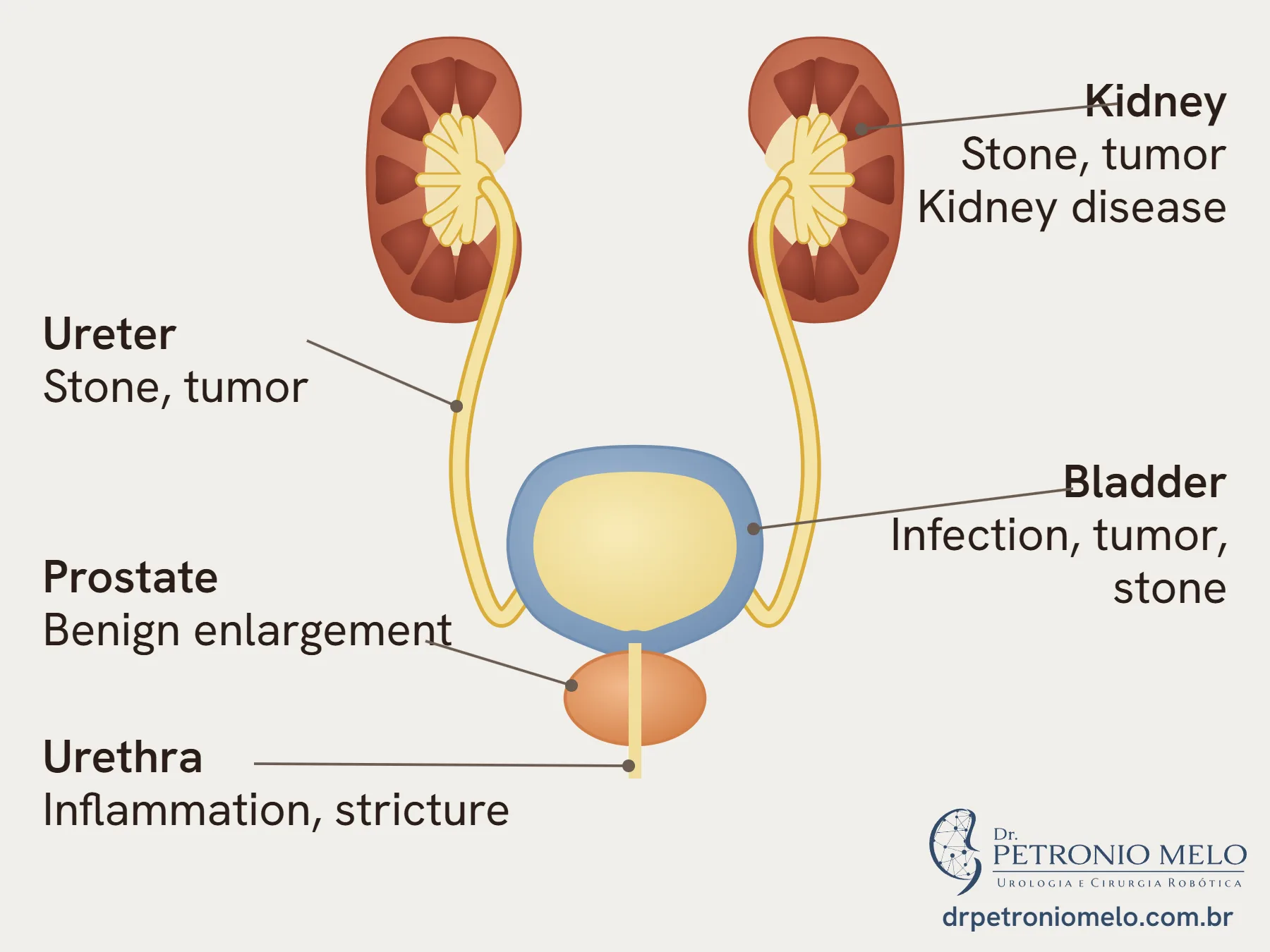
Where the blood can come from
What is the chance of cancer
In a hematuria clinic with 4,020 patients, 12.1% had cancer. The figure was 18.9% among those who saw blood and 4.8% among those who had blood only on testing.4
For microscopic hematuria, the American guideline sorts people into low, intermediate and high risk, based on age, sex, smoking, the amount of blood, whether it persists and any history of visible blood.2,3 A validation study found a urothelial tumor in 3.8% at high risk, 0.8% at intermediate risk and 0.2% at low risk.5
How the investigation works
- Consultation and urine testA conversation about symptoms, smoking, exposure at work and medicines, with a urine test and a culture if infection is suspected.
- ImagingCT, MRI or ultrasound looks at the kidneys and ureters. The choice of test depends on the risk and on each person.2,3
- CystoscopyLooks at the bladder and urethra from the inside. In microscopic hematuria, whether it is needed depends on the risk.2,3
The European guideline says that, with symptoms suggesting bladder cancer, cystoscopy cannot be replaced by cytology or by any other non-invasive test.1 For people at low or intermediate risk, the American guideline provides for shared decision-making about the tests.2,3
If you take a blood thinner
People who take an anticoagulant or an antiplatelet medicine go through the same evaluation as those who do not.2 In a small study, these medicines were not significant risk factors after adjustment.6 Do not stop the medicine on your own.
How I approach it
In my practice, I start with the history and the urine test and choose the tests according to each person's risk. Visible blood always deserves evaluation, and I explain what each test is looking for. The decision is made together with you, and your family takes part if you wish.
When to see a urologist
- If you saw blood in your urine, even once
- If a urine test showed blood
- If you smoke or have smoked and have blood in your urine
- If you have blood in your urine and take a blood thinner
Frequently asked questions
Is blood in the urine always cancer?+
No. In a clinic with 4,020 patients, 12.1% had cancer. The figure was 18.9% among those who saw blood and 4.8% among those who had blood only on testing.4 Infection, stones and an enlarged prostate also cause blood in the urine.
Does it need investigating if the blood appeared only once?+
Visible blood in the urine should be evaluated, even if it has gone away. The investigation looks at the bladder and the rest of the urinary tract.1
How many red blood cells count as hematuria?+
The American guideline defines microscopic hematuria as 3 or more red blood cells per high-power field on microscopy.2
Do people taking blood thinners need investigation?+
Yes. The evaluation is the same as for people who do not take these medicines.2 In a small study, they were not significant risk factors after adjustment.6
Can cytology or a urine test replace cystoscopy?+
No. The European guideline says that, with symptoms suggesting bladder cancer, cystoscopy cannot be replaced by cytology or by any other non-invasive test.1
References
- EAU Guidelines on Non-muscle-invasive Bladder Cancer. European Association of Urology; 2026. Diagnosis chapter. EAU
- Barocas DA, Boorjian SA, Alvarez RD, et al. Microhematuria: AUA/SUFU Guideline. J Urol. 2020;204(4):778-786. PubMed
- Barocas DA, Lotan Y, Matulewicz RS, et al. Updates to Microhematuria: AUA/SUFU Guideline (2025). J Urol. 2025;213(5):547-557. PubMed
- Edwards TJ, Dickinson AJ, Natale S, et al. A prospective analysis of the diagnostic yield resulting from the attendance of 4020 patients at a protocol-driven haematuria clinic. BJU Int. 2006;97(2):301-5. PubMed
- Udedibia E, Solosky K, Macdonald EJ, et al. Critical Analysis of the AUA 2020/2025 Microscopic Hematuria Guidelines to Predict Urothelial but Not Renal Cortical Neoplasms and Validation of the Individual Clinical Components in Risk Stratification for Urothelial Neoplasms but Not Renal Cortical Neoplasms. J Urol. 2026;215(4):441-449. PubMed
- Rysankova K, Vrtkova A, Viktoria MG, et al. Risk of genitourinary malignancy in patients that receive anticoagulant or antiplatelet therapy. Bratisl Lek Listy. 2023;124(10):738-741. PubMed
Would you like to talk about your case?
In the consultation, I go over your tests and your priorities.
Book a consultation