

Quick answer
A stone needs treatment when there is little chance of it passing on its own, pain that does not ease, a blockage that persists, infection or a risk to the kidney.1 Small stones that are not moving and cause no symptoms can be monitored.1 The technique depends on the size, position and density of the stone and on each person's anatomy.1
When it is possible to wait
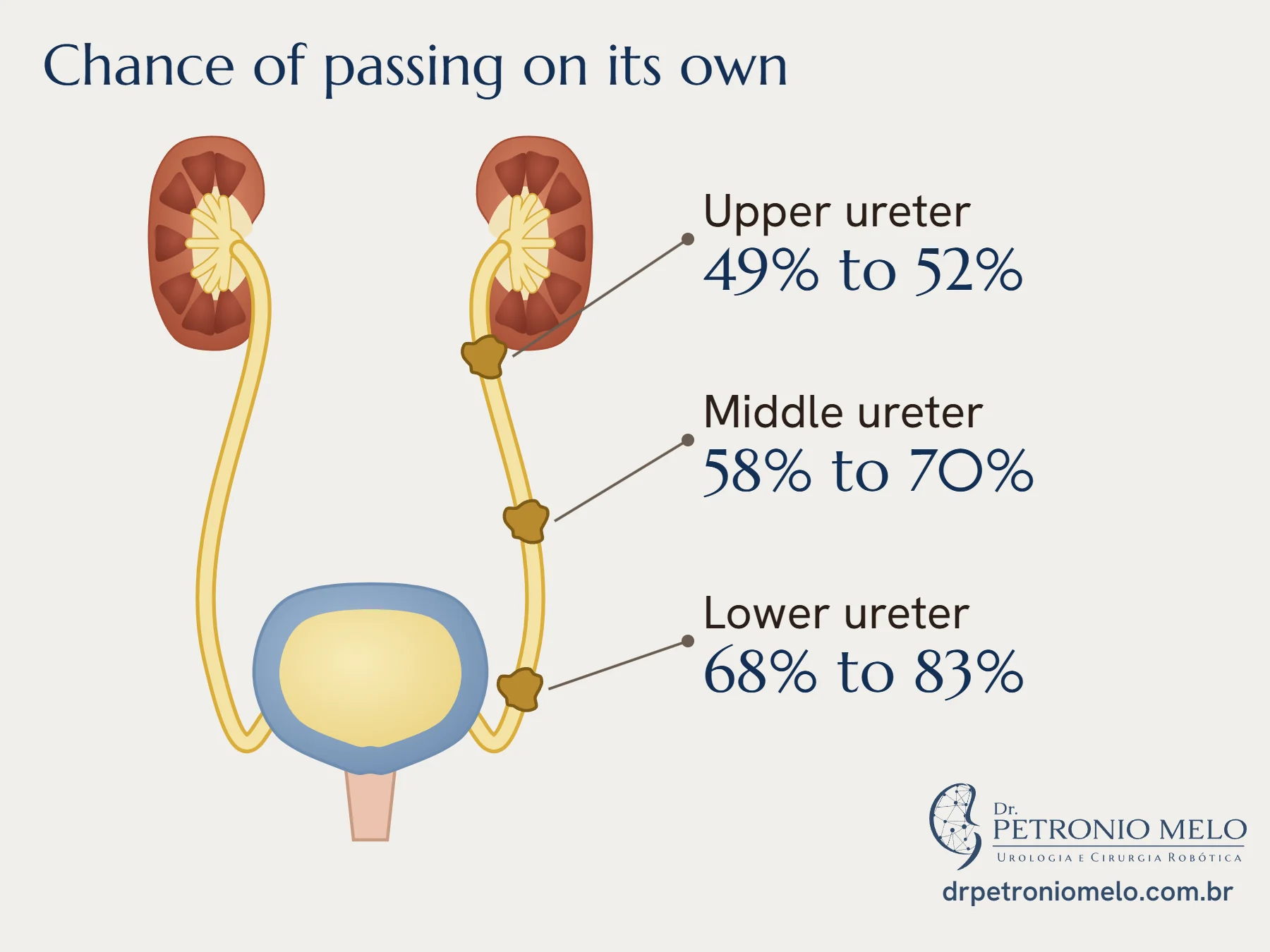
Small stones in the ureter can be monitored with regular check-ups, as long as there is no infection, uncontrolled pain or worsening kidney function.1 Almost 75% of stones smaller than 5 mm pass on their own, and passing takes 17 days on average, from 6 to 29.1
In the kidney, stones that cause no symptoms can be monitored. In one review, 7% to 26% of them ended up needing surgery.1 If the stone grows, the interval between tests gets shorter, and intervention is advised for stones that grow and are larger than 5 mm.1
When to treat
| Where it is | When the stone needs to come out |
|---|---|
| In the ureter | Little chance of passing on its own, pain that continues despite medicine, a blockage that does not resolve, kidney failure, blockage on both sides or a single kidney1 |
| In the kidney | Growth, blockage, infection, pain or blood in the urine. A high risk of new stones, other illnesses, the patient's preference and their routine, such as a job that involves travel, also count1 |
Which technique for each case
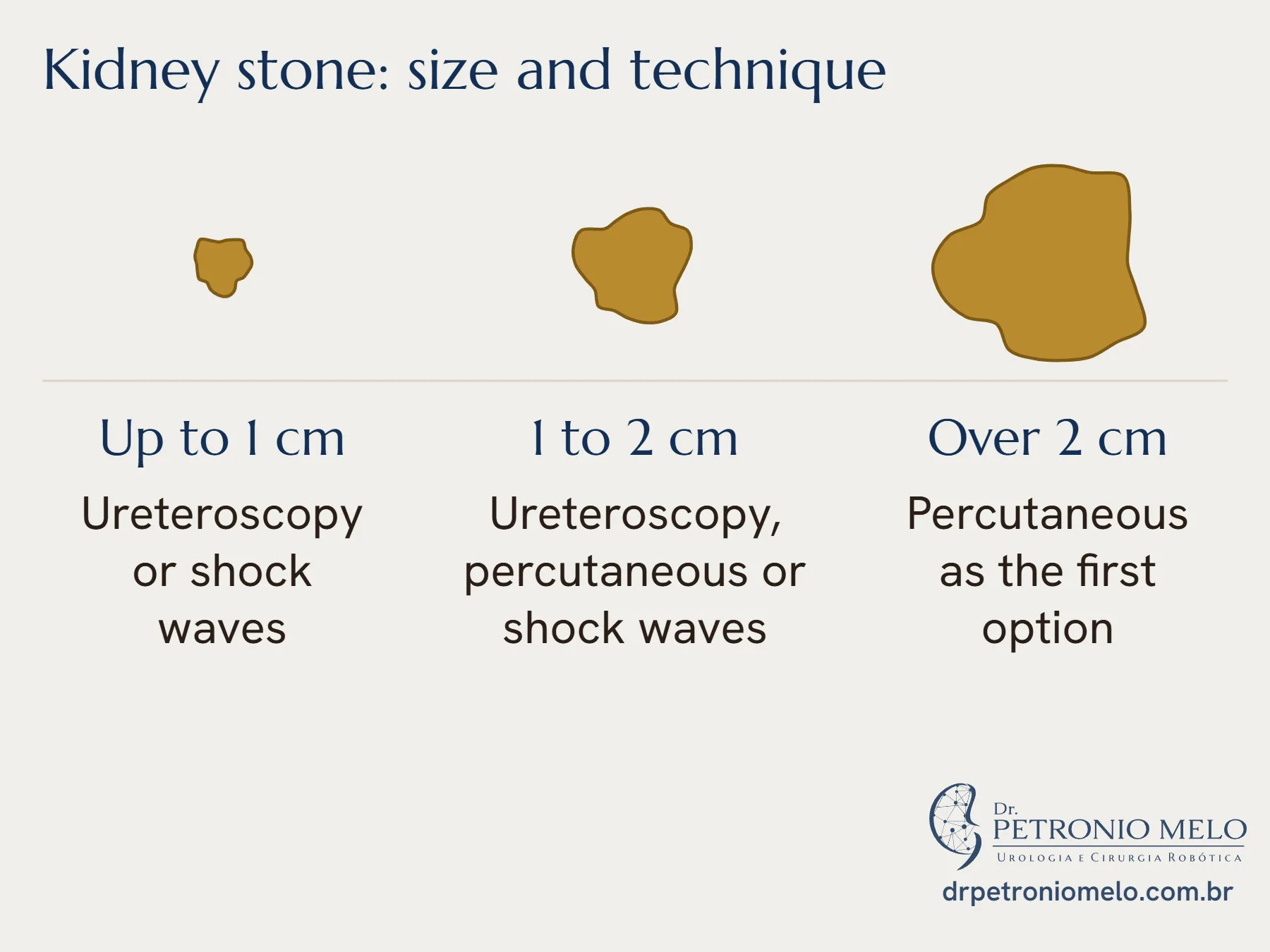
For removing the stone, the European guideline separates cases by position and size.1
- Stones in the ureter. Ureteroscopy is more likely to clear the stone in a single procedure, with more complications than shock waves.1 In severe obesity, it is the first option.1
- Kidney stones of 1 to 2 cm. Percutaneous surgery with smaller instruments removes more stone than ureteroscopy and shock waves, with a higher risk of bleeding and a longer hospital stay.1
- Stones in the lower pole of the kidney. Shock waves work less well, because the fragments tend to stay in the calyx. Percutaneous surgery and ureteroscopy are options even above 1 cm.1
- Kidney stones above 2 cm. Percutaneous surgery is the first option. Ureteroscopy is for people who cannot have percutaneous surgery, with a higher chance of needing a second procedure.1
The density of the stone on CT also counts. Above 1,000 Hounsfield units, it usually breaks less with shock waves.1
What helps a stone pass
An anti-inflammatory relieves pain and may reduce the risk of another attack while the stone moves down.1 For stones larger than 5 mm in the lower ureter, an alpha-blocker may help the stone pass. This is an off-label use, agreed with the patient, and for people who do not need the stone removed.1
Uric acid stones can be dissolved with medicine that makes the urine less acidic, which requires follow-up.1 If infection, uncontrolled pain or worsening kidney function appears, the attempt to wait ends.1
What to assess before surgery
- CT scan: shows the stone and the anatomy of the kidney, which guides the approach.1
- Infection: the urine is checked, and any infection needs to be treated.1
- Blood-thinning medicines: the plan changes with the technique. Ureteroscopy is usually the alternative for people who cannot stop these medicines.1
- Stone composition: the patient's history, an earlier analysis and the density on CT help predict how it will respond.1
How I approach it
In my practice, I look at each patient's stone and routine. Today, laser ureteroscopy and percutaneous surgery solve most cases. I present the options with the advantages and limits of each one, and the decision is made together with you.
When to see a urologist
- If the pain comes back even with medicine
- If you have fever or chills along with the pain
- If the stone has not passed after a few weeks
- If a test shows that the stone has grown
- If a test shows a swollen kidney
Frequently asked questions
Does every kidney stone need surgery?+
No. Small stones that are not moving can be monitored. Treatment comes in when the stone grows, causes a blockage, infection or pain.1
At what size does a stone need surgery?+
There is no single number. In the ureter, the chance of passing on its own falls as the stone gets bigger, and in the kidney, above 2 cm, percutaneous surgery is the first option in the European guideline.1 Size, position, density, symptoms and each person's routine all count together.
How can I pass a kidney stone faster?+
For stones larger than 5 mm in the lower ureter, an alpha-blocker may help, as an off-label use agreed with the patient.1 When there is infection, uncontrolled pain or a blockage that persists, the path is to treat, not to wait.1
Can a stone be dissolved with medicine?+
Uric acid stones can be dissolved by making the urine less acidic with medicine and follow-up. For kidney stones, this is the option the European guideline describes.1
How long can I wait for the stone to pass?+
The average time for ureteral stones to pass was about 17 days, ranging from 6 to 29 days.1 Monitoring only makes sense without infection, with controlled pain and with the kidney working well.1
Does a stone that causes no pain need treatment?+
Not always. The guideline says that whether to treat, or to monitor once a year, stones in the calyces that cause no symptoms and have been stable for six months is still debated.1 Intervention is advised for stones that grow and are larger than 5 mm.1
References
- EAU Guidelines on Urolithiasis. European Association of Urology; 2026. Guidelines chapter. EAU
Would you like to talk about your case?
In the consultation, I go over your tests and your priorities.
Book a consultation