

Quick answer
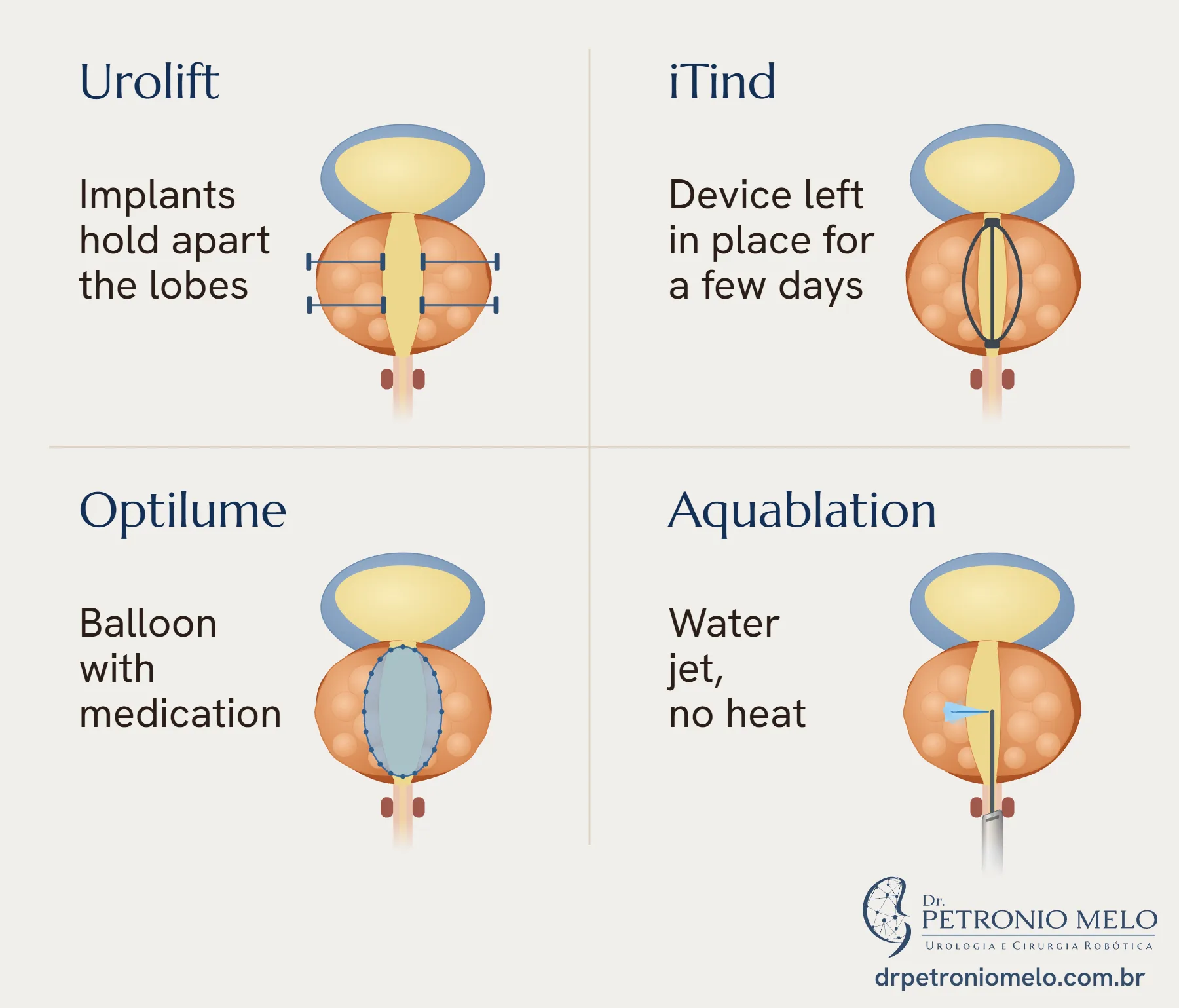
Urolift, iTind, Optilume and Aquablation are techniques for an enlarged prostate that had few cases of loss of ejaculation in the studies.1,6 Urolift uses implants, iTind is a temporary device, Optilume is a balloon with medication and Aquablation uses a water jet.1,3 I assess all of them with my patients, along with the traditional operations.
The four techniques
Urolift
Small implants hold the lobes of the prostate to the sides and leave the urethra more open, without removing tissue. They stay in the body.1
The European guideline gives a strong recommendation for men with a prostate under 70 g, without a middle lobe, who want to preserve ejaculation.1 In practice, this has to be assessed case by case. The IPSS, the symptom score, fell by 39% to 52% in the studies.1
Retreatment was 13.6% at 5 years in one study, and reintervention was 16.1% at 4 years in real-world data.1 Blood in the urine and burning are common, in 16% to 63% and 25% to 58% of men, and go away in 2 to 4 weeks.1
iTind
It is a nitinol device with three struts that stays in the urethra for 5 to 7 days and is then removed.1,2 The pressure of the struts opens the urine passage. Nothing stays in the body afterward.
The European guideline treats it as a technique under evaluation and does not give a prostate weight.1 In practice, this has to be assessed case by case. In a randomized study of 175 men, the IPSS fell by 9.25 points and the stream rose by 3.52 mL/s at 12 months, with no new problems with ejaculation or erections.2
Optilume
A balloon opens the urethra in the front part of the prostate and leaves a medication, paclitaxel, in the wall, which helps keep it open.3
In the PINNACLE study, with 148 men and prostates of 20 to 80 g, the IPSS fell by 11.5 points and the stream rose by 10.3 mL/s at 1 year.3 Follow-up has now reached 2 years.4 In practice, this has to be assessed case by case.
Aquablation
A water jet removes the tissue, guided by ultrasound and without heat.1 The European guideline gives a strong recommendation for prostates of 30 to 80 g, especially for men who want to preserve ejaculation.1
In the WATER study, with 181 men, loss of ejaculation was 10%, against 36% with TURP.1 At 5 years, repeat surgery was 5.1%, against 1.5% with TURP.1,5
Above 80 g, the guideline considers the technique possible and calls for more randomized studies.1 In prostates of 80 to 150 g, in the WATER II study, bleeding events occurred in 13.9% of men.1 In practice, this has to be assessed case by case.
How I approach it
In my practice, I look at the size and shape of the prostate, your symptoms and what you want to preserve. These techniques are options I compare with you, along with Rezum, EchoLaser, HoLEP, Greenlight and TURP.
When to see a urologist
- If you have an enlarged prostate and medications do not bring enough relief
- If preserving ejaculation weighs on your decision
- If you want to know which technique makes sense in your case
- After treatment, if you have fever, difficulty urinating or blood with clots
Frequently asked questions
What is Urolift?+
Small implants hold the lobes of the prostate to the sides and leave the urethra more open. They stay in the body.1
What is iTind?+
It is a nitinol device that stays in the urethra for 5 to 7 days, opens the passage with pressure and is then removed.1,2
What is Optilume?+
It is a balloon that opens the urethra and leaves a medication, paclitaxel, in its wall.3
What is Aquablation?+
It removes tissue with a water jet, guided by ultrasound and without heat.1
Which of these techniques is best?+
It depends on the size and shape of the prostate and on what you want to preserve. The European guideline recommends Urolift for prostates under 70 g without a middle lobe, and Aquablation for 30 to 80 g.1 In practice, this has to be assessed case by case.
Do these techniques preserve ejaculation?+
They had few cases of loss in the studies. With Aquablation, loss was 10%, against 36% with TURP.1,6
Can I have one of these techniques?+
It depends on your case. I assess all of them with you, along with the traditional operations.
References
- EAU Guidelines on the Management of Non-neurogenic Male LUTS. European Association of Urology; 2026. Disease management chapter. EAU
- Chughtai B, Elterman D, Shore N, et al. The iTind Temporarily Implanted Nitinol Device for the Treatment of Lower Urinary Tract Symptoms Secondary to Benign Prostatic Hyperplasia: A Multicenter, Randomized, Controlled Trial. Urology. 2021;153:270-276. PubMed
- Kaplan SA, Moss J, Freedman S, et al. The PINNACLE Study: A Double-blind, Randomized, Sham-controlled Study Evaluating the Optilume BPH Catheter System for the Treatment of Lower Urinary Tract Symptoms Secondary to Benign Prostatic Hyperplasia. J Urol. 2023;210(3):500-509. PubMed
- Kaplan SA, Moss JL, Freedman SJ, et al. Two-year long-term follow-up of treatment with the Optilume BPH catheter system in a randomized controlled trial for benign prostatic hyperplasia (The PINNACLE Study). Prostate Cancer Prostatic Dis. 2024;27(3):531-536. PubMed
- Gilling PJ, Barber N, Bidair M, et al. Five-year outcomes for Aquablation therapy compared to TURP: results from a double-blind, randomized trial in men with LUTS due to BPH. Can J Urol. 2022;29(1):10960-10968. PubMed
- Franco A, Ditonno F, Manfredi C, et al. Systematic Review and Pooled Analysis of Functional and Sexual Outcomes of Minimally Invasive Surgical Treatments for Benign Prostatic Obstruction. Eur Urol. 2026;89(4):318-331. PubMed
3D illustrations: BodyParts3D, © The Database Center for Life Science, licensed under CC Attribution-Share Alike 2.1 Japan.
Would you like to talk about your case?
In the consultation, I go over your tests and your priorities.
Book a consultation