

Quick answer
An inguinal hernia is part of the contents of the abdomen pushing out through a weak spot in the wall, in the groin. It shows up as a bulge that usually grows with effort.1 About 27% of men and 3% of women will have an inguinal hernia during their lives.1 Most people end up needing surgery, usually with mesh, which can be open, laparoscopic or robotic.1,2,4 Severe pain and a bulge that no longer goes back in call for immediate evaluation.1
What it is
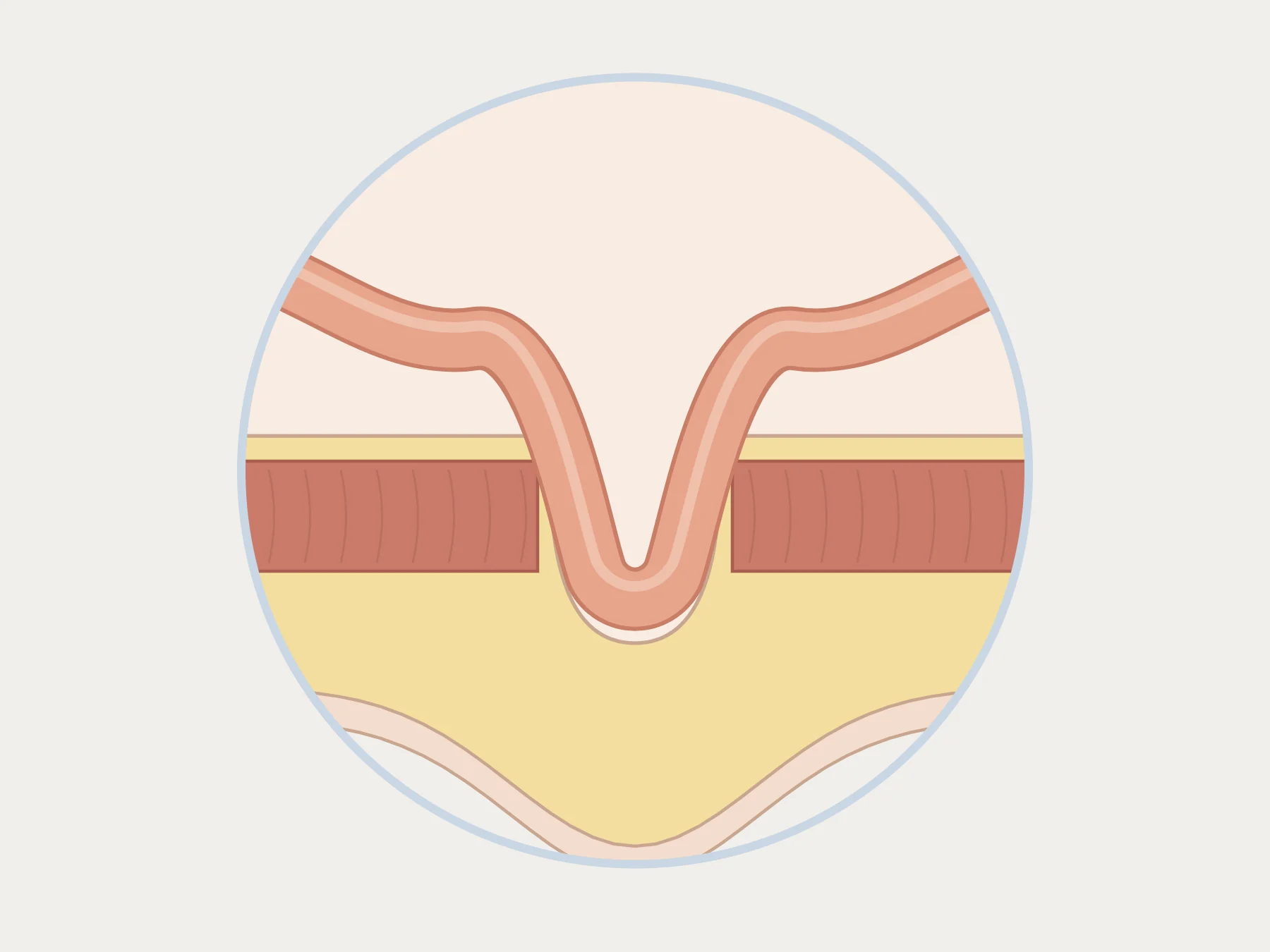
The abdominal wall has a weaker spot in the groin. When pressure rises, the contents inside can push against this area and form a sac that shows under the skin.
Men have 8 to 10 times more inguinal hernias than women. The risk is also higher after prostatectomy, with a family history, low body weight and connective tissue diseases.1
What an inguinal hernia looks like: pictures
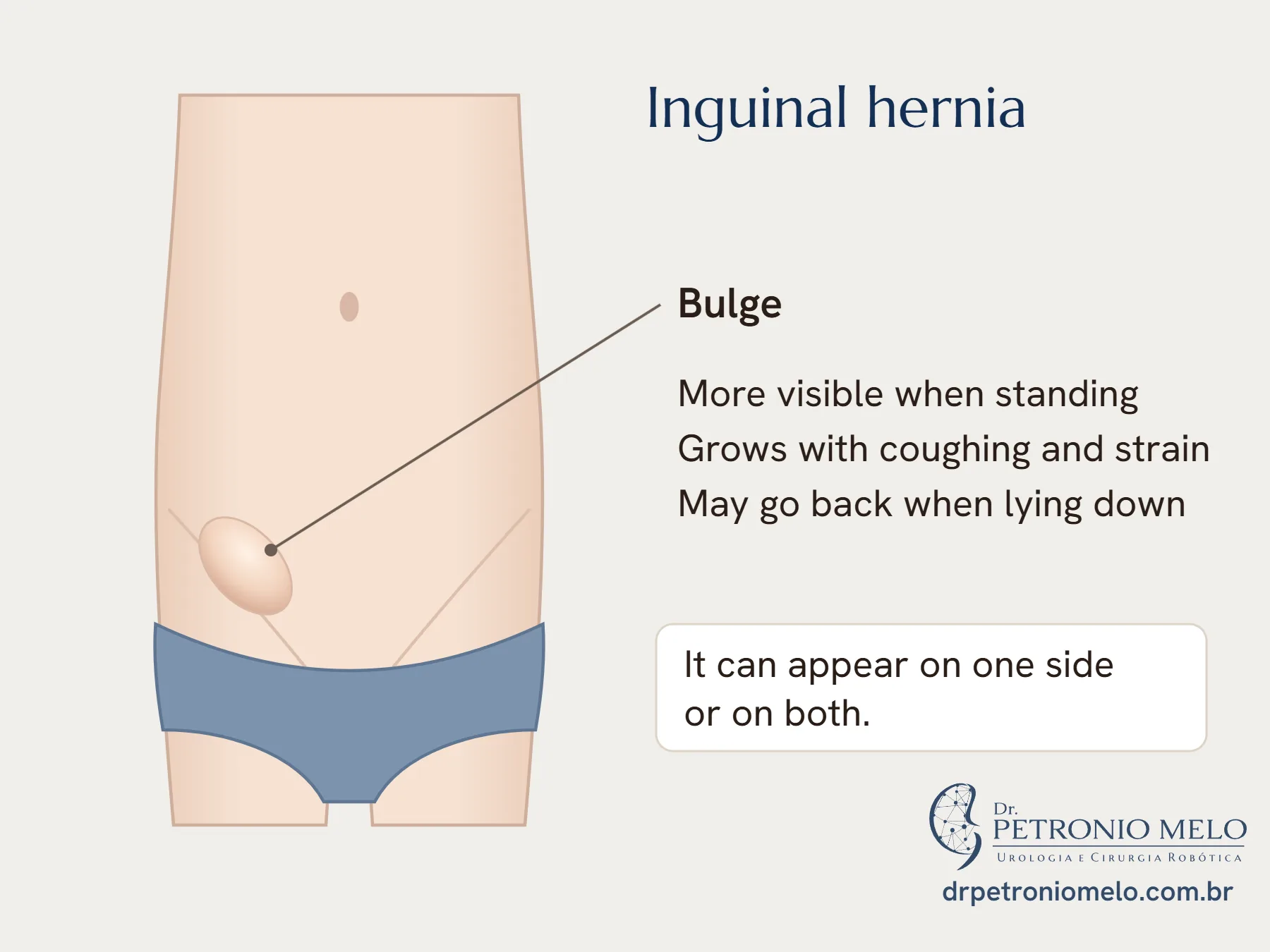
The hernia shows up as a bulge in the groin, on one side or both. It can be small and only appear with effort, or extend down toward the scrotum.
Symptoms
- a bulge in the groin1
- pain, heaviness or discomfort in the area1
- worsening when straining, lifting, coughing or standing for a long time1
Some hernias cause almost no symptoms.3
When to operate
Surgery is recommended to treat symptoms, such as pain, and to prevent bowel obstruction and strangulation.2
In men with few symptoms, watchful waiting is an option. In a study of 254 men who started with watchful waiting, an estimated 68% had surgery within 11.5 years, mainly because of pain, and the figure reached 79% in those over 65. Three needed emergency surgery.3 The authors concluded that watchful waiting is reasonable, but symptoms tend to progress.3
The techniques
| Technique | Approach | What studies show |
|---|---|---|
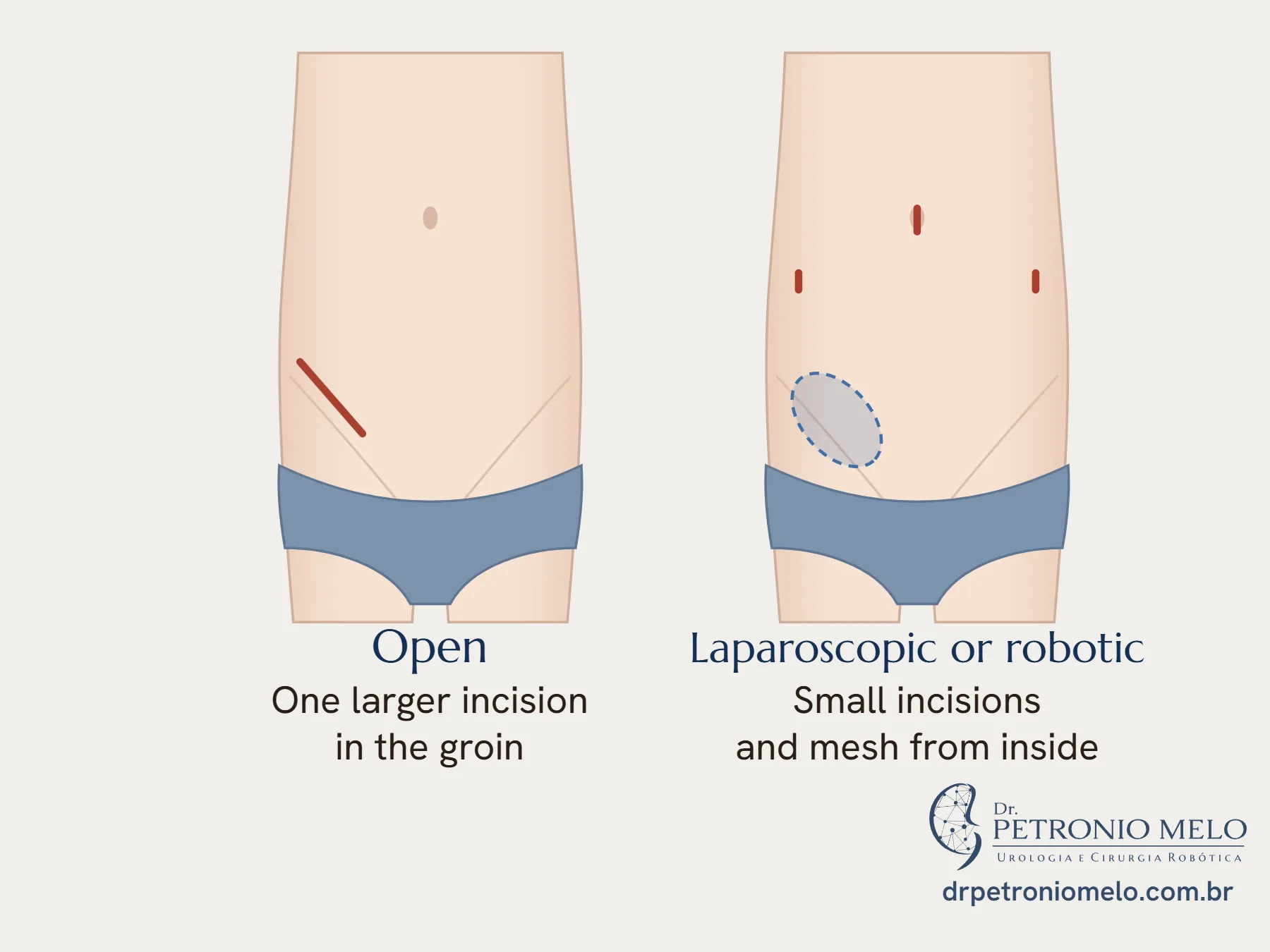
| Open | A larger incision in the groin | May be the first choice in some cases |
| Laparoscopic | Small incisions in the belly | Less chronic pain and faster recovery than open surgery |
| Robotic | Small incisions in the belly | For simple hernias, no clinical benefit over laparoscopy at 30 days, with a longer operating time |
Sources for the table: the international guideline and the RIVAL study.2,4,5
The international guideline recommends mesh for most patients, because it lowers the risk of the hernia coming back without increasing chronic pain.4 For a first hernia on one side, it recommends the laparoendoscopic technique when an experienced surgeon and the resources are available, because of less pain after the operation and less chronic pain. Some features of the person and of the hernia make open surgery the first choice.4
Robotic surgery is a form of minimally invasive surgery. In the RIVAL study, with 102 patients with a hernia on one side, pain, wound complications and quality of life were similar to laparoscopy at 30 days, and the operating time was longer.5 I do all three techniques and offer robotic surgery as the first option. We decide together what makes the most sense for your case.
Recovery
- The operation usually takes 30 to 90 minutes.2
- The hospital stay is usually under 24 hours.
- I advise returning to work after 14 days.
- Physical effort waits until after 4 to 6 weeks.
Risks
Complications are uncommon and include:2
- wound infection
- pain or numbness in the groin for more than 3 months
- the hernia coming back
- a blood clot in the legs or lungs
In a registry of 57,906 patients, chronic pain at rest occurred in 5.2% after open surgery and in 4.3% after endoscopic surgery.4
When to see a urologist
- If you notice a bulge in the groin, even without pain
- If your groin hurts or feels heavy when you strain
- If you have a hernia and the symptoms are getting worse
- If you have any warning sign, for immediate evaluation
Frequently asked questions
What is an inguinal hernia?+
It is part of the contents of the abdomen pushing out through a weak spot in the wall, in the groin. It shows up as a bulge that usually grows with effort.1
What does an inguinal hernia look like?+
It is a bulge in the groin that is usually more visible when standing, coughing or straining, and may go back in when lying down.1 The pictures on this page show how it appears.
What are the danger signs?+
A bulge that suddenly grows, that used to go back in and now does not, with severe pain, redness or fever, or with nausea, vomiting and a swollen belly.1 These signs call for immediate evaluation.
Does an inguinal hernia always need surgery?+
Not always right away. In men with few symptoms, watchful waiting is a safe option, but in one study an estimated 68% had surgery within 11.5 years.3
Is inguinal hernia surgery dangerous?+
Complications are uncommon and include wound infection, pain or numbness for more than 3 months, the hernia coming back and blood clots.2 The risk is discussed case by case.
How long does the operation take?+
Usually 30 to 90 minutes.2 The hospital stay is usually under 24 hours.
Does the operation use mesh?+
For most patients, yes. The international guideline recommends mesh for most cases.4
Is robotic surgery better than laparoscopic surgery for a hernia?+
A randomized study of 102 patients showed no clinical benefit for simple hernias in the first 30 days, with a longer operating time.5 I do all three techniques, offer robotic surgery as the first option, and the choice depends on the case.
References
- National Institute of Diabetes and Digestive and Kidney Diseases (NIDDK). Inguinal Hernia. NIH
- National Health Service (NHS). Inguinal hernia repair. NHS
- Fitzgibbons RJ Jr, Ramanan B, Arya S, et al. Long-term results of a randomized controlled trial of a nonoperative strategy (watchful waiting) for men with minimally symptomatic inguinal hernias. Ann Surg. 2013;258(3):508-15. PubMed
- Stabilini C, van Veenendaal N, Aasvang E, et al. Update of the international HerniaSurge guidelines for groin hernia management. BJS Open. 2023;7(5):zrad080. PubMed
- Prabhu AS, Carbonell A, Hope W, et al. Robotic Inguinal vs Transabdominal Laparoscopic Inguinal Hernia Repair: The RIVAL Randomized Clinical Trial. JAMA Surg. 2020;155(5):380-387. PubMed
Would you like to talk about your case?
In the consultation, I go over your tests and your priorities.
Book a consultation