

Quick answer
Active surveillance means closely monitoring a low-risk prostate cancer with scheduled tests, and treating it with curative intent if the tumor changes. The European guideline places it as the standard approach for low risk and for some favorable intermediate-risk cases.1 At ten years, cancer-specific survival was 98.1% to 100%.1 More than a third of men are reclassified along the way.1
What active surveillance is
Some tumors grow so slowly that they would hardly ever cause symptoms. In these cases, active surveillance avoids or delays surgery and radiotherapy, and with them their effects on urine and erections.1
Watchful waiting is a different strategy, for men who would not benefit from curative treatment:1
| Item | Active surveillance | Watchful waiting |
|---|---|---|
| Intent | Curative, if the tumor changes | Palliative, if symptoms appear |
| Life expectancy | More than 10 years | Less than 10 years |
| Follow-up | Set schedule | Adjusted to each patient |
| Tests | PSA, rectal exam, MRI and biopsy | Symptoms, with or without periodic PSA |
Who can choose it
The most common criteria are ISUP 1, a small or non-palpable tumor on the rectal exam and a PSA below 10 ng/mL. A PSA density below 0.15 ng/mL/cc is also used, and this limit is still debated.1
The guideline accepts some men with ISUP 2, such as those with under 10% pattern 4, a PSA below 10 ng/mL and little disease on biopsy and imaging. In these cases, the risk of progression may be higher.1
A cribriform or intraductal pattern on biopsy rules out active surveillance.1 A family history, on its own, does not.1
How follow-up works
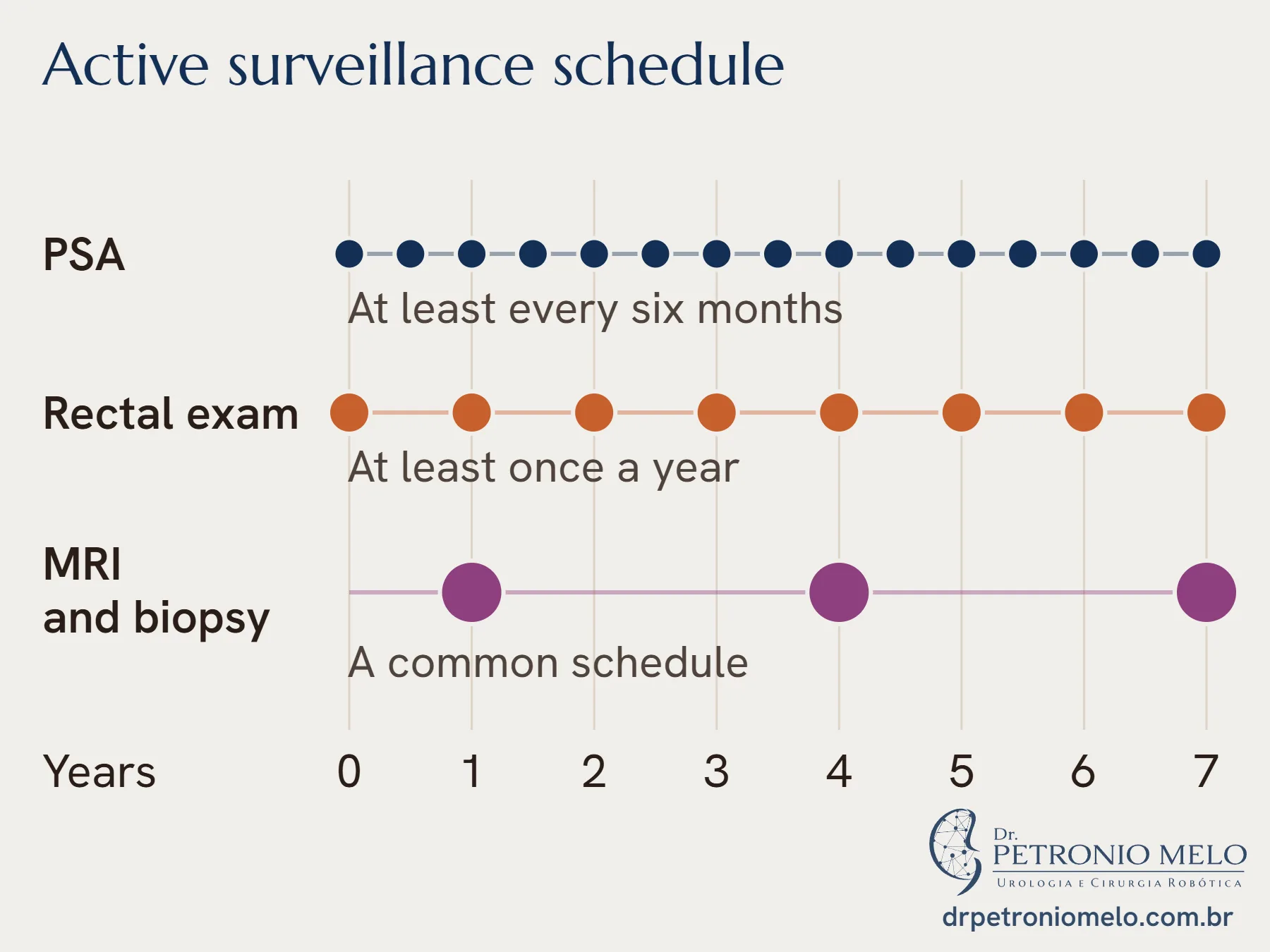
- At the startMRI, if not yet done. Without an MRI before the first biopsy, a confirmatory biopsy comes between 6 and 12 months.1
- Every six monthsPSA, at least at this interval.1
- Every yearRectal exam, at least once a year.1
- Over the yearsMRI and repeat biopsies, with no set frequency. A common schedule is at 1, 4 and 7 years.1
A change in PSA alone leads to further investigation, with MRI or biopsy. On its own, it does not change the plan. Worsening on MRI also needs a biopsy before any decision.1
What the studies show
| Study | How it was done | Result |
|---|---|---|
| ProtecT, 15 years | 1,643 men randomly assigned to monitoring, surgery or radiotherapy | Death from prostate cancer: 3.1%, 2.2% and 2.9%. Metastases: 9.4%, 4.7% and 5.0% |
| Canada, 2015 | 993 men on surveillance | Cancer-specific survival of 94.3% at 15 years, with 55% still untreated |
| Johns Hopkins, 2015 | 1,298 men at favorable risk | Cancer-specific survival of 99.9% at 15 years, with 57% treated |
| PRIAS, 2016 | 5,302 men in 18 countries | 52% had left surveillance at 5 years, and 73% at 10 years |
In ProtecT, more than a third of the men had intermediate or high risk, so the group is different from those who enter surveillance today. In the monitored group, 24.4% were alive and had had no treatment at all by the end of the study.2
When to stop surveillance
Reclassification on biopsy is the main reason to change course: an ISUP 3 or higher tumor, or a cribriform or intraductal pattern.1 Moving to ISUP 2 does not always end surveillance, especially on a targeted biopsy.1
The patient's wishes also count. In a registry of 14,623 men from several countries, 5% changed course because of anxiety.6 If age advances or another illness appears, follow-up can move to watchful waiting.1
How I approach it
In my practice, I present active surveillance as an option when the tumor is low risk, and I explain what it requires. I confirm the risk with MRI and biopsy, always under sedation. We agree on the testing schedule and on what would make us move to treatment. If you would rather be treated, or if the worry weighs on your daily life, we talk about surgery and radiotherapy.
When to see a urologist
- If your report shows ISUP 1 and you want to know whether surveillance fits your case
- If your PSA has risen during surveillance
- If your scheduled tests are overdue
- If urinary symptoms or blood in the urine appear
Frequently asked questions
Is it safe not to treat prostate cancer now?+
In well-selected cases, long-term results are favorable. At ten years, cancer-specific survival was 98.1% to 100% in the studies gathered by the European guideline.1 Follow-up has to be kept up.
Is active surveillance the same as doing nothing?+
No. There is a schedule of PSA, rectal exams, MRI and biopsies, and treatment with curative intent comes in if the tumor changes.1
Who can have active surveillance?+
Men with low-risk cancer and some with favorable intermediate risk. The European guideline places it as the standard approach in these cases.1
How often do I have the tests?+
According to the European guideline, PSA is done at least every six months and the rectal exam at least once a year. Repeat biopsies have no set frequency, and a common schedule is at 1, 4 and 7 years.1
References
- EAU-EANM-ESTRO-ESUR-ISUP-SIOG Guidelines on Prostate Cancer. European Association of Urology; 2026. EAU
- Hamdy FC, Donovan JL, Lane JA, et al. Fifteen-Year Outcomes after Monitoring, Surgery, or Radiotherapy for Prostate Cancer. N Engl J Med. 2023;388(17):1547-1558. PubMed
- Klotz L, Vesprini D, Sethukavalan P, et al. Long-term follow-up of a large active surveillance cohort of patients with prostate cancer. J Clin Oncol. 2015;33(3):272-277. PubMed
- Tosoian JJ, Mamawala M, Epstein JI, et al. Intermediate and Longer-Term Outcomes From a Prospective Active-Surveillance Program for Favorable-Risk Prostate Cancer. J Clin Oncol. 2015;33(30):3379-3385. PubMed
- Bokhorst LP, Valdagni R, Rannikko A, et al. A Decade of Active Surveillance in the PRIAS Study: An Update and Evaluation of the Criteria Used to Recommend a Switch to Active Treatment. Eur Urol. 2016;70(6):954-960. PubMed
- Bangma C, Doan P, Zhu L, et al. Has Active Surveillance for Prostate Cancer Become Safer? Lessons Learned from a Global Clinical Registry. Eur Urol Oncol. 2025;8(2):324-337. PubMed
Would you like to talk about your case?
In the consultation, I go over your tests and your priorities.
Book a consultation