

Quick answer
In localized prostate cancer, surgery and radiotherapy both aim to cure.1 At 15 years, deaths from the disease were 2.2% with surgery and 2.9% with radiotherapy, with no statistical difference.2 The choice usually comes down to the effects of each: surgery weighs more on urine leakage, and radiotherapy on the bowel.3,4
When this question comes up
This choice applies to men whose tumor shows no signs of disease outside the prostate and who need treatment. In low-risk disease, active surveillance is usually the recommended approach. It can also be discussed in some intermediate-risk cases.6 The biopsy report and the PSA define your risk group.
What each treatment involves
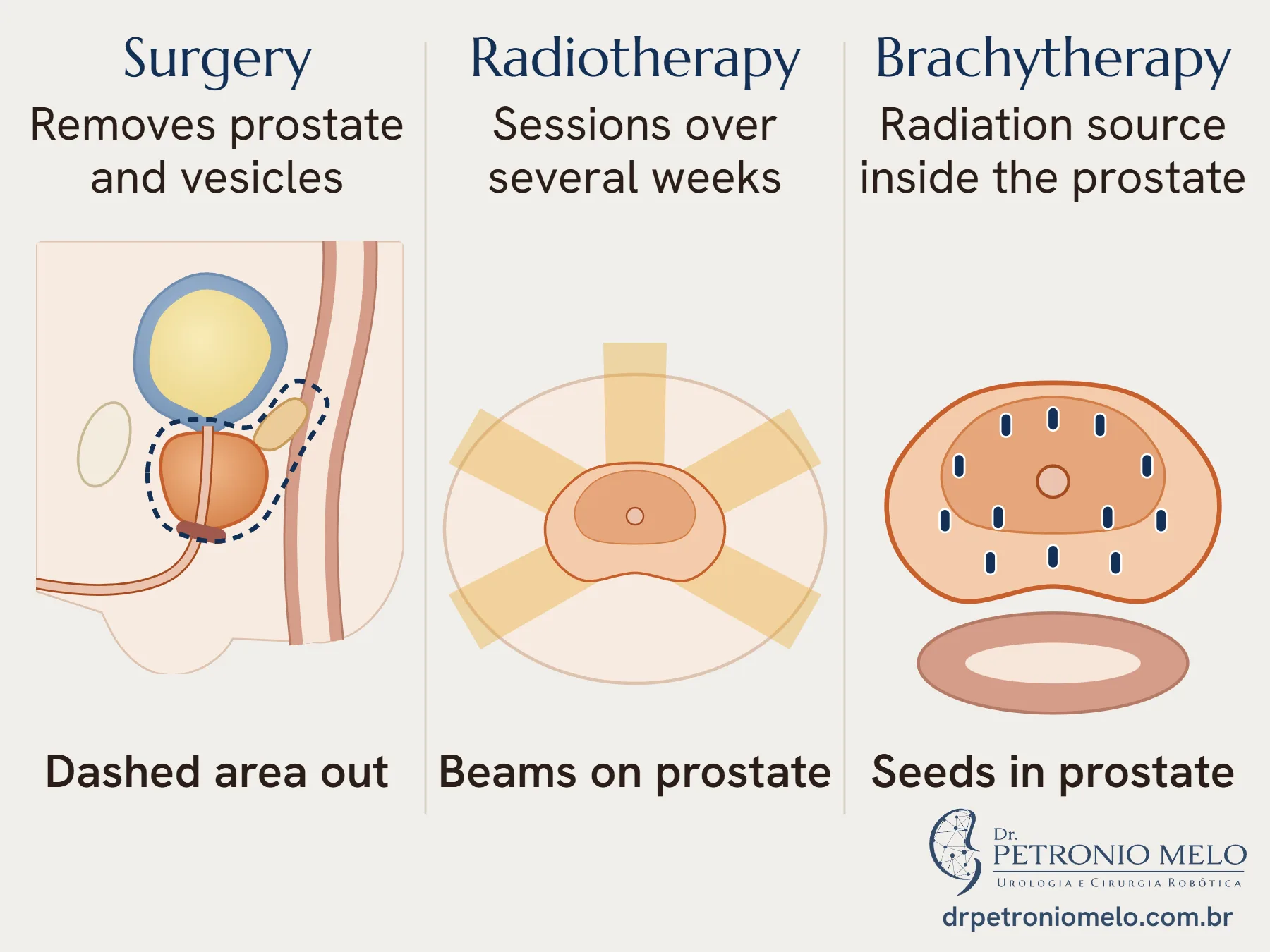
Radical prostatectomy removes the prostate and the seminal vesicles, with a short hospital stay. External radiotherapy delivers radiation to the prostate in sessions over several weeks, without any cut. In brachytherapy, the radiation source is placed inside the prostate.1
For moderate hypofractionation, the European guideline describes 20 sessions over four weeks or 28 sessions over six weeks.6
Hormone therapy may be given with radiotherapy. In an analysis of 12 studies with 10,853 men, it improved metastasis-free survival.7 In high-risk disease, the European guideline recommends two to three years of this treatment.6
What the studies show about the cancer
ProtecT is a British randomized study. It assigned men with localized tumors to surgery, radiotherapy or active monitoring and followed them for 15 years.2
| At 15 years | Surgery | Radiotherapy |
|---|---|---|
| Death from the cancer | 2.2% | 2.9% |
| Metastases | 4.7% | 5% |
| Long-term hormone therapy | 7.2% | 7.7% |
| Clinical progression | 10.5% | 11% |
The men entered the study from 1999 to 2009, and both techniques have changed since then. More than a third had intermediate- or high-risk disease.2
Effects on urine, erections and the bowel
This is where the biggest differences lie. These are the data reported by the ProtecT patients themselves:3
| Effect | Surgery | Radiotherapy with hormone therapy |
|---|---|---|
| Using pads for urine leakage, from 7 to 12 years | 18% to 24% | 3% to 8% |
| Erections firm enough for intercourse, at 7 years | 18% | 27% |
| Waking two or more times a night to urinate, at 12 years | 34% | 48% |
| Fecal leakage, at 12 years | 6% | 12% |
At 12 years, erections were poor in both groups. Age also plays a part: men under active monitoring had a gradual decline in urinary and sexual function.3
An American study of 2,445 men confirmed the pattern at 10 years. Surgery had more urine leakage, without worse sexual function. In cases with a worse prognosis, radiotherapy with hormone therapy had worse bowel and hormonal results.4
Technique also counts. In a randomized study at the University of São Paulo, 95.4% of men who had robotic surgery were continent at 18 months, against 78.8% with open surgery.5
What if the cancer comes back
If PSA rises after surgery, radiotherapy is one of the options.8 After radiotherapy, there are also possible treatments, which depend on individual evaluation.9 This sequence is part of the conversation, especially for younger men.
How I approach it
In my practice, I compare the two options with you, with the numbers and without rushing. I take into account your age, urinary symptoms, erections, bowel, previous operations and the size of your prostate.
I am a surgeon, and I make that clear in the conversation.
When to see a urologist
- If you have been diagnosed and need to choose a treatment
- If you want a second opinion on the recommendation
- If you have already been treated and your PSA has risen again
Frequently asked questions
Does radiotherapy cure prostate cancer?+
In localized cancer, radiotherapy aims to cure, like surgery.1 In a study with 15 years of follow-up, 2.9% of men treated with radiotherapy and 2.2% of those who had surgery died of the disease, a difference without statistical significance.2
What are the side effects of radiotherapy to the prostate?+
The effects most linked to radiotherapy are bowel and urinary effects, such as waking at night to urinate. At 12 years, 12% reported fecal leakage, against 6% of those who had surgery.3 When hormone therapy is added, hormonal effects may also appear.4
Do radiotherapy effects appear years later?+
They can appear and can persist. The ProtecT study followed the men for 12 years and showed urinary and bowel effects over that period.3
Which is better, surgery or radiotherapy?+
Neither is better for everyone. Disease control was similar in the studies, and the side effects are different.2,3 The choice depends on your tumor, your health and what matters most to you.
If the cancer comes back after surgery, can I have radiotherapy?+
Yes. Radiotherapy is one of the options when PSA rises again after surgery.8
Can I have surgery after radiotherapy?+
It is possible in selected cases, and the decision needs careful evaluation.9
References
- Eastham JA, Auffenberg GB, Barocas DA, et al. Clinically Localized Prostate Cancer: AUA/ASTRO Guideline, Part I. J Urol. 2022;208(1):10-18. PubMed
- Hamdy FC, Donovan JL, Lane JA, et al. Fifteen-Year Outcomes after Monitoring, Surgery, or Radiotherapy for Prostate Cancer. N Engl J Med. 2023;388(17):1547-1558. PubMed
- Donovan JL, Hamdy FC, Lane JA, et al. Patient-Reported Outcomes 12 Years after Localized Prostate Cancer Treatment. NEJM Evid. 2023;2(4):EVIDoa2300018. PubMed
- Al Hussein Al Awamlh B, Wallis CJD, Penson DF, et al. Functional Outcomes After Localized Prostate Cancer Treatment. JAMA. 2024;331(4):302-317. PubMed
- Nahas WC, Rodrigues GJ, Rodrigues Gonçalves FA, et al. Perioperative, Oncological, and Functional Outcomes Between Robot-Assisted Laparoscopic Prostatectomy and Open Radical Retropubic Prostatectomy: A Randomized Clinical Trial. J Urol. 2024;212(1):32-40. PubMed
- EAU-EANM-ESTRO-ESUR-ISUP-SIOG Guidelines on Prostate Cancer. European Association of Urology; 2026. EAU
- Kishan AU, Sun Y, Hartman H, et al. Androgen deprivation therapy use and duration with definitive radiotherapy for localised prostate cancer: an individual patient data meta-analysis. Lancet Oncol. 2022;23(2):304-316. PubMed
- Morgan TM, Boorjian SA, Buyyounouski MK, et al. Salvage Therapy for Prostate Cancer: AUA/ASTRO/SUO Guideline Part II: Treatment Delivery for Non-metastatic Biochemical Recurrence After Primary Radical Prostatectomy. J Urol. 2024;211(4):518-525. PubMed
- Morgan TM, Boorjian SA, Buyyounouski MK, et al. Salvage Therapy for Prostate Cancer: AUA/ASTRO/SUO Guideline Part III: Salvage Therapy After Radiotherapy or Focal Therapy, Pelvic Nodal Recurrence and Oligometastasis, and Future Directions. J Urol. 2024;211(4):526-532. PubMed
Would you like to talk about your case?
In the consultation, I go over your tests and your priorities.
Book a consultation