

Quick answer
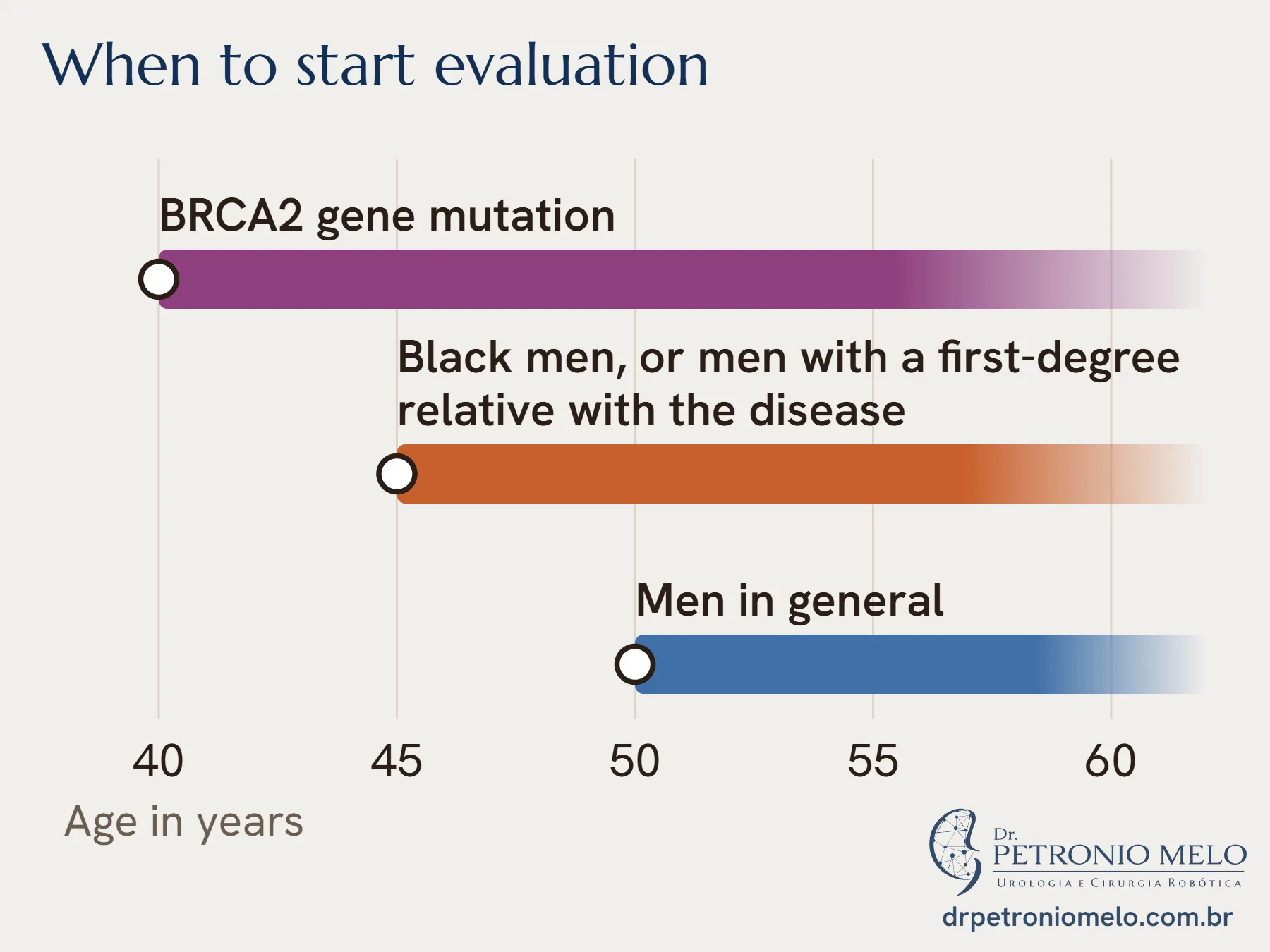
Screening means looking for prostate cancer in men without symptoms, with PSA and a rectal exam. The Brazilian Society of Urology (SBU) and the European guideline advise starting at 50, or at 45 for Black men and men with a first-degree relative with the disease.1,2 The Brazilian Ministry of Health does not recommend screening the whole population and advises a shared decision with men who ask for the test.3 Both positions include a conversation about risks and benefits.
What screening is
Screening looks for the disease in people without symptoms. Early diagnosis investigates people who already have signs.3
Localized prostate cancer usually causes no symptoms, and that is what justifies looking early.1 On the other side is overdiagnosis, which can lead to unnecessary tests and treatments.1,4
What each organization advises
| Organization | Advice |
|---|---|
| SBU | Individual evaluation from age 50, or from 45 for Black men and men with a first-degree relative with the disease2 |
| European guideline | From 50, from 45 with a family history or African ancestry, and from 40 with a BRCA2 mutation, with a strategy adjusted to risk1 |
| American guideline | PSA with shared decision-making and intervals adjusted to each man8 |
| US Preventive Services Task Force | From 55 to 69, an individual decision: the benefit is small for some men. After 70, the harms are greater7 |
| Brazilian Ministry of Health and INCA | Do not recommend screening the whole population and advise a shared decision with men who ask for the test3 |
What the studies show
| Study | How it was done | Result |
|---|---|---|
| European, 23 years | 162,236 men aged 55 to 69, with repeated PSA tests | 13% fewer prostate cancer deaths and 30% more diagnoses. One death prevented for every 456 men invited |
| CAP, 15 years | 415,357 men, with a single invitation to a PSA test | Prostate cancer deaths: 0.69% in the invited group and 0.78% in the other. The absolute reduction was small |
| Swedish, 2022 | 37,887 men invited, with PSA and MRI | Biopsying only the lesions seen on MRI halved the number of insignificant tumors: 0.6% and 1.2% |
A Cochrane review of five randomized studies found no gain in disease-specific survival. The European guideline notes that two studies showed a favorable effect: the European study and CAP.1 The disagreements come from this picture, and the Swedish study shows one way to reduce harm by using MRI.6
How the prostate exam works
- ConversationWe talk about your age, family, symptoms, medications and previous tests.
- PSAA blood test, done in a laboratory.
- Rectal examWith a glove and lubricant, the doctor feels the part of the prostate next to the rectum. It takes a few seconds and may be uncomfortable.
- Next stepWith the results, we decide whether to monitor, repeat the PSA or order an MRI.
The rectal exam is still useful alongside PSA. In about 18% of cases, cancer is found only because the rectal exam is abnormal. In a large European study, an abnormal rectal exam with a high PSA more than doubled the chance of a positive biopsy: 48.6% and 22.4%.1
First signs
Early prostate cancer usually causes no symptoms, which appear later.1 A weak stream, frequent urges to urinate or blood in the urine have several causes and deserve evaluation at any age.
How I approach it
In my practice, before ordering the test, I explain what it can show and what may come next. Once the decision is made, I do the evaluation with PSA and a rectal exam. When there is a family history, I ask who had the disease, at what age and whether there were other tumors, such as breast or ovarian cancer. The interval between tests depends on each man's result and risk.
When to see a urologist
Frequently asked questions
At what age should I have a prostate exam?+
The Brazilian Society of Urology (SBU) and the European guideline advise starting at 50, or at 45 for Black men and men with a first-degree relative with the disease.1,2 Men with a BRCA2 gene mutation start at 40.1
Is PSA enough, without the rectal exam?+
The rectal exam adds information. In about 18% of cases, cancer is found only because the rectal exam is abnormal, whatever the PSA value.1 The rectal exam also helps define the stage and the risk group.1
What are the first signs of prostate cancer?+
Localized cancer usually causes no symptoms. They tend to appear later.1 That is why having no symptoms does not rule out the disease.
Why does the Brazilian Ministry of Health not recommend screening?+
It considers that screening the whole population increases diagnoses without a significant reduction in deaths and with harm to men's health. The Ministry advises discussing risks and benefits with men who ask for the test.3
Do I need the exam every year?+
Not always. The interval depends on your risk and your previous results. The American guideline accepts longer intervals, adjusted to each man.8
Can MRI replace PSA and the rectal exam?+
No. The European guideline advises against using MRI as the first screening test.1 It comes later, to help decide about a biopsy.
References
- EAU-EANM-ESTRO-ESUR-ISUP-SIOG Guidelines on Prostate Cancer. European Association of Urology; 2026. EAU
- Sociedade Brasileira de Urologia. Aconselhamento para o diagnóstico precoce do câncer de próstata. 2020. SBU
- Instituto Nacional de Câncer. Ministério da Saúde recomenda o não rastreamento populacional do câncer de próstata. 2023. INCA
- Roobol MJ, de Vos II, Månsson M, et al. European Study of Prostate Cancer Screening: 23-Year Follow-up. N Engl J Med. 2025;393(17):1669-1680. PubMed
- Martin RM, Turner EL, Young GJ, et al. Prostate-Specific Antigen Screening and 15-Year Prostate Cancer Mortality: A Secondary Analysis of the CAP Randomized Clinical Trial. JAMA. 2024;331(17):1460-1470. PubMed
- Hugosson J, Månsson M, Wallström J, et al. Prostate Cancer Screening with PSA and MRI Followed by Targeted Biopsy Only. N Engl J Med. 2022;387(23):2126-2137. PubMed
- US Preventive Services Task Force, Grossman DC, Curry SJ, et al. Screening for Prostate Cancer: US Preventive Services Task Force Recommendation Statement. JAMA. 2018;319(18):1901-1913. PubMed
- Wei JT, Barocas D, Carlsson S, et al. Early Detection of Prostate Cancer: AUA/SUO Guideline Part I: Prostate Cancer Screening. J Urol. 2023;210(1):46-53. PubMed
Would you like to talk about your case?
In the consultation, I go over your tests and your priorities.
Book a consultation