

Quick answer
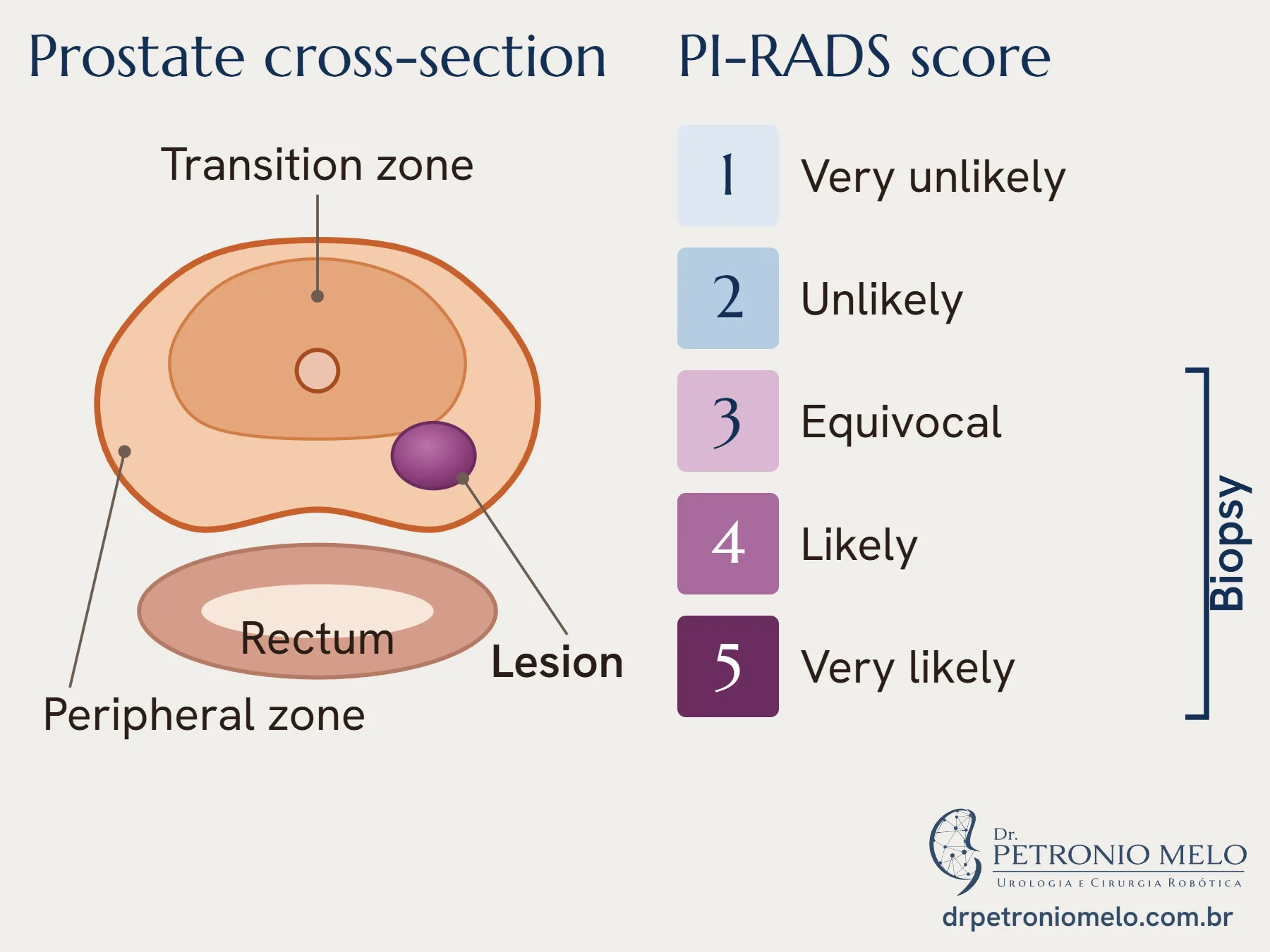
PI-RADS is the score from 1 to 5 that the radiologist gives a prostate MRI. The higher the score, the greater the chance of clinically significant cancer.2 In a review of 117 studies, that chance was 3% for PI-RADS 1, 6% for 2, 20% for 3, 53% for 4 and 83% for 5.3 The score is not a diagnosis. Men with PI-RADS 3 to 5 may be candidates for a targeted biopsy.1 In my practice, from a score of 3 upward, I always recommend a biopsy.
What PI-RADS is
The name stands for Prostate Imaging Reporting and Data System. It standardizes how the MRI is read, so that the same lesion gets the same score in different centers.2
The report describes each suspicious area, with its size and location. The final score is that of the most suspicious lesion.2
What each score means
The categories come from PI-RADS version 2.1.2 The percentages show in how many men significant cancer was found, in the 2026 review of 117 studies with 25,228 patients.3 These are averages: your risk also depends on your PSA, rectal exam and history.
What to do with the result
PI-RADS 1 or 2. The chance is low, but not zero. It ranges from 3%, with a PSA density below 0.10 ng/mL/cc, to 18%, with a density above 0.20 ng/mL/cc. The European guideline accepts skipping the biopsy when PI-RADS is 2 or lower, the density is below 0.20 ng/mL/cc and there is no family history.1
PI-RADS 3. Most of these men do not have significant cancer, and still it appeared in 20%.3 The European guideline considers that they may be candidates for a targeted biopsy.1 In my practice, I recommend the biopsy.
PI-RADS 4 or 5. A targeted biopsy is the next step. The guideline suggests also sampling the area around the lesion.1
Why it comes before the biopsy
The European guideline advises having the MRI before the biopsy.1 Two studies support this recommendation:
| Study | Who took part | What it showed |
|---|---|---|
| PROMIS, 2017 | 576 men | MRI found 93% of significant cancers, and ultrasound-guided biopsy 48%. With MRI, 27% could avoid a first biopsy |
| PRECISION, 2018 | 500 men | Significant cancer in 38% with MRI and targeted biopsy, against 26% with standard biopsy. Of those who had an MRI, 28% did not need a biopsy |
MRI also has limits. In PROMIS, specificity was 41%: many suspicious areas were not significant cancer.4 And the guideline advises against using MRI as the first screening test.1
With or without contrast
MRI without contrast is called biparametric. In the 2025 PRIME study, it found clinically significant cancer in 29.2% of men, and MRI with contrast in 29.6%.6
In the European guideline, the option without contrast depends on high-quality images, experienced reading and the possibility of calling the patient back to complete the scan.1
How I approach it
In my practice, I order the MRI before recommending a biopsy and prefer a center with experience in the prostate. I read the report together with the PSA, the density, the rectal exam and the family history. With scores of 1 and 2, we talk about monitoring without a biopsy when the other data support it. From a score of 3 upward, I always recommend a biopsy.
When to see a urologist
- If you received a report with any PI-RADS score
- If your PSA keeps rising after a normal MRI
- If the MRI showed a lesion and you have questions about the biopsy
Frequently asked questions
Does PI-RADS 4 mean cancer?+
Not necessarily. A score of 4 means that clinically significant cancer is likely. In a review of 117 studies, it was found in 53% of men with this score.3 Only a biopsy confirms it.
Does PI-RADS 3 need a biopsy?+
In my practice, yes. From a score of 3 upward, I always recommend a biopsy. The European guideline considers that men with PI-RADS 3 to 5 may be candidates for a targeted biopsy.1 In the review of 117 studies, a score of 3 had significant cancer in 20% of men.3
Can PI-RADS 2 have cancer?+
It can, and the chance is low. In the review of 117 studies, it was 6%.3 With PI-RADS 1 or 2, the chance ranges from 3% with a PSA density below 0.10 ng/mL/cc to 18% with a density above 0.20 ng/mL/cc.1
Is PI-RADS 5 always cancer?+
No. A score of 5 means that clinically significant cancer is very likely. In the review of 117 studies, it was found in 83% of men.3
Can MRI replace a biopsy?+
No. It shows whether there is a suspicious area and helps decide about a biopsy, which is the test that confirms cancer. In one study, 27% of men could have avoided a first biopsy.4
References
- EAU-EANM-ESTRO-ESUR-ISUP-SIOG Guidelines on Prostate Cancer. European Association of Urology; 2026. EAU
- Turkbey B, Rosenkrantz AB, Haider MA, et al. Prostate Imaging Reporting and Data System Version 2.1: 2019 Update of Prostate Imaging Reporting and Data System Version 2. Eur Urol. 2019;76(3):340-351. PubMed
- Nedelcu A, Oerther B, Benkendorff A, et al. PI-RADS Version 2.1 for Prostate MRI Interpretation: Associations of Study Quality and Cancer Detection Metrics. AJR Am J Roentgenol. 2026;226(2):e2533583. PubMed
- Ahmed HU, El-Shater Bosaily A, Brown LC, et al. Diagnostic accuracy of multi-parametric MRI and TRUS biopsy in prostate cancer (PROMIS): a paired validating confirmatory study. Lancet. 2017;389(10071):815-822. PubMed
- Kasivisvanathan V, Rannikko AS, Borghi M, et al. MRI-Targeted or Standard Biopsy for Prostate-Cancer Diagnosis. N Engl J Med. 2018;378(19):1767-1777. PubMed
- Ng ABCD, Asif A, Agarwal R, et al. Biparametric vs Multiparametric MRI for Prostate Cancer Diagnosis: The PRIME Diagnostic Clinical Trial. JAMA. 2025;334(13):1170-1179. PubMed
Would you like to talk about your case?
In the consultation, I go over your tests and your priorities.
Book a consultation