

Quick answer
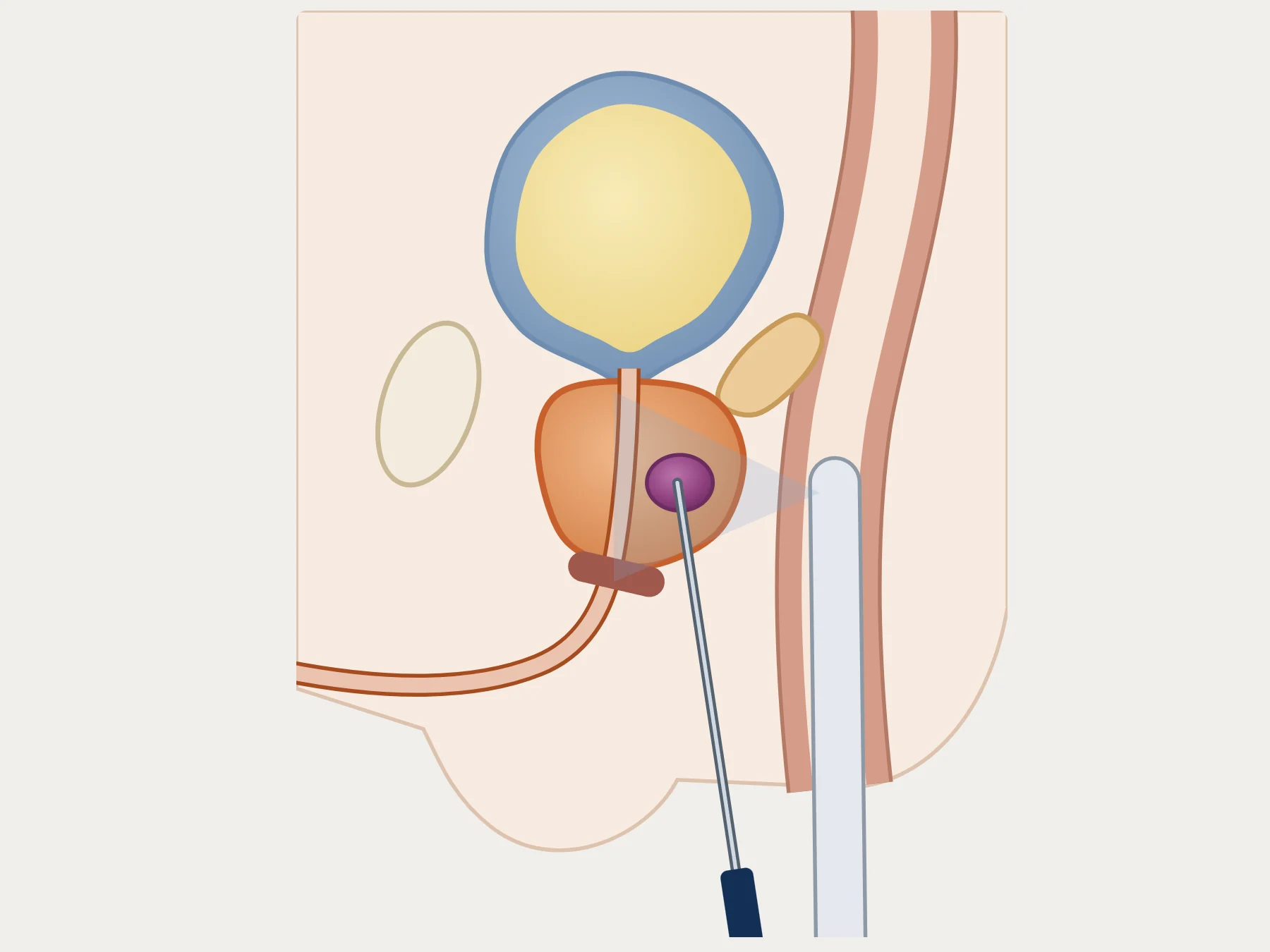
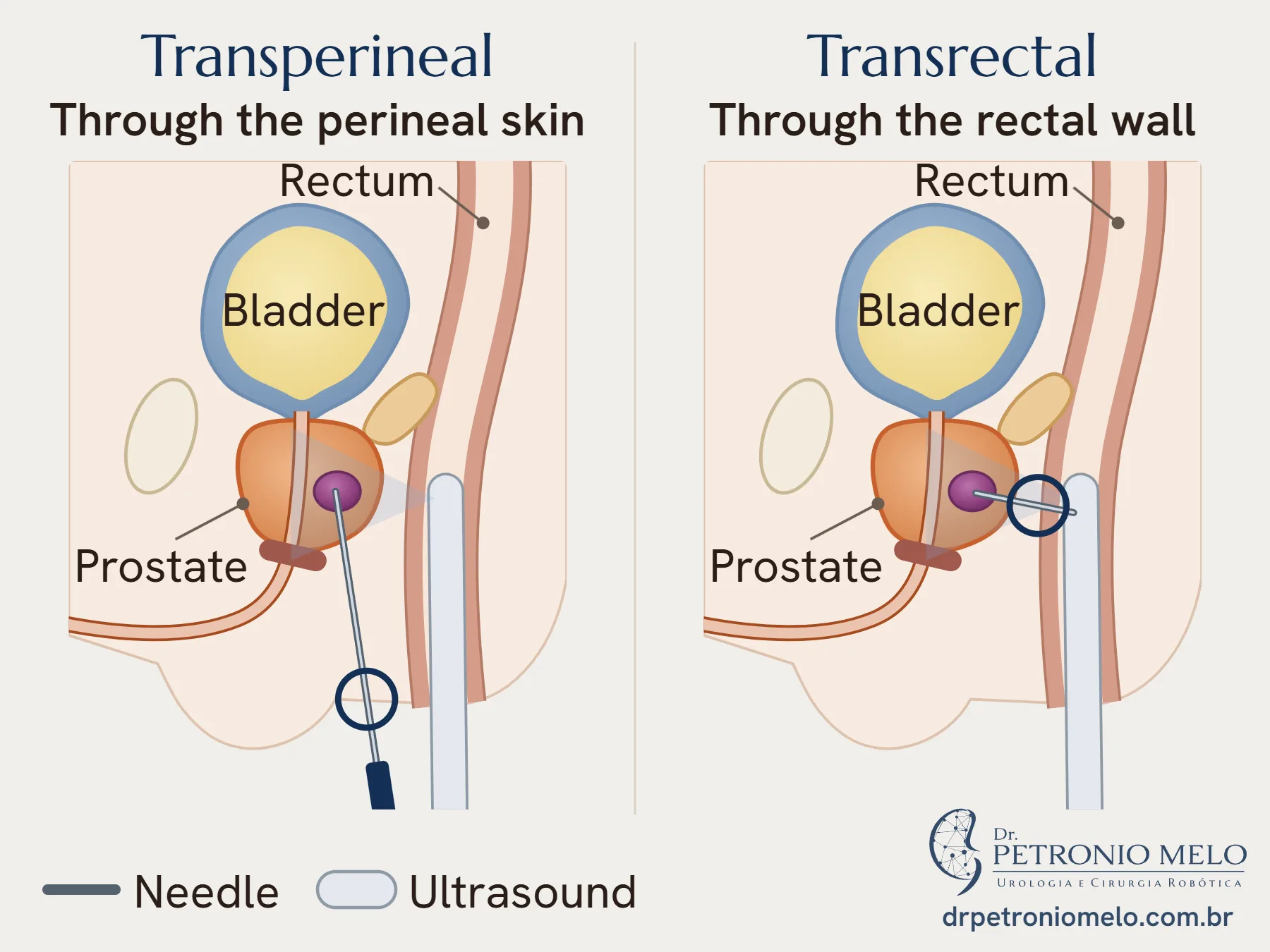
In a transperineal biopsy, the needle goes in through the skin of the perineum, between the scrotum and the anus, to take samples of the prostate without passing through the rectum. I always perform the test under sedation. The European guideline recommends this route because of the low risk of infection and the lower use of antibiotics.1
When it is recommended
A biopsy is discussed when the PSA or the rectal exam raises suspicion. The MRI comes first and helps decide.1 In a randomized study, 28% of men who had an MRI first did not need a biopsy.6
With a PI-RADS 4 or 5 lesion, the guideline advises sampling the lesion and the tissue around it. With a negative MRI, low clinical suspicion and no family history, the biopsy can be skipped, with PSA follow-up.1
How the test is done
- PreparationYou get advice about your medications, especially blood thinners.
- SedationYou receive sedation, and the skin of the perineum is disinfected.1
- SamplingGuided by ultrasound and by the MRI images, the needle takes at least 3 to 5 samples from the lesion. Systematic sampling uses about 12 samples.1
- ReportThe samples go to the pathologist. The report shows whether there is cancer and how aggressive it is.
What the studies show
Three randomized studies compared the transperineal and transrectal routes:
| Study | Infection | Significant cancer detected |
|---|---|---|
| PREVENT, 2024 658 men | 0 with the transperineal route, without antibiotics, and 1.4% with the transrectal route | 53% transperineal and 50% transrectal |
| TRANSLATE, 2025 1,126 men | Requiring hospital admission: under 1% transperineal and 2% transrectal | 60% transperineal and 54% transrectal |
| ProBE-PC, 2024 718 men | 2.7% transperineal and 2.6% transrectal | Not the focus of the study |
In PREVENT, the difference in infection was not statistically significant. TRANSLATE was the only one to show more detection with the transperineal route.2,3 A review of studies with MRI-guided biopsy found similar results for the two routes, and the transperineal route allows antibiotics to be skipped safely.5
The transrectal route is still a safe option, as ProBE-PC concluded.4 We choose the route with you, case by case.
Risks and recovery
- Right afterThere may be mild pain and a small bruise in the perineum.
- First few daysBlood in the urine is common.
- Following weeksSemen may look dark or contain blood for a while.
In a series of targeted biopsies cited by the European guideline, 53.4% of men had blood in the urine and 37.2% in the semen. Fever and urinary retention occurred in 3% each.1
In TRANSLATE, retention requiring a catheter occurred in 6% with the transperineal route and 5% with the transrectal route. Urinary symptoms and sexual function were similar after four months.3
How I approach it
In my practice, I order the MRI before recommending a biopsy. When a biopsy is needed, I prefer the transperineal route, always under sedation, and I sample the lesion seen on MRI and the rest of the prostate. Before the test, I review your medications and explain what to expect in the following days.
When to see a urologist
- If your PSA or rectal exam is abnormal
- If your MRI shows PI-RADS 3, 4 or 5
- If you have had a negative biopsy and the suspicion remains
- If you have been asked to have a biopsy and want to understand the options
Frequently asked questions
Does a transperineal biopsy hurt?+
I always perform the test under sedation. Afterward, there may be mild pain in the perineum for the first few days.
What is the difference between a transperineal and a transrectal biopsy?+
In the transperineal route, the needle goes in through the skin of the perineum. In the transrectal route, it passes through the wall of the rectum. Studies show similar or higher cancer detection with the transperineal route, and the European guideline recommends it because of the low risk of infection.1,2,3,5
Do I need antibiotics?+
For men without risk factors, such as diabetes or a history of urinary retention, the European guideline accepts skipping antibiotics with the transperineal route.1
Does the biopsy affect erections?+
In a randomized study, sexual function four months later was similar between the two routes.3 That study did not compare with men who had no biopsy.
Is it normal to have blood in the urine and semen?+
Yes, it is common after a biopsy.1 Fever, difficulty urinating or blood with clots call for contact the same day.
Does everyone with a high PSA need a biopsy?+
No. With a negative MRI, a PSA density below 0.20 ng/mL/cc and no family history, the European guideline accepts skipping the biopsy and following the PSA.1
References
- EAU-EANM-ESTRO-ESUR-ISUP-SIOG Guidelines on Prostate Cancer. European Association of Urology; 2026. EAU
- Hu JC, Assel M, Allaf ME, et al. Transperineal Versus Transrectal Magnetic Resonance Imaging-targeted and Systematic Prostate Biopsy to Prevent Infectious Complications: The PREVENT Randomized Trial. Eur Urol. 2024;86(1):61-68. PubMed
- Bryant RJ, Marian IR, Williams R, et al. Local anaesthetic transperineal biopsy versus transrectal prostate biopsy in prostate cancer detection (TRANSLATE): a multicentre, randomised, controlled trial. Lancet Oncol. 2025;26(5):583-595. PubMed
- Mian BM, Feustel PJ, Aziz A, et al. Complications Following Transrectal and Transperineal Prostate Biopsy: Results of the ProBE-PC Randomized Clinical Trial. J Urol. 2024;211(2):205-213. PubMed
- Zattoni F, Rajwa P, Miszczyk M, et al. Transperineal Versus Transrectal Magnetic Resonance Imaging-targeted Prostate Biopsy: A Systematic Review and Meta-analysis of Prospective Studies. Eur Urol Oncol. 2024;7(6):1303-1312. PubMed
- Kasivisvanathan V, Rannikko AS, Borghi M, et al. MRI-Targeted or Standard Biopsy for Prostate-Cancer Diagnosis. N Engl J Med. 2018;378(19):1767-1777. PubMed
Would you like to talk about your case?
In the consultation, I go over your tests and your priorities.
Book a consultation