

Quick answer
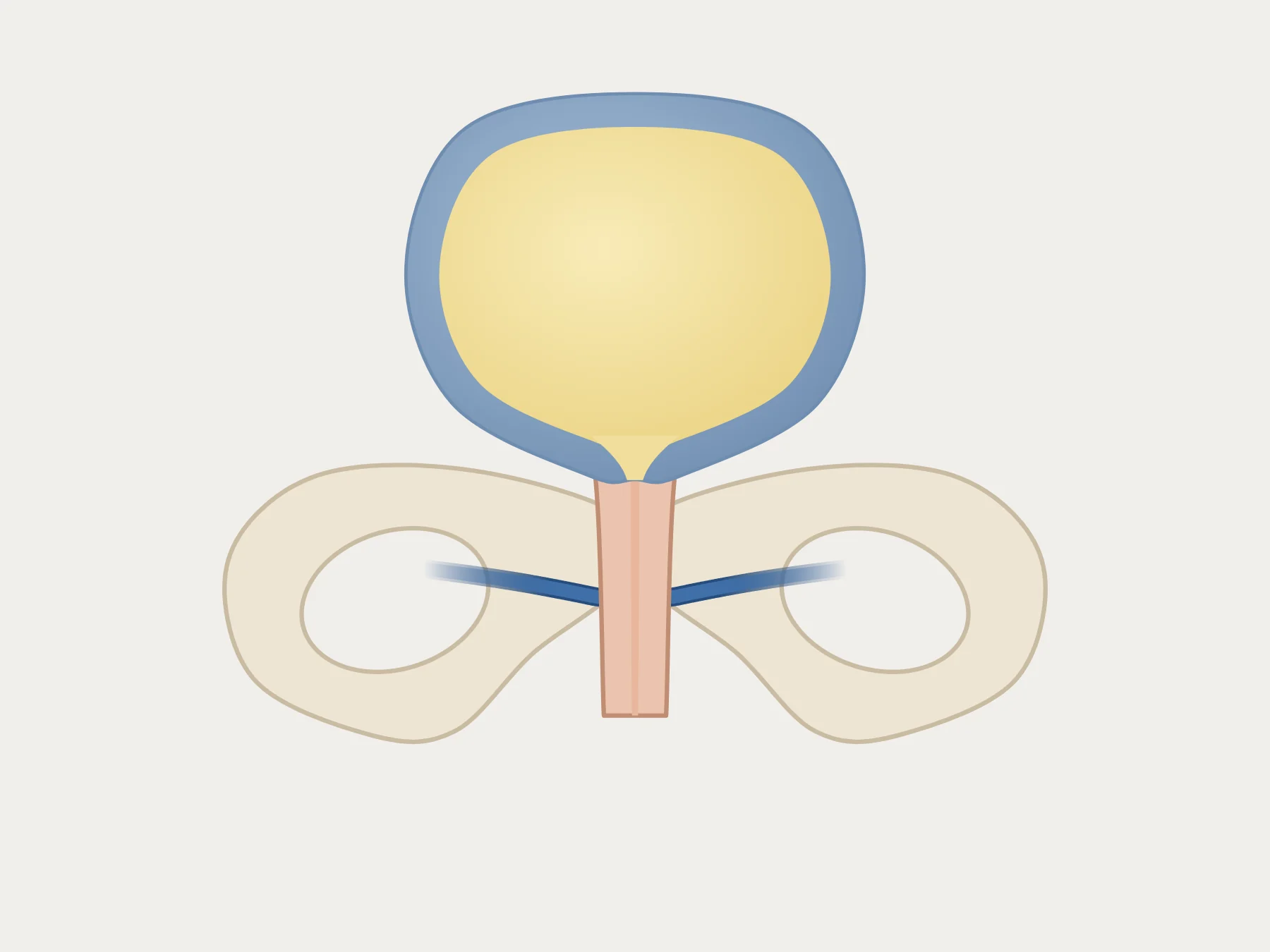
A sling is an operation for stress urinary incontinence in women: a narrow tape is placed under the middle part of the urethra and supports the channel during effort.1,2 It is the most studied operation for this problem, with a good safety profile.2 Like any surgery, it has risks, and the choice is made after talking through the other options.1
What a sling is
In stress incontinence, urine escapes when coughing, laughing or lifting because the urethra loses its support. The sling gives that support back. The tape sits loosely at rest and acts as a backstop when pressure rises.
Who it is recommended for
A sling is offered to women who have stress incontinence and want surgical treatment, after a detailed conversation about the risks, benefits and other operations.1 Supervised pelvic floor training, for at least 3 months, is the first option.1 See Kegel exercises.
The American guideline separates simpler cases from those that need more attention. Advanced prolapse, predominant urgency, neurological disease, difficulty emptying the bladder, previous incontinence surgery, a mesh complication, obesity and older age can change the options and the results.6
Before surgery, urodynamics is for selected situations, such as when there are other bladder symptoms or the type of leakage is unclear.1
How the operation is done
The tape is passed through a small incision in the vagina and sits under the middle part of the urethra.2 There are two main routes:2
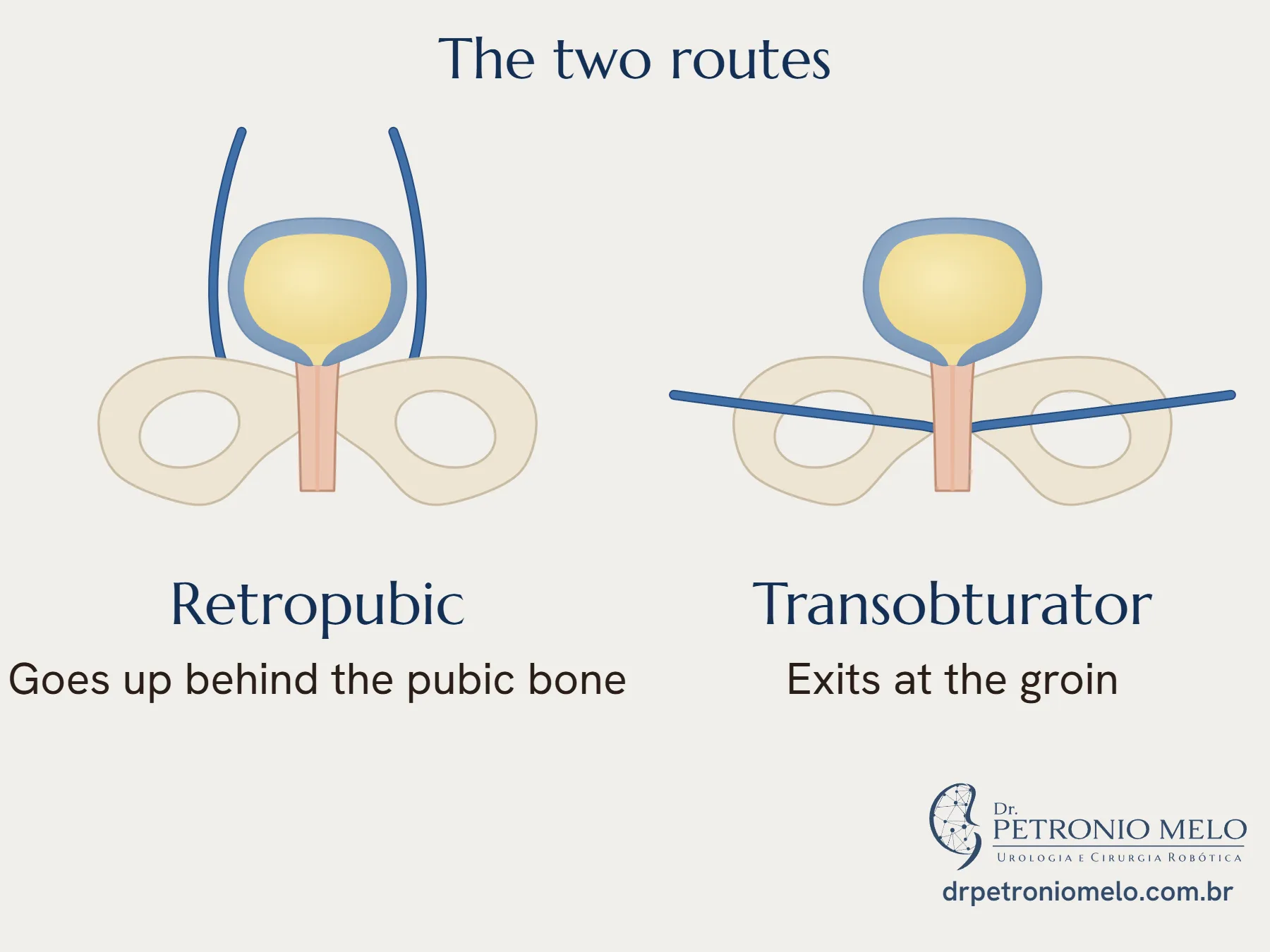
The European guideline recommends cystoscopy during placement of a synthetic tape, to check that the bladder has not been perforated.1 In my practice, I almost always use the transobturator route, known as TVT-O, with spinal or general anesthesia. The hospital stay is about 12 hours, with no catheter.
There is also the single-incision sling. In the short term, it seems equivalent to the conventional one, but long-term results remain uncertain.1
Recovery
In my practice, work resumes after 2 weeks. Exercise and sex wait until after 4 to 6 weeks.
Results
| Study | Who was studied | Result |
|---|---|---|
| Richter, 2010 | 597 women in a randomized study | Objective success at 12 months of 80.8% with the retropubic route and 77.7% with the transobturator route. Patient-reported success of 62.2% and 55.8% |
| Ford, 2017 (Cochrane) | 81 studies, 12,113 women | Short-term reported cure of 71% to 97% with the retropubic route and 62% to 98% with the transobturator route. Long term, 51% to 88% and 43% to 92% |
| Nilsson, 2013 | 17-year follow-up, with 78% of the women who could be assessed | More than 90% continent on examination, and 87% cured or much better by their own report |
Sources for the table: the studies cited.2,3,4 The figures vary because each study defines success differently. None of them is a promise of results.
Retropubic or transobturator
| What to compare | Retropubic | Transobturator |
|---|---|---|
| Bladder perforation | 4.5% | 0.6% |
| Groin pain | 1.3% | 6.4% |
| Pain above the pubic bone | 2.9% | 0.8% |
| Tape exposure in the vagina | 21 in 1,000 | 24 in 1,000 |
Source for the table: Cochrane review.2 After the retropubic route, difficulty urinating is also more frequent.2 On the other hand, repeat incontinence surgery in the long term was more likely after the transobturator route, with low-quality evidence, and the European guideline reports better long-term results with the retropubic route.1,2
Risks and the debate about mesh
A synthetic tape stays in the body permanently.5 The European guideline asks that women be informed about the complications and about all the alternatives, given the public debate about surgical mesh.1 The complications described include persistent pain, nerve injury, sexual problems, mesh exposure in the vagina and, occasionally, injury to nearby organs.5
If difficulty urinating appears after surgery, the tape may need revision.1
Other operations
- A sling made from the patient's own tissue. The tape is made from tissue taken from the abdominal wall.5
- Colposuspension. Stitches lift the bladder neck, through open or laparoscopic surgery.1,5
- Bulking agents injected into the urethra. Substances placed in the wall of the urethra help close it.1,5
In studies with 5 years of follow-up, the share of women who did not need further treatment was 99% with the retropubic sling, 97% with the transobturator sling, 96% with the sling made from the patient's own tissue and 87% with Burch colposuspension.1
When to see a urologist
- If leakage on effort interferes with your routine
- If pelvic floor training has not solved it
- If you have had incontinence surgery and the leakage came back
- If you have questions about mesh and want to know the options
Frequently asked questions
What is sling surgery?+
It is the placement of a narrow tape under the middle part of the urethra, to support the channel during effort. It treats stress urinary incontinence in women.1,2
Who is a sling recommended for?+
For women with stress incontinence who want surgical treatment, after talking through the risks, benefits and other options.1 Pelvic floor training, for at least 3 months, usually comes first.1
How is sling surgery done?+
The tape is passed through a small incision in the vagina and comes out in the lower abdomen, in the retropubic route, or in the groin, in the transobturator route.2 The European guideline recommends cystoscopy to check the bladder during placement of a synthetic sling.1
Does sling surgery work?+
In a study of 597 women, objective success at 12 months was 80.8% with the retropubic route and 77.7% with the transobturator route.3 In a 17-year follow-up, more than 90% of the women assessed were continent on examination.4
What is the difference between retropubic and transobturator slings?+
Short-term cure rates are similar.2 The transobturator route has less bladder perforation and less difficulty urinating, but more groin pain.2 The European guideline reports better long-term results with the retropubic route.1
What are the risks of a sling?+
Bladder perforation, difficulty urinating, pain in the groin or above the pubic bone and exposure of the tape in the vagina are among the risks.2 Serious complications, such as persistent pain, have been reported.5
What is recovery from sling surgery like?+
In my practice, the hospital stay is about 12 hours, with no catheter. Work resumes after 2 weeks, and exercise and sex wait until after 4 to 6 weeks.
Does the tape stay forever?+
Yes. A synthetic tape stays in the body permanently.5
References
- European Association of Urology. EAU Guidelines on Non-neurogenic Female LUTS. Disease management chapter. EAU
- Ford AA, Rogerson L, Cody JD, Aluko P, Ogah JA. Mid-urethral sling operations for stress urinary incontinence in women. Cochrane Database Syst Rev. 2017;7:CD006375. PubMed
- Richter HE, Albo ME, Zyczynski HM, et al. Retropubic versus transobturator midurethral slings for stress incontinence. N Engl J Med. 2010;362(22):2066-76. PubMed
- Nilsson CG, Palva K, Aarnio R, Morcos E, Falconer C. Seventeen years follow-up of the tension-free vaginal tape procedure for female stress urinary incontinence. Int Urogynecol J. 2013;24(8):1265-9. PubMed
- National Health Service (NHS). Surgery and procedures for urinary incontinence. NHS
- Kobashi KC, Vasavada S, Bloschichak A, et al. Updates to Surgical Treatment of Female Stress Urinary Incontinence (SUI): AUA/SUFU Guideline (2023). J Urol. 2023;209(6):1091-1098. AUA/SUFU
Would you like to talk about your case?
In the consultation, I go over your tests and your priorities.
Book a consultation