

Quick answer
Cystitis is a urinary tract infection limited to the bladder, without fever, chills or back pain.1 The typical symptoms are burning when urinating, frequent trips to the toilet and urgency.1 In women, the European guideline recommends fosfomycin, pivmecillinam, nitrofurantoin or nitroxoline as first choice, and does not recommend aminopenicillins or fluoroquinolones.1 Cystitis is called recurrent with at least 3 episodes a year or 2 in 6 months.1
What it is
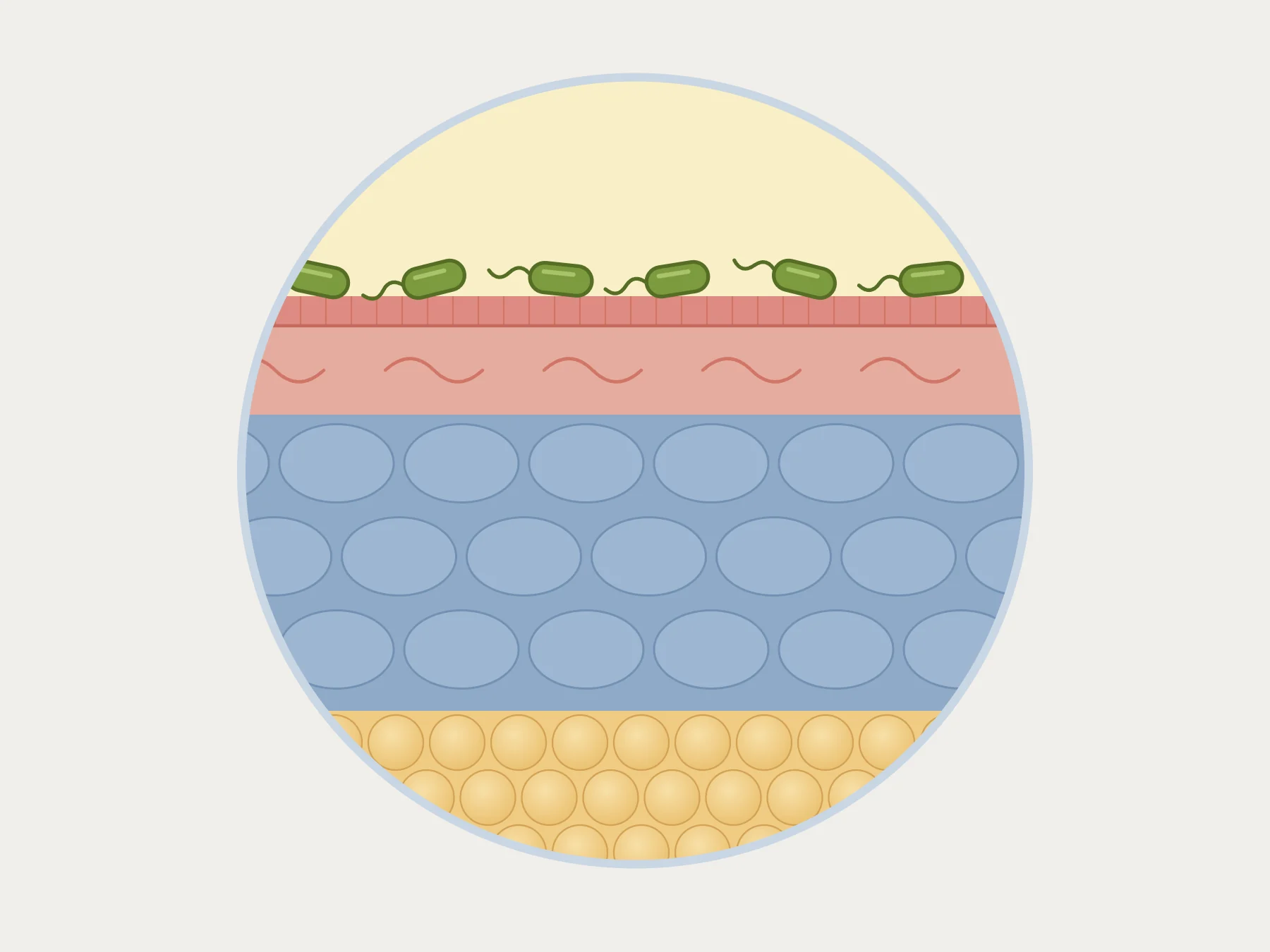
The bacterium enters through the urethra, reaches the bladder and attaches to the inner lining, which becomes inflamed. That inflammation causes the burning and the constant need to urinate. Most cases are caused by Escherichia coli.1 Almost half of women have at least one episode in their lives.1
Symptoms
- burning or pain when urinating1,2
- a frequent and urgent need, even with little urine1,2
- discomfort in the lower abdomen2
- urine that is cloudy, bloody or strong-smelling2
Fever, chills and back pain are not part of cystitis.1 If they appear, the infection may have reached the kidney, and evaluation should happen the same day.
How it is diagnosed
In women, a history of burning, urgency and frequent trips to the toilet, without vaginal discharge, makes the diagnosis very likely.1 A urine culture is not needed for every cystitis. The European guideline recommends one when:1
- symptoms do not improve or come back within 4 weeks of treatment
- symptoms are atypical
- there is a risk of resistant bacteria
- an infection beyond the bladder is suspected
- the woman is pregnant
In my practice, I always order a urine culture, except for a first episode of uncomplicated cystitis in women.
How it is treated
In women, the European guideline recommends fosfomycin, pivmecillinam, nitrofurantoin or nitroxoline as first choice. Aminopenicillins and fluoroquinolones should not be used for cystitis.1 The choice also depends on local bacterial resistance and on your history.1
The antibiotic depends on each institution's protocol, which varies a lot. For uncomplicated cystitis, I usually start with fosfomycin or nitrofurantoin.
In men, cystitis on its own is rare.1 The evaluation checks whether the prostate is involved, because that changes the antibiotic.1
While treatment takes effect, painkillers, rest and fluids help with the discomfort.4
How to prevent recurrent cystitis
For prevention, I follow the European guideline. It advises following an order, and any urological risk factor should be identified and treated.1
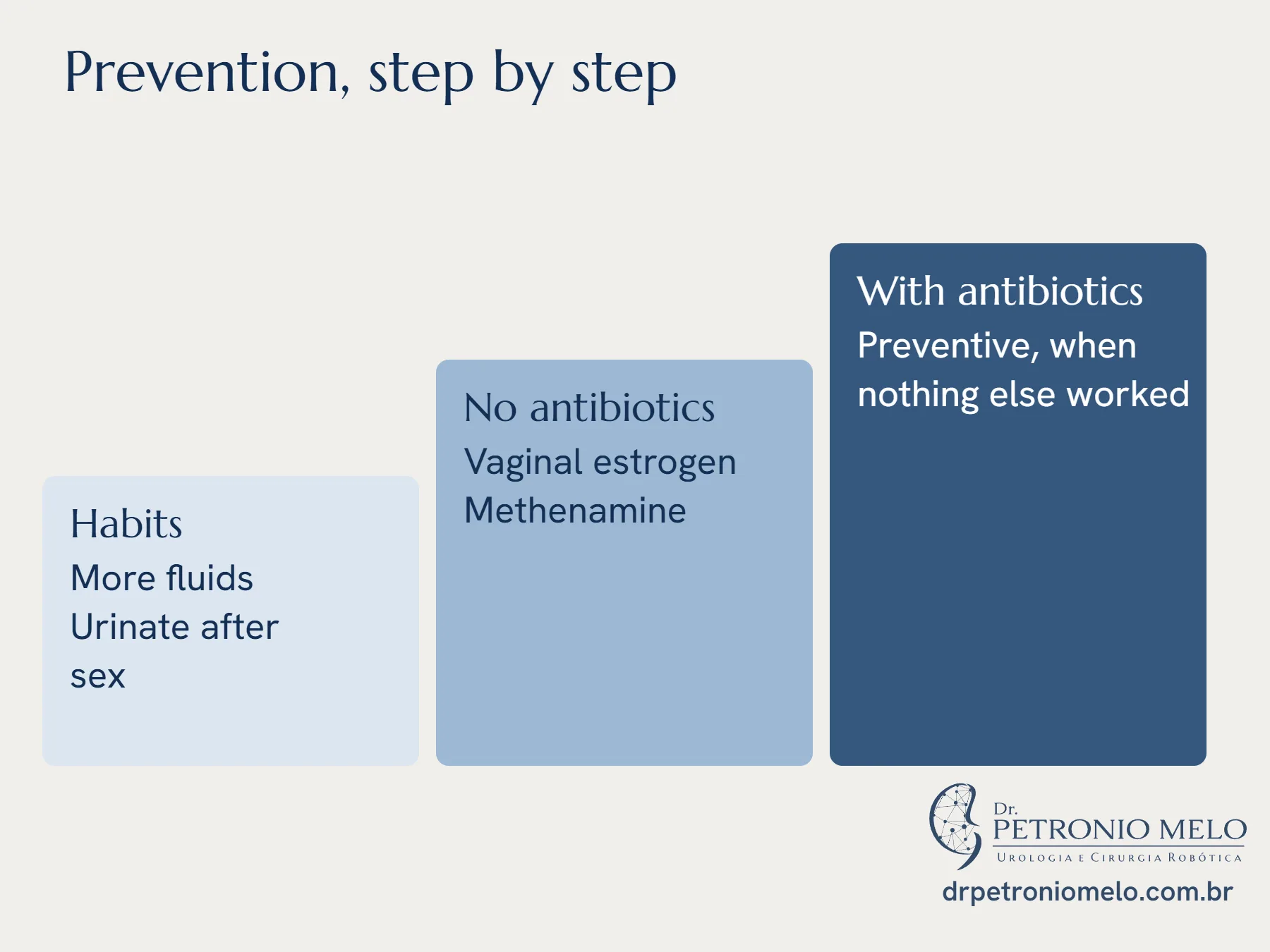
Habits. Drinking little fluid, delaying trips to the toilet, including after sex, and vaginal douching are factors to avoid, although the evidence is limited.1 In a study of women who drank little water, an extra 1.5 liters a day reduced episodes and antibiotic use over 12 months.1
Non-antibiotic measures. After menopause, the guideline recommends vaginal estrogen.1 In women without urinary tract abnormalities, methenamine is an option.1 Cranberry and D-mannose can be used by those who accept the weak or conflicting evidence, and this should be explained beforehand.1 Bacterial vaccines, such as OM-89 and MV140, are the most studied.1
Preventive antibiotics. They are the most effective protection against new episodes, but are kept for when the earlier measures are not enough.1 They can be taken continuously at a low dose or after sex, and once they are stopped, cystitis tends to come back.1
When to see a urologist
- If symptoms do not improve in 48 hours or get worse4
- If you have fever, chills or back pain2
- If you are a man, are pregnant or have diabetes4
- If you have 2 episodes in 6 months or 3 in a year1,4
- If there is blood in the urine4
- If urine tests keep coming back clear and the pain continues, which may be interstitial cystitis
Frequently asked questions
What is cystitis?+
It is a urinary tract infection limited to the bladder, without fever, chills or back pain.1
What are the symptoms of cystitis?+
Burning when urinating, a frequent and urgent need to urinate, discomfort in the lower abdomen and urine that is cloudy, bloody or strong-smelling.1,2
What causes cystitis?+
Most of the time, a bacterium that enters through the urethra and multiplies in the bladder. Escherichia coli is the most common.1,3
Does cystitis go away on its own?+
The European guideline recommends carefully weighing whether an antibiotic is needed.1 The decision is individual, and fever or back pain change the plan.2
Which antibiotic treats cystitis?+
It depends on each institution's protocol, which varies a lot. For uncomplicated cystitis, I usually start with fosfomycin or nitrofurantoin. In women, the European guideline recommends fosfomycin, pivmecillinam, nitrofurantoin or nitroxoline as first choice.1
Is a urine culture needed for every cystitis?+
The European guideline recommends it in specific situations, such as symptoms that do not improve or come back within 4 weeks, atypical symptoms and pregnancy.1 In my practice, I always order a urine culture, except for a first episode of uncomplicated cystitis in women.
Can recurrent cystitis be prevented?+
Yes. The European guideline advises following an order, starting with risk factors, then non-antibiotic measures and, last, preventive antibiotics.1
Do cranberry and D-mannose work?+
The evidence is weak for cranberry and conflicting for D-mannose, and the European guideline asks for this to be explained before use.1
References
- European Association of Urology. EAU Guidelines on Urological Infections. EAU
- National Institute of Diabetes and Digestive and Kidney Diseases (NIDDK). Symptoms & Causes of Bladder Infection in Adults. NIH
- National Institute of Diabetes and Digestive and Kidney Diseases (NIDDK). Definition & Facts of Bladder Infection in Adults. NIH
- National Health Service (NHS). Urinary tract infections (UTIs). NHS
Would you like to talk about your case?
In the consultation, I go over your tests and your priorities.
Book a consultation