
Quick answer
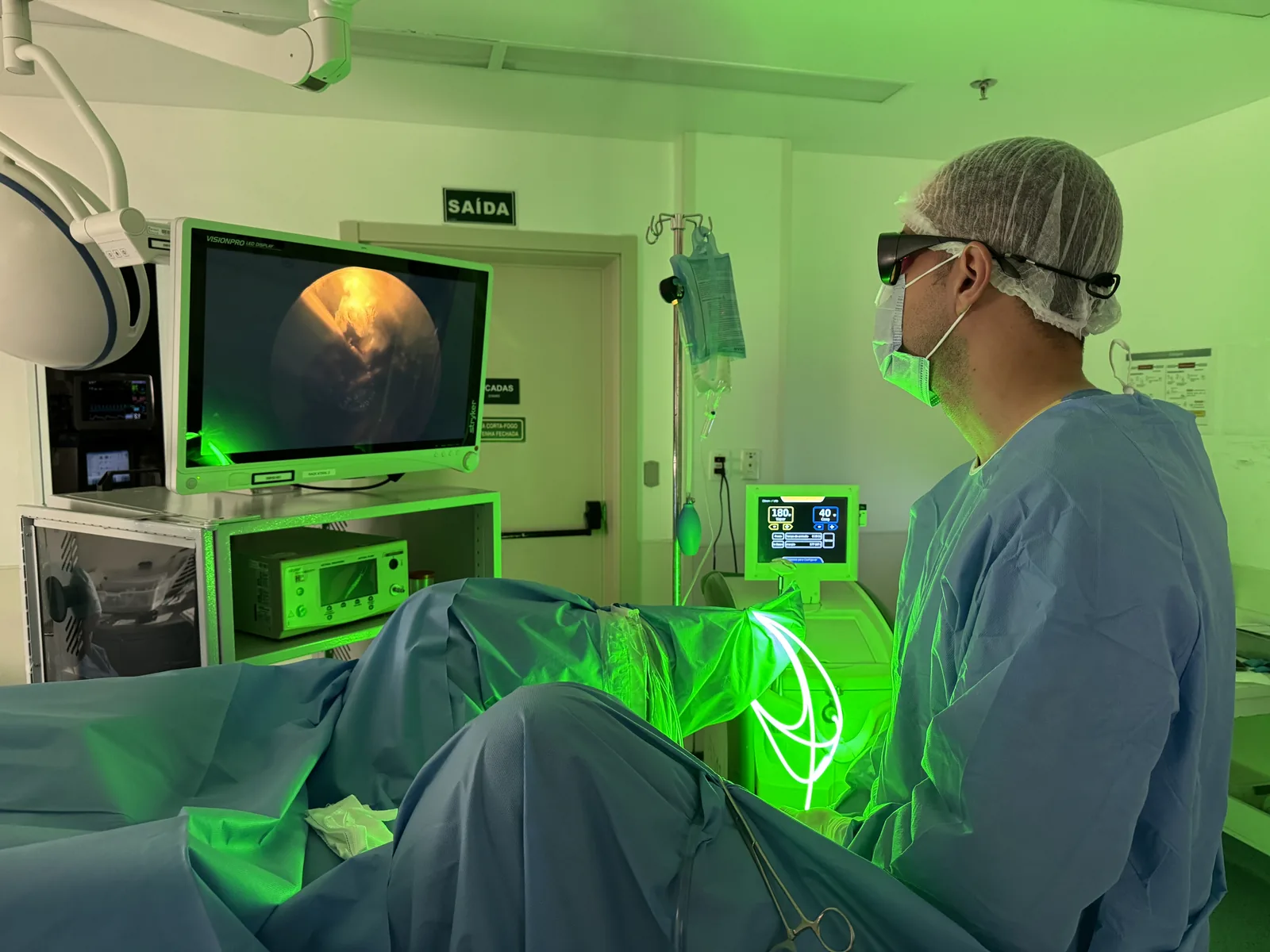
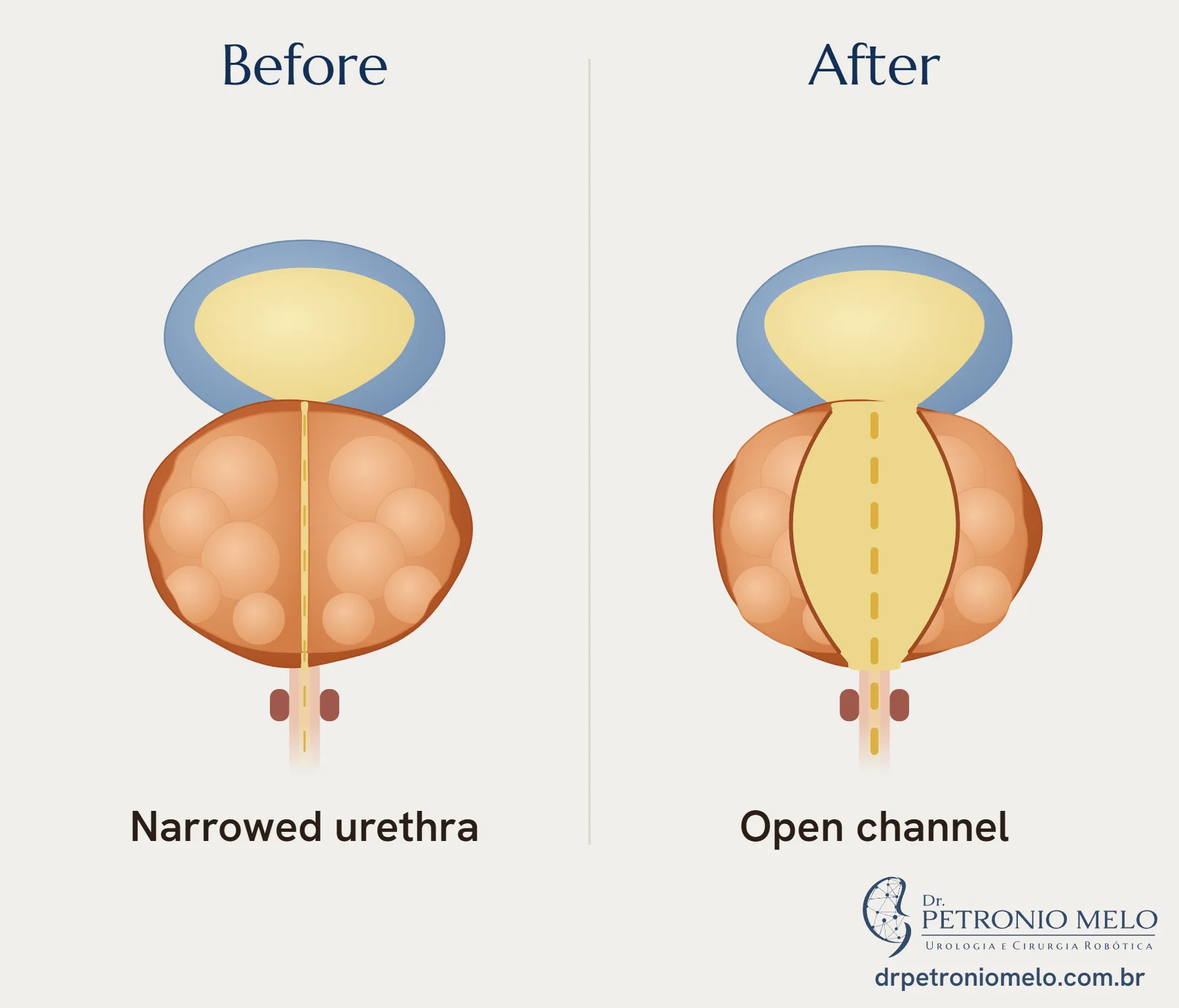
Greenlight is vaporization of the prostate with a green laser. The surgery is done through the urethra, with no cuts in the skin, and turns the tissue that narrows the urinary channel into vapor. The European guideline recommends it as an alternative to TURP in prostates of 30 to 80 g.1 Compared with TURP, it had shorter catheter time and hospital stay and a longer operation.1
How it is done
- AnesthesiaIn my practice, the surgery is done under general anesthesia.
- AccessAn instrument goes in through the urethra, with no cuts in the skin.
- LaserThe fiber fires the green laser sideways, and the tissue turns to vapor little by little, from the inside out.
- BleedingThe same laser helps control bleeding during surgery.
- Catheter and dischargeIn my practice, the catheter and hospital stay are both under 24 hours. In studies with 80 W and 120 W devices, the stay was on average 32 hours shorter than after TURP.1
Unlike HoLEP, which frees the tissue in one piece and removes it, Greenlight removes the tissue by vaporizing it. So the tissue is not broken up and does not go to the lab. The prostate capsule stays in place.
Who it is for
The European guideline strongly recommends Greenlight for men with moderate or severe symptoms and a prostate of 30 to 80 g, as an alternative to TURP.1 In men who take anticoagulants and have a prostate under 80 g, it accepts considering the technique, as a weak recommendation.1
For prostates above 100 g, there are no randomized studies.1 In practice, this has to be assessed case by case. I usually compare it with other options before deciding.
What the studies show
| Source | Patients | Result |
|---|---|---|
| GOLIATH, 2016 | 281 men at 29 centers, against TURP | Equivalent results at 2 years; free of complications in 83.6% versus 78.9%2 |
| Study against HoLEP | Prostates above 60 g | Stronger stream after HoLEP; 22% of Greenlight cases were converted to TURP1 |
| Real-world data | 4-year follow-up | New procedure in 7.8%, versus 7.5% after TURP1 |
Compared with TURP, Greenlight had fewer transfusions, while operating time and repeat surgery favored TURP.1 A long-term Finnish study found a second operation in 23.5% after Greenlight and in 17.8% after TURP.1
Risks
Blood in the urine can appear weeks after surgery. In a series with older 80 W and 120 W devices, this happened in 33.8% of men, over an average follow-up of 33 months.1 Today the standard is the 180 W device.1
Urinary retention, urinary infection and narrowing of the urethra or bladder neck were no different from TURP in these studies.1 We go over each risk before surgery.
Erections and ejaculation
In a review of 151 studies, prostate surgery did not significantly change erection scores.3 Retrograde ejaculation, in which semen goes into the bladder, is very common after Greenlight, and the European guideline found no difference from TURP.1,3
If preserving ejaculation matters to you, you can consider Rezum.
How I approach it
I have performed more than 500 Greenlight operations. In my practice, I look at the size of the prostate, your medications and what you want to preserve before recommending surgery. I compare Greenlight with the other options and explain what may change in urination and sexual life.
When to see a urologist
- If you have an enlarged prostate and medications do not bring enough relief
- If you have had urinary retention
- If you want to compare Greenlight with other techniques
- After surgery, if you have fever, difficulty urinating or blood with clots
Frequently asked questions
What is Greenlight?+
It is surgery done through the urethra, with no cuts in the skin. A fiber fires a green laser sideways and vaporizes the tissue that narrows the urinary channel.1
Is Greenlight better than TURP?+
At 2 years, the results were equivalent to TURP in the GOLIATH study.2 Catheter time and hospital stay were shorter, and the operation was longer.1 The choice depends on your case.
What anesthesia is used, and how long are the catheter and hospital stay?+
In my practice, I use general anesthesia, and the catheter and hospital stay are both under 24 hours.
Is it suitable for any prostate size?+
The European guideline recommends it for prostates of 30 to 80 g. Above 100 g, randomized studies are lacking.1 In practice, this has to be assessed case by case.
Can people on blood thinners have Greenlight?+
The European guideline accepts considering the technique in men who take anticoagulants and have a prostate under 80 g, as a weak recommendation.1
Does ejaculation change after Greenlight?+
It usually does. Retrograde ejaculation, in which semen goes into the bladder, is very common, and the European guideline found no difference from TURP.1
Might I need another operation?+
It can happen. In real-world data, a new procedure was needed within 4 years in 7.8%, close to the 7.5% after TURP. In a long-term Finnish study, a second operation was needed in 23.5% versus 17.8%.1
References
- EAU Guidelines on the Management of Non-neurogenic Male LUTS. European Association of Urology; 2026. Disease management chapter. EAU
- Thomas JA, Tubaro A, Barber N, et al. A Multicenter Randomized Noninferiority Trial Comparing GreenLight-XPS Laser Vaporization of the Prostate and Transurethral Resection of the Prostate for the Treatment of Benign Prostatic Obstruction: Two-yr Outcomes of the GOLIATH Study. Eur Urol. 2016;69(1):94-102. PubMed
- Manfredi C, García-Gómez B, Arcaniolo D, et al. Impact of Surgery for Benign Prostatic Hyperplasia on Sexual Function: A Systematic Review and Meta-analysis of Erectile Function and Ejaculatory Function. Eur Urol Focus. 2022;8(6):1711-1732. PubMed
Would you like to talk about your case?
In the consultation, I go over your tests and your priorities.
Book a consultation