
Quick answer
Robotic simple prostatectomy removes the benign tissue from inside the prostate through small cuts in the abdomen, and the capsule stays in place. It is used for large prostates, usually above 80 g.1 In practice, this has to be assessed case by case. In 27 studies with 764 men, the IPSS, the symptom score, fell by 17.2 points on average.1
How it is done
- AnesthesiaIn my practice, the surgery is done under general anesthesia.
- AccessThe robot's instruments go in through small cuts in the abdomen.
- ApproachThe tissue can be reached through the bladder or through the prostate capsule.1 I usually use the modified Millin technique: I reach the prostate through the Retzius space, between the pubic bone and the bladder, and open the capsule.
- RemovalThe obstructing tissue is separated from the capsule and removed through one of the cuts.
- ReconstructionI suture the bladder neck to the urethra and close the capsule.
- Catheter and dischargeIn my practice, the hospital stay is under 24 hours, and the catheter stays for 5 to 7 days.
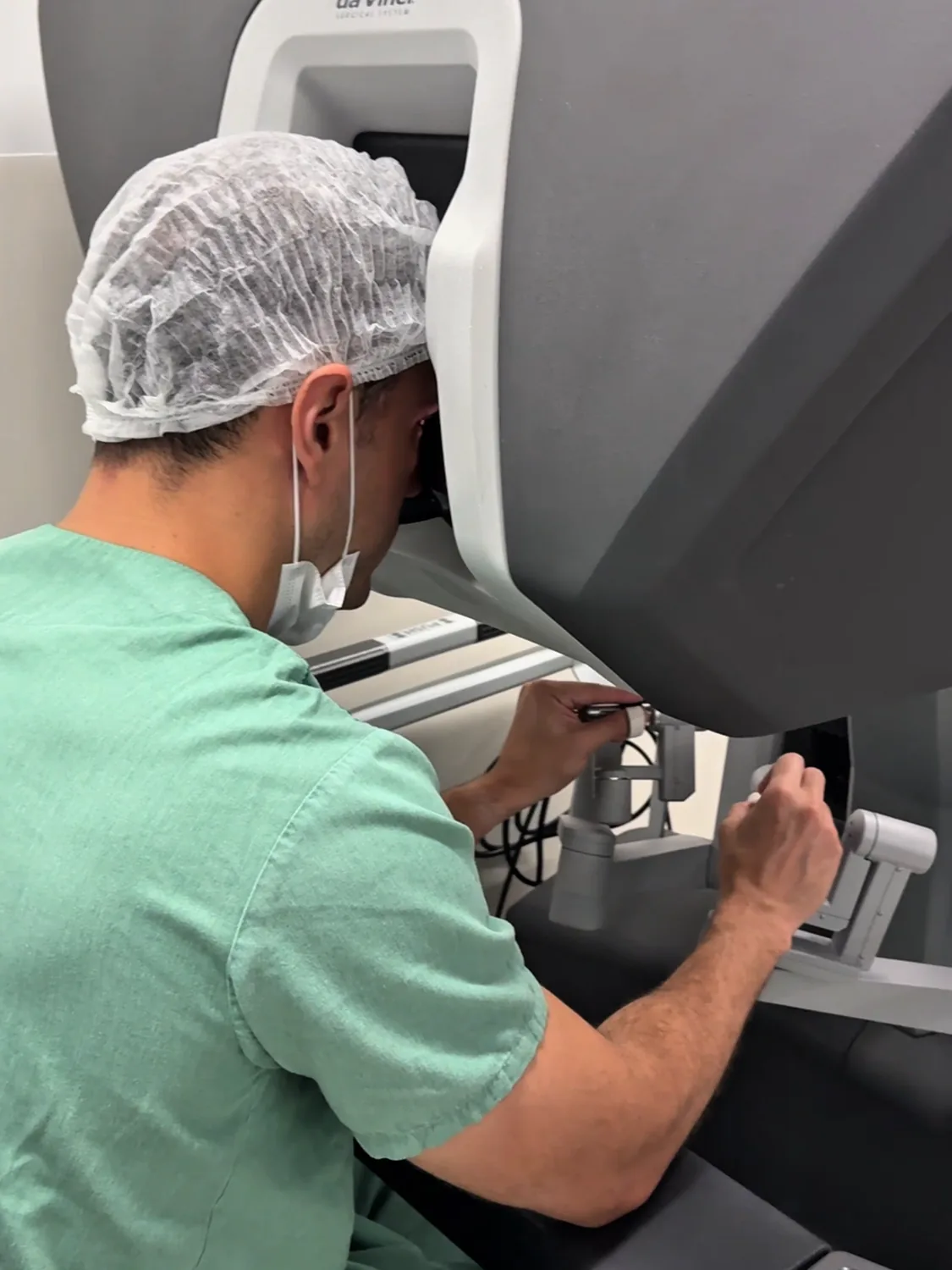
The robot gives a magnified view and wristed instruments, which help with suturing in a small space.
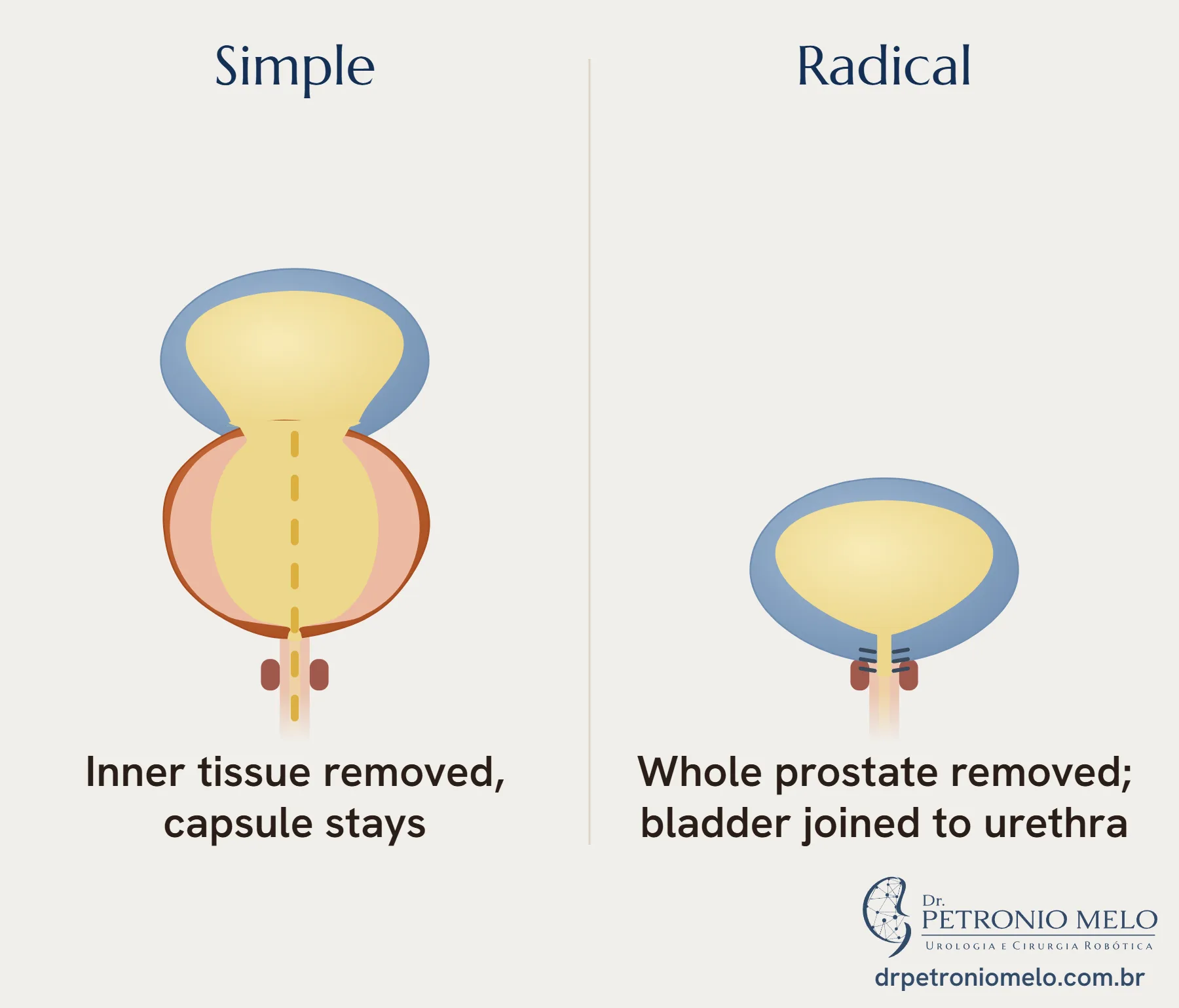
Simple is not radical
The name can be confusing. Simple prostatectomy treats a benign prostate and removes only the tissue inside it. Radical prostatectomy treats cancer and removes the whole prostate.
Who it is for
Open surgery is the traditional option for prostates above 80 to 100 g.1 The robotic or laparoscopic approach is feasible above 80 g, and the European guideline calls for randomized studies.1 In practice, this has to be assessed case by case.
In a series of prostates over 200 g, robotic surgery and HoLEP did not differ in complications.1 The choice between the two depends on your anatomy, any previous bladder surgery and your general health.
What the studies show
| Source | Patients | Result |
|---|---|---|
| European guideline | 27 studies, 764 men | Stream 14.3 mL/s stronger and IPSS 17.2 points lower1 |
| Autorino, 2015 | 1,330 cases, 487 robotic | Median prostate of 100 g; blood loss of 200 mL; hospital stay of 4 days2 |
| Fuschi, 2021 | Prostates of 120 g or more, against HoLEP | No functional difference; longer hospital stay and fewer new irritative symptoms3 |
Compared with open surgery, the minimally invasive approach had a shorter hospital stay, less bleeding and fewer transfusions, and a longer operation.1 Compared with laser enucleation, it came out behind in operating time, catheter time, hospital stay, bleeding and transfusion.1 One review pooled 6,659 men.4
Risks
In the series of 1,330 cases, complications occurred in 10.6%, and transfusion in 3.5%.2 In 4% of cases, examination of the tissue found cancer.2
Erections and ejaculation
Retrograde ejaculation, in which semen goes into the bladder, is very common after operations for an enlarged prostate, and erections, after most of them, do not seem to change.5 See what changes with each technique in ejaculation and erections.
How I approach it
I have performed more than 1,500 robotic and laparoscopic operations, more than 500 of them robotic. In my practice, I look at the size of the prostate, your other conditions and what you want to preserve before recommending surgery. I compare robotic surgery with HoLEP and explain what may change in urination and sexual life.
When to see a urologist
- If you have a large prostate and medications do not bring enough relief
- If you have had urinary retention or use a catheter
- If you want to compare robotic surgery with other techniques
- After surgery, if you have fever, severe pain or blood with clots
Frequently asked questions
What is robotic simple prostatectomy?+
It is an operation that uses the robot to remove the benign tissue from inside the prostate. The capsule stays in place.1
What is the difference between simple and radical prostatectomy?+
Simple prostatectomy removes the benign tissue that blocks urine. Radical prostatectomy removes the whole prostate and is done for cancer.
Who is it for?+
The European guideline describes it as a feasible option for prostates above 80 g, while noting that randomized studies are still needed.1 In practice, this has to be assessed case by case.
How long is the hospital stay?+
In my practice, the stay is under 24 hours, and the catheter stays for 5 to 7 days. In a multicenter series of 1,330 cases, the median stay was 4 days.2
How do you perform the operation?+
I usually use the modified Millin technique, under general anesthesia. I reach the prostate through the Retzius space, open the capsule, remove the obstructing tissue and suture the bladder neck to the urethra.
Will I need a transfusion?+
You might. In the same series, 3.5% needed a transfusion.2
References
- EAU Guidelines on the Management of Non-neurogenic Male LUTS. European Association of Urology; 2026. Disease management chapter. EAU
- Autorino R, Zargar H, Mariano MB, et al. Perioperative Outcomes of Robotic and Laparoscopic Simple Prostatectomy: A European-American Multi-institutional Analysis. Eur Urol. 2015;68(1):86-94. PubMed
- Fuschi A, Al Salhi Y, Velotti G, et al. Holmium laser enucleation of prostate versus minimally invasive simple prostatectomy for large volume (≥120 mL) prostate glands: a prospective multicenter randomized study. Minerva Urol Nephrol. 2021;73(5):638-648. PubMed
- Pandolfo SD, Del Giudice F, Chung BI, et al. Robotic assisted simple prostatectomy versus other treatment modalities for large benign prostatic hyperplasia: a systematic review and meta-analysis of over 6500 cases. Prostate Cancer Prostatic Dis. 2023;26(3):495-510. PubMed
- Manfredi C, García-Gómez B, Arcaniolo D, et al. Impact of Surgery for Benign Prostatic Hyperplasia on Sexual Function: A Systematic Review and Meta-analysis of Erectile Function and Ejaculatory Function. Eur Urol Focus. 2022;8(6):1711-1732. PubMed
Would you like to talk about your case?
In the consultation, I go over your tests and your priorities.
Book a consultation