
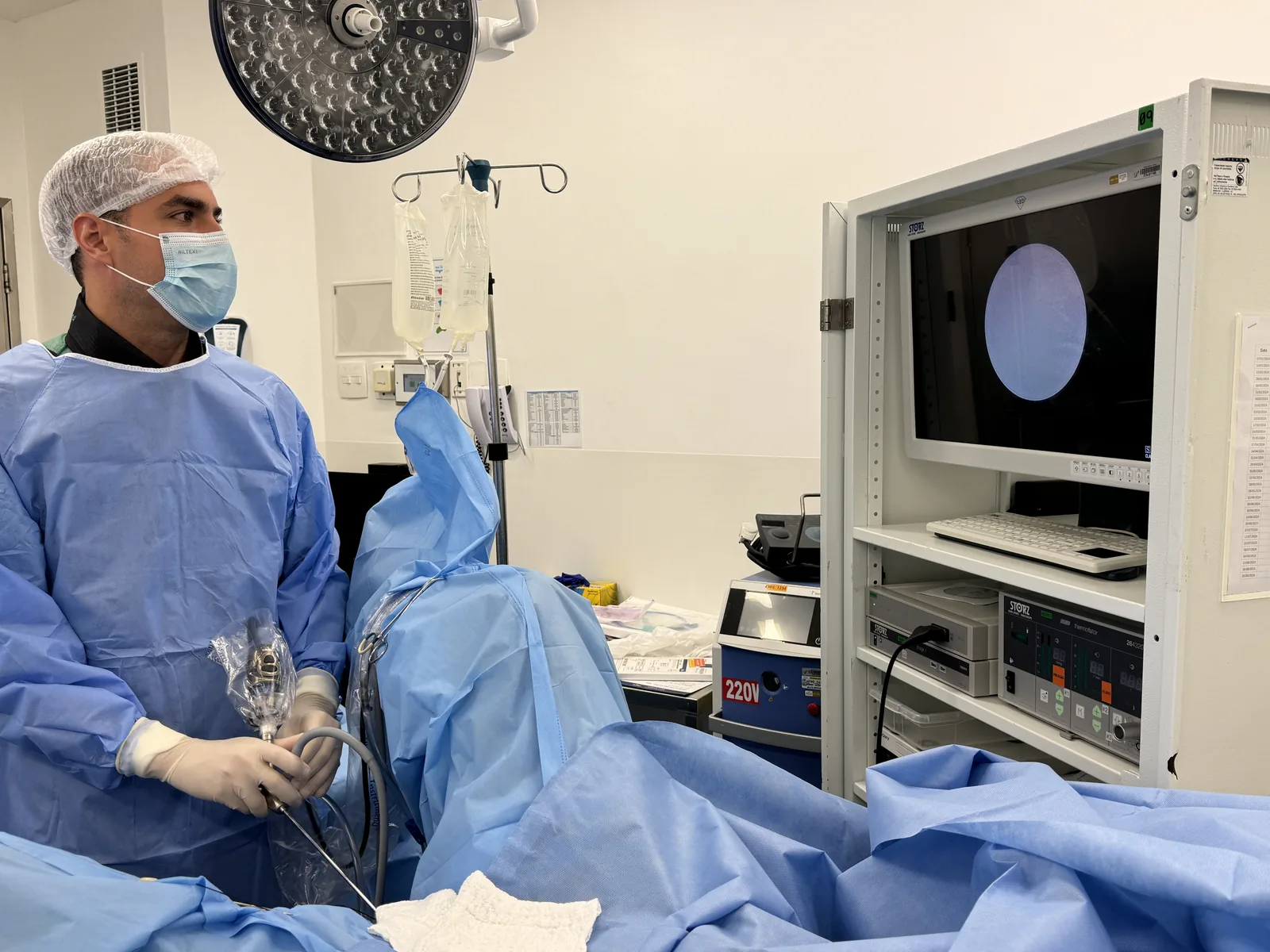
Quick answer
Cystoscopy is the test that looks inside the urethra and bladder, with a thin scope and a camera. It is used to investigate blood in the urine, to diagnose and follow bladder tumors and to evaluate other urinary complaints. In my practice, it is done with local anesthesia and sedation, usually with a rigid scope, in hospital.
How the test is done
The scope goes in through the urethra, saline fills the bladder and the camera shows the whole wall. If there is a lesion, pathology confirms the diagnosis after a biopsy or a TURBT.1
What it is for
- Investigating blood in the urine
- Diagnosing bladder cancer. The diagnosis of the tumor depends on cystoscopy and on analysis of the tissue1
- Following people who have already been treated for a bladder tumor
- Evaluating repeated infections, narrowing of the urethra and other complaints, when indicated
According to the European guideline, no test available today replaces cystoscopy. Cytology and urine markers can complement it.1
Rigid or flexible
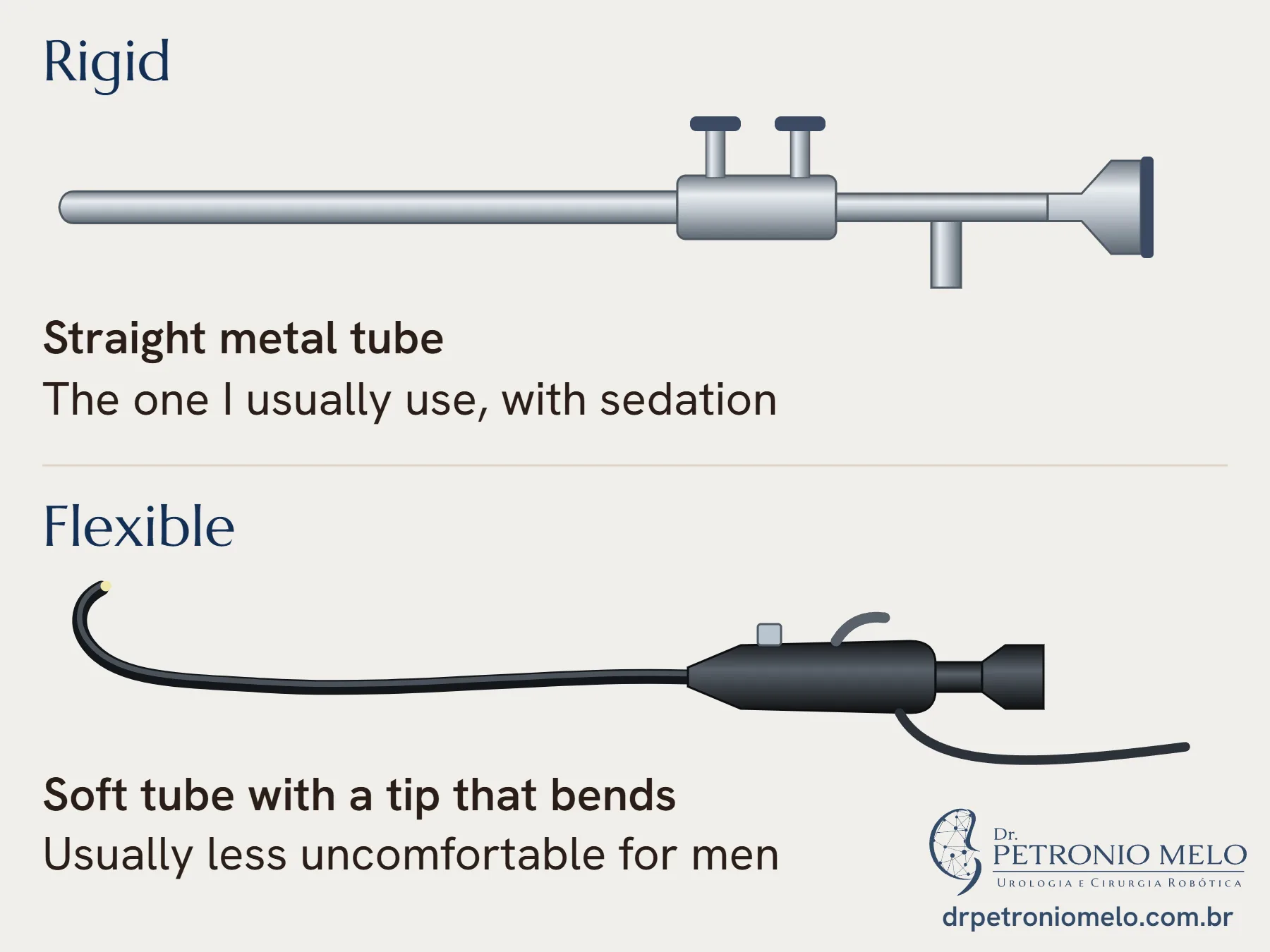
Cystoscopy can be done in the office. A flexible scope with anesthetic gel is better tolerated than a rigid one, especially in men, and the European guideline recommends the flexible scope when available.1 In men, squeezing the saline bag while passing the part of the urethra closest to the bladder reduces pain.1
Preparation and risks
Two 2015 reviews did not recommend routine antibiotics for people whose urine shows no infection. One of them found less infection with the medicine, but many patients would need to take it to prevent one case.2,3 In a study of flexible cystoscopy without antibiotics, 1.9% of patients had an infection with fever.4
After the test, some burning and pink urine may occur for a short time.
How I approach it
In my practice, cystoscopy is done with local anesthesia and sedation, usually with a rigid scope, in hospital. The flexible scope is also an option, which I assess with the patient. After the test, I explain the next step, and your family takes part if you wish.
When to see a urologist
- If blood appears in your urine
- If you are being followed for a bladder tumor
- After the test, if you have a fever, severe pain or difficulty urinating
Frequently asked questions
Does cystoscopy hurt?+
In my practice, it is done with local anesthesia and sedation, usually with a rigid scope, in hospital. Without sedation, a flexible scope with anesthetic gel is better tolerated, especially in men.1
What is cystoscopy for?+
To look inside the urethra and bladder. It is needed to diagnose bladder cancer and for follow-up after treatment.1
Can any test replace cystoscopy?+
According to the European guideline, no test available today replaces cystoscopy. Cytology and markers can complement it.1
Do I need antibiotics?+
Two 2015 reviews did not recommend routine antibiotics for people whose urine shows no infection.2,3 The decision depends on the patient and the urine test.
What is normal after the test?+
Some burning when urinating and pink urine are common for a short time. In a study without antibiotics, 1.9% of patients had an infection with fever.4 Fever, severe pain or difficulty urinating call for contacting your urologist.
References
- EAU Guidelines on Non-muscle-invasive Bladder Cancer. European Association of Urology; 2026. Diagnosis chapter. EAU
- Carey MM, Zreik A, Fenn NJ, et al. Should We Use Antibiotic Prophylaxis for Flexible Cystoscopy? A Systematic Review and Meta-Analysis. Urol Int. 2015;95(3):249-59. PubMed
- Garcia-Perdomo HA, Jimenez-Mejias E, Lopez-Ramos H. Efficacy of antibiotic prophylaxis in cystoscopy to prevent urinary tract infection: a systematic review and meta-analysis. Int Braz J Urol. 2015;41(3):412-24. PubMed
- Herr HW. The risk of urinary tract infection after flexible cystoscopy in patients with bladder tumor who did not receive prophylactic antibiotics. J Urol. 2015;193(2):548-51. PubMed
- Aaronson DS, Walsh TJ, Smith JF, et al. Meta-analysis: does lidocaine gel before flexible cystoscopy provide pain relief? BJU Int. 2009;104(4):506-9. PubMed
- Patel AR, Jones JS, Babineau D. Lidocaine 2% gel versus plain lubricating gel for pain reduction during flexible cystoscopy: a meta-analysis of prospective, randomized, controlled trials. J Urol. 2008;179(3):986-90. PubMed
Would you like to talk about your case?
In the consultation, I go over your tests and your priorities.
Book a consultation