
Quick answer
Radical cystectomy removes the bladder and the lymph nodes of the pelvis. It is the standard treatment for bladder cancer that invades the muscle. In men, the prostate is removed with it. The surgeon then rebuilds the path for urine, with an ileal conduit (Bricker) or a neobladder. In my practice, I do a Bricker most of the time, and the choice is made case by case with the patient. The hospital stay is one week on average.
When it is recommended
Radical cystectomy with removal of the lymph nodes is the standard treatment for cancer that invades the muscle, often after chemotherapy, with or without immunotherapy, when the patient can receive it.1 It may also be recommended for tumors that do not invade the muscle but carry a very high risk or do not respond to BCG.9
The guideline asks that patients know the benefits and risks of all the alternatives before deciding.1
How the operation is done
In women, the classic operation also removes the urethra, the uterus and the part of the vagina next to the bladder. In selected cases, pelvic organs can be preserved.1
Bricker or neobladder
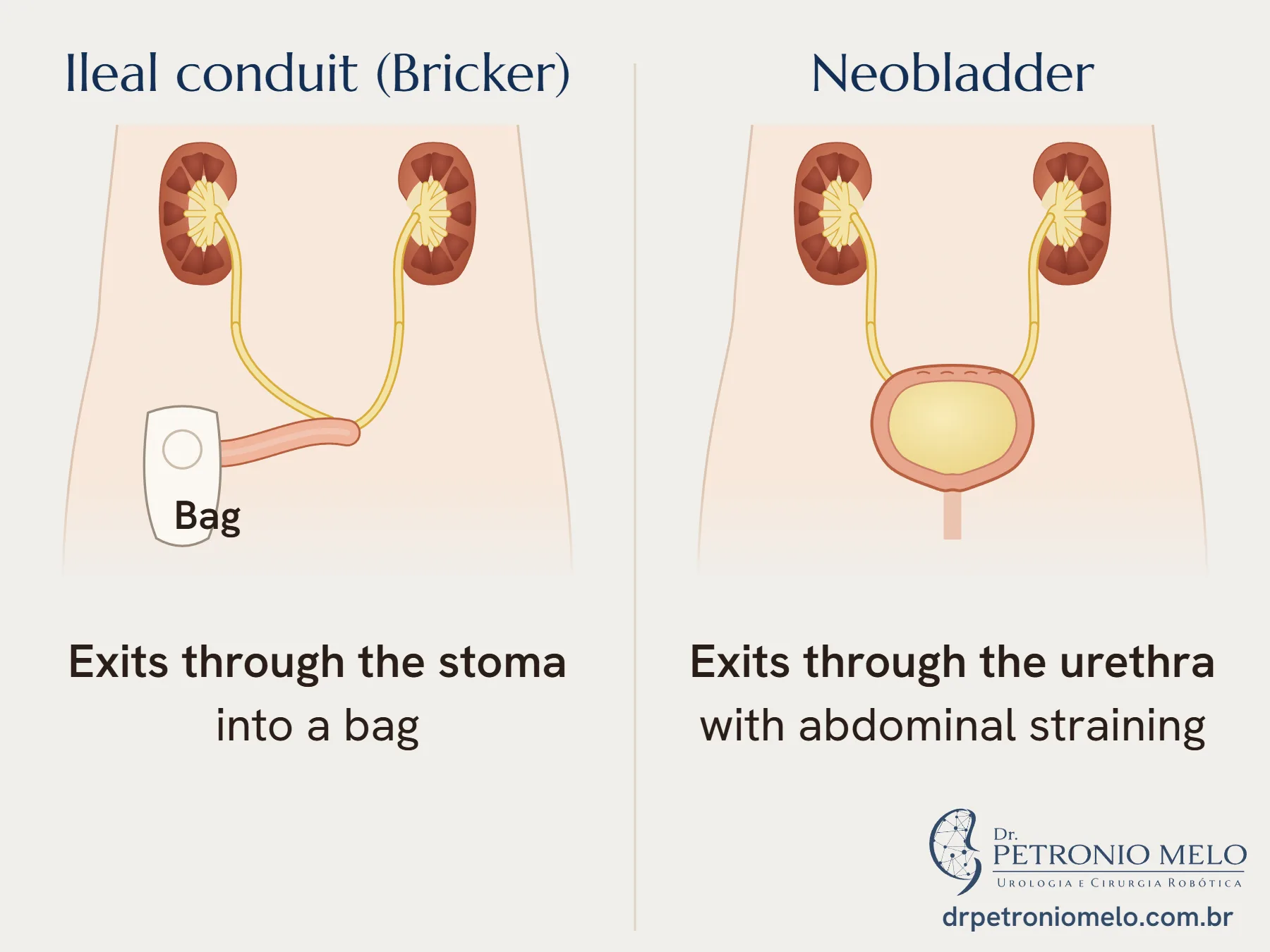
With an ileal conduit, a piece of bowel carries urine from the ureters to an opening in the skin, the stoma. Urine goes into a bag.
With a neobladder, the bowel becomes a reservoir connected to the urethra. It is used in 10% to 20% of patients in the registries cited by the guideline, and emptying it takes abdominal straining.1 In men, daytime continence reached 92%, and nighttime continence 51%.7 In women, about two thirds need to pass a catheter to empty it.7
No randomized study has compared the two, and reviews do not show one to be better for quality of life.1,5,6 The choice takes into account other illnesses, heart, lung and memory function, support at home and the patient's preference.1
Robotic or open
In the RAZOR study, two-year progression-free survival was 72.3% with the robot and 71.6% with open surgery. Adverse events occurred in 67% and 69%.2 In the iROC study, patients operated on with the robot spent 82 days alive and out of hospital in the 90 days after surgery, against 80 with open surgery. Thrombosis and wound complications were less frequent with the robot.3 A review of randomized studies found similar time to recurrence and similar serious complications, with low-certainty evidence.8
The European guideline considers the surgeon's experience and the center's volume to be the main factors, more than the technique.1
Risks
This is major surgery. In a series of 1,142 patients, 64% had some complication within 90 days, and 13% had grade 3 to 5 complications. Thirty-day mortality was 1.5%.4 Readmission within 30 days happens in about 25%.1
How I approach it
In my practice, I do an ileal conduit (Bricker) most of the time, but the choice is made case by case with the patient. The hospital stay is one week on average. Before surgery, I explain the reconstruction options and what changes in daily life with each one. The decision is made together with you, and your family takes part if you wish.
When to see a urologist
- If TURBT shows cancer that invades the muscle
- If the tumor comes back despite treatment inside the bladder
- If you want to discuss the types of reconstruction before surgery
Frequently asked questions
What is a cystectomy?+
It is the operation that removes the bladder. In cancer that invades the muscle, radical cystectomy is the standard treatment and includes removing the lymph nodes of the pelvis.1
Where does urine go after surgery?+
It depends on the reconstruction. With an ileal conduit, or Bricker, urine comes out through an opening in the skin into a bag. With a neobladder, a reservoir made from bowel is connected to the urethra.1
Which is better, Bricker or neobladder?+
No randomized study has compared the two. Reviews do not show one to be better for quality of life.5,6 The choice takes into account other illnesses, the patient's condition and their preference.1
How long will I stay in hospital?+
In my practice, one week on average.
References
- EAU Guidelines on Muscle-invasive and Metastatic Bladder Cancer. European Association of Urology; 2026. Disease management chapter. EAU
- Parekh DJ, Reis IM, Castle EP, et al. Robot-assisted radical cystectomy versus open radical cystectomy in patients with bladder cancer (RAZOR): an open-label, randomised, phase 3, non-inferiority trial. Lancet. 2018;391(10139):2525-2536. PubMed
- Catto JWF, Khetrapal P, Ricciardi F, et al. Effect of Robot-Assisted Radical Cystectomy With Intracorporeal Urinary Diversion vs Open Radical Cystectomy on 90-Day Morbidity and Mortality Among Patients With Bladder Cancer. JAMA. 2022;327(21):2092-2103. PubMed
- Shabsigh A, Korets R, Vora KC, et al. Defining early morbidity of radical cystectomy for patients with bladder cancer using a standardized reporting methodology. Eur Urol. 2009;55(1):164-74. PubMed
- Nuijens ST, Cobussen-Boekhorst H, Heesakkers JPFA, et al. Patient-reported outcomes and health-related quality of life after urinary diversions. Curr Opin Urol. 2021;31(6):574-579. PubMed
- Xing W, Zeng S, Xu Z, et al. Comparison of Health-Related Quality of Life Between Ileal Conduit Diversion and Orthotopic Neobladder in Women: A Meta-Analysis. Front Oncol. 2022;12:862884. PubMed
- EAU Guidelines on Muscle-invasive and Metastatic Bladder Cancer. European Association of Urology; 2026. Follow-up chapter. EAU
- Rai BP, Bondad J, Vasdev N, et al. Robot-assisted vs open radical cystectomy for bladder cancer in adults. BJU Int. 2020;125(6):765-779. PubMed
- EAU Guidelines on Non-muscle-invasive Bladder Cancer. European Association of Urology; 2026. Disease management chapter. EAU
Would you like to talk about your case?
In the consultation, I go over your tests and your priorities.
Book a consultation