
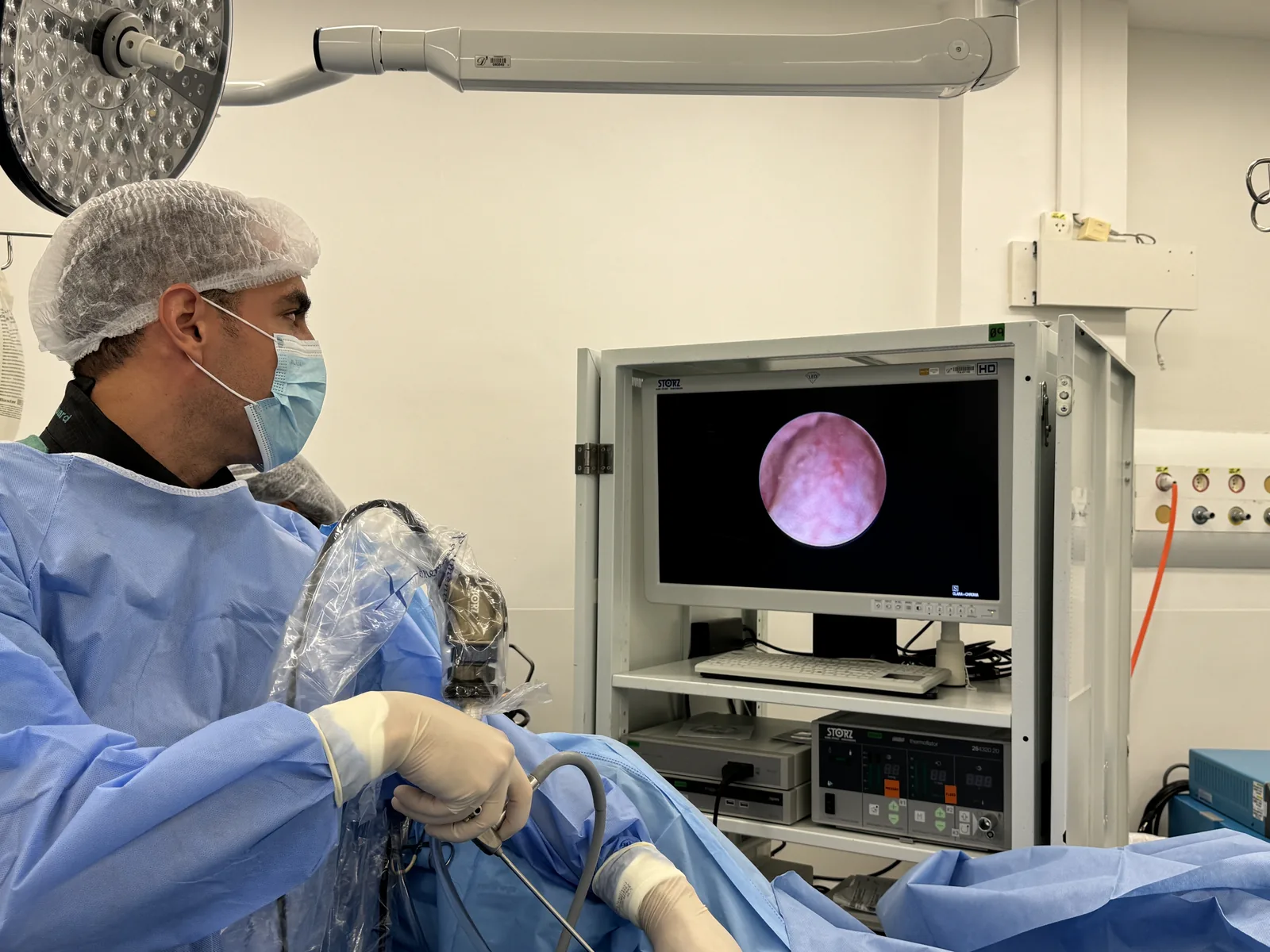
Quick answer
TURBT removes a bladder tumor through the urethra, without cuts in the skin. It has two goals: to remove all the visible tumor and to provide tissue so the pathologist can define the stage. In my practice, it is done under general anesthesia. The catheter stays until the urine clears, with continuous irrigation, and the hospital stay is usually 1 to 2 days.
What TURBT is
TURBT stands for transurethral resection of bladder tumor. It is the first step in treating most bladder tumors, because it makes the diagnosis, defines the stage and removes the visible tumor.1 The pathology result defines the next step.
How the operation is done
- Look at the whole bladderThe scope goes in through the urethra, and the surgeon examines the wall and finds the tumors.
- Remove the tumorAn energized loop removes the tumor, in pieces or in a single piece. Single-piece removal is feasible for tumors up to 3 cm.1
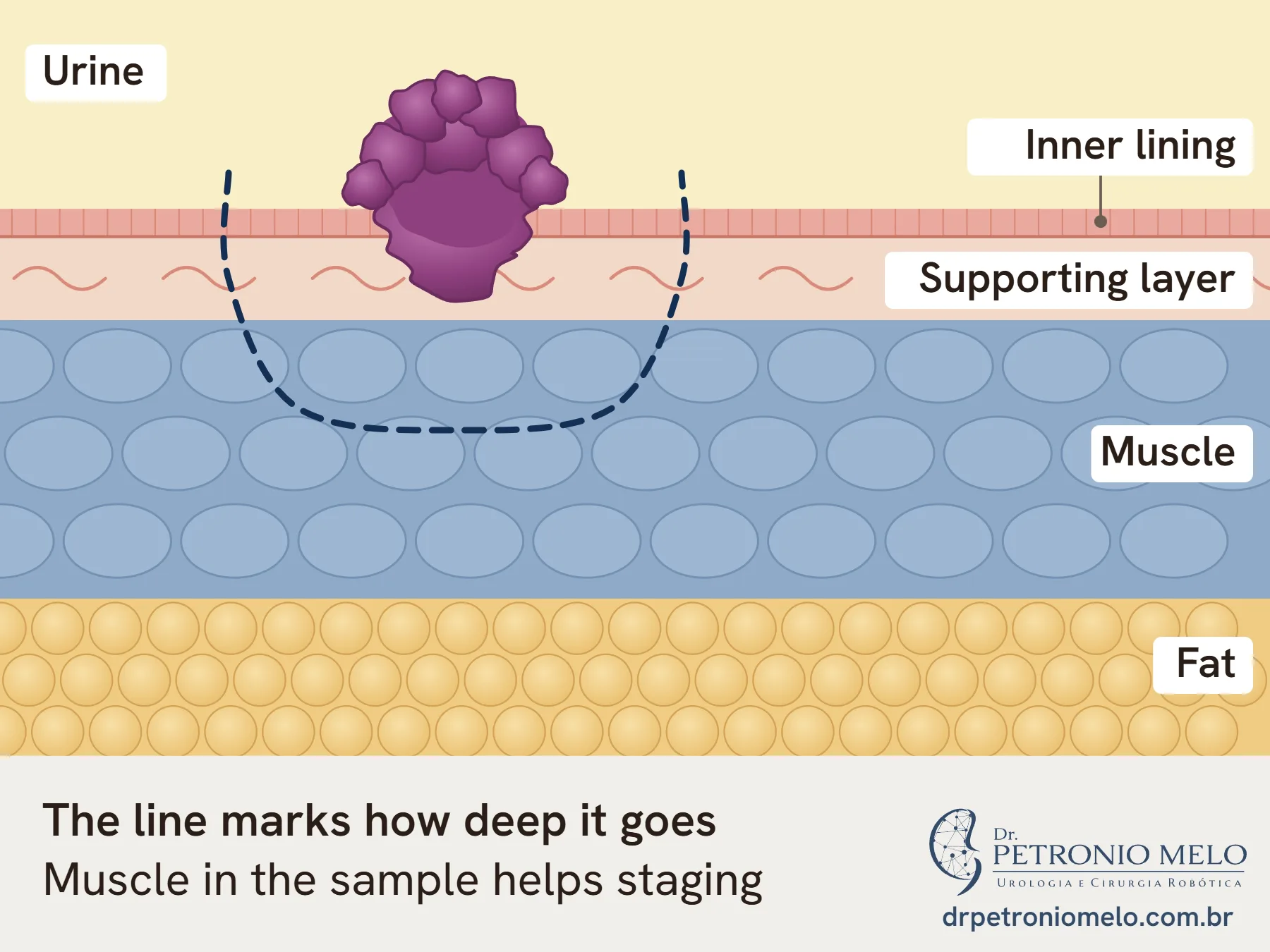
- Sample the muscleWhenever possible, the sample includes the muscle layer, except in low-grade tumors.1
- Control bleedingThe surgeon seals the bleeding points, and the pieces come out through the scope for pathology.
In a 2025 review, single-piece removal had less perforation and more muscle in the sample, with no difference in tumor recurrence at 12 and 24 months.4 Blue light, when available, can find lesions that ordinary light does not show. It reduces recurrence, with no difference in progression.2
Why the sample needs muscle
Cancer that invades the muscle is treated differently. Without muscle in the sample, the risk of remaining disease and of an underestimated stage is higher.1
Catheter and irrigation
After surgery, a catheter stays in the bladder. With continuous irrigation, saline goes in through one channel of the catheter and comes out through another, with the urine, until the color clears.
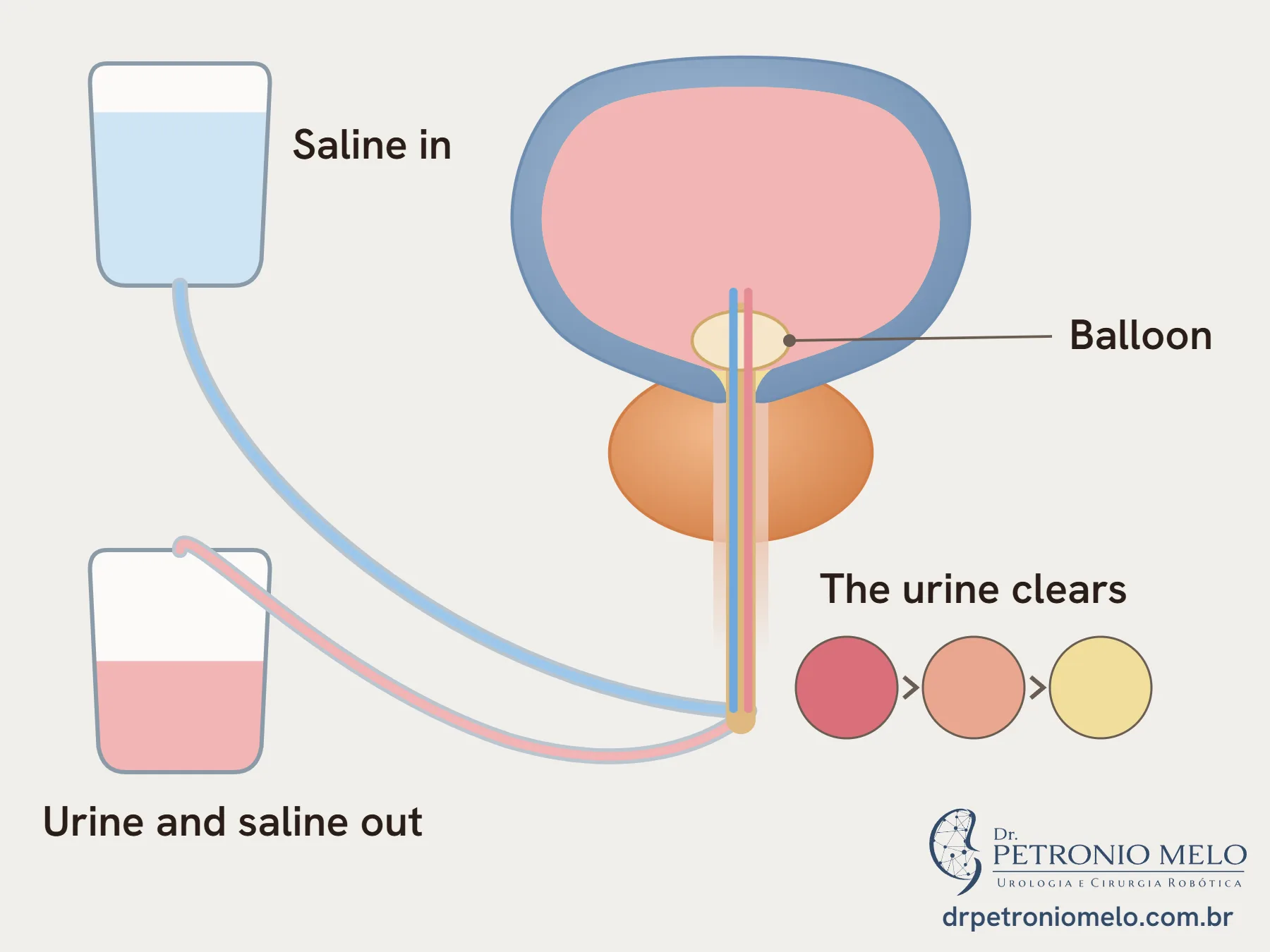
The European guideline cites reviews suggesting that continuous saline irrigation helps prevent early recurrence.2
Second TURBT
A new TURBT, two to six weeks later, is recommended for T1 tumors, when the first was incomplete or when no muscle came in the sample, with exceptions.2 After a first TURBT for a T1 tumor, the guideline cites remaining disease in 51% of cases and an underestimated stage in 8%.2
Risks
In a series of 2,821 patients, complications occurred in 5.1% of cases: bleeding in 2.8% and bladder perforation in 1.3%. Transfusion was needed in 3.4%.3
How I approach it
In my practice, TURBT is done under general anesthesia. The catheter stays until the urine clears, with continuous bladder irrigation, and is removed before discharge. The hospital stay is usually 1 to 2 days. I explain the pathology result calmly, because the next step comes from it. On the second resection, I published a literature review in 2017 with the results from one center.
When to see a urologist
- If blood appears in your urine
- If a test shows a lesion in the bladder
- After surgery, if you cannot urinate, if clots appear or if you have a fever
Frequently asked questions
What is TURBT?+
It stands for transurethral resection of bladder tumor. A scope goes in through the urethra, and an energized loop removes the tumor, without cuts in the skin.1
How long will I stay in hospital after TURBT?+
In my practice, usually 1 to 2 days. The catheter stays until the urine clears, with continuous bladder irrigation, and is removed before discharge.
Does TURBT cure the cancer?+
It removes the visible tumor and provides the tissue to define the stage.1 The next treatment depends on that result. Tumors that do not invade the muscle can come back, which is why there is follow-up with cystoscopy.2
Why is a second TURBT sometimes needed?+
For T1 tumors, or when the first was incomplete or had no muscle in the sample. After a first TURBT for a T1 tumor, the European guideline cites remaining disease in 51% of cases and an underestimated stage in 8%.2
Is it normal to have blood in the urine after TURBT?+
Urine may look pink for a few days after surgery. If bleeding increases, if clots appear or if you cannot urinate, contact your urologist.
References
- EAU Guidelines on Non-muscle-invasive Bladder Cancer. European Association of Urology; 2026. Diagnosis chapter. EAU
- EAU Guidelines on Non-muscle-invasive Bladder Cancer. European Association of Urology; 2026. Disease management chapter. EAU
- Collado A, Chéchile GE, Salvador J, et al. Early complications of endoscopic treatment for superficial bladder tumors. J Urol. 2000;164(5):1529-32. PubMed
- Basile G, Uleri A, Leni R, et al. En Bloc Versus Conventional Transurethral Resection of Bladder Tumors: A Systematic Review and Meta-analysis of Oncological, Histopathological, and Surgical Outcomes. Eur Urol Oncol. 2025;8(2):520-533. PubMed
Would you like to talk about your case?
In the consultation, I go over your tests and your priorities.
Book a consultation