
Quick answer
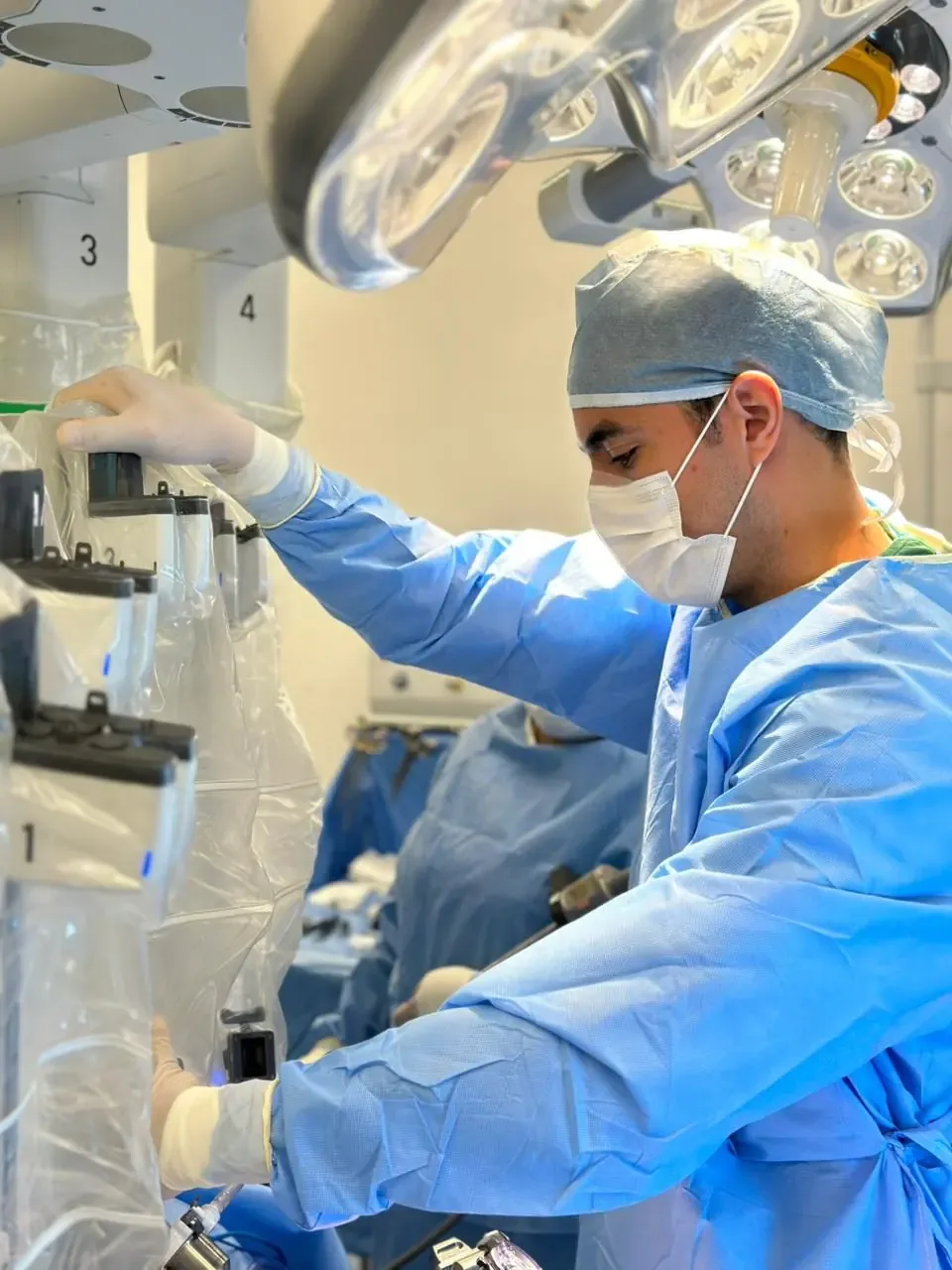
Partial nephrectomy removes the tumor with a margin of healthy tissue and preserves the rest of the kidney. The European guideline recommends it as the treatment of choice for tumors up to 7 cm, whenever feasible. It can be done by open, laparoscopic or robotic surgery. In my practice, with the robot, the hospital stay is under 24 hours, the catheter comes out before discharge and most cases do not use a drain.
Why preserve the kidney
For T1 tumors, the cancer results of partial surgery are comparable to those of removing the whole kidney, and the partial operation better preserves kidney function.1 That is why it is the treatment of choice in these cases.1
For T2 tumors, larger than 7 cm, it can be considered in people with a single kidney, tumors in both kidneys or chronic kidney disease, if feasible.1
How the operation is done
- Find the tumorThe instruments go in through small cuts, and the surgeon frees the kidney and finds the tumor.
- Control the flow, when neededThe flow in the artery can be paused for a short time. In one review, techniques with and without the pause showed no relevant differences.3
- Remove the tumorThe tumor comes out with a margin of healthy tissue and goes to pathology.
- Close the areaThe tumor bed is sutured, and blood returns to the kidney.
The position of the tumor matters
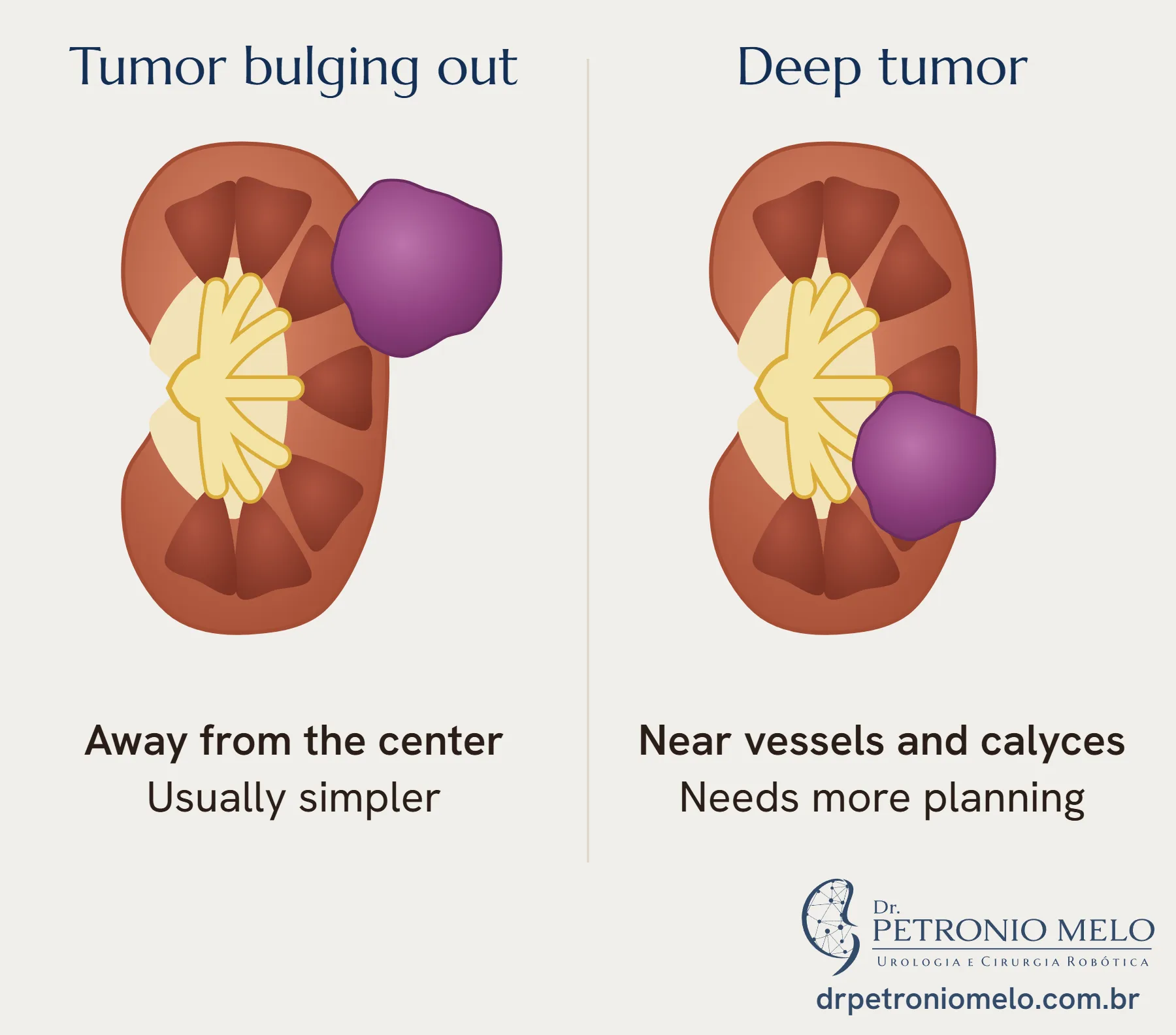
Size is only part of the assessment. A tumor that grows outward from the kidney is usually simpler to remove than a deep tumor, close to the blood vessels and to the calyces, which collect urine.
Open, laparoscopic or robotic
The European guideline says the choice depends on the surgeon's experience.1 The comparisons show the following:
- A review of 34 studies and 60,808 patients found less bleeding, fewer transfusions, fewer complications and a shorter stay with the robotic approach. The operation took longer.2
- A prospective multicenter study found fewer complications with the robotic and laparoscopic approaches than with open surgery, with no difference in margins.6
- The randomized OpeRa study showed no difference in 30-day complications, 37% against 46%, and was stopped early.1
Risks
The risks include bleeding and urine leaking from the suture site. In one series, urine leakage occurred in 3% of cases, with a higher risk for tumors close to the calyces.5
A positive margin, when there are tumor cells at the edge of the specimen, occurs in about 2% to 8% of operations for T1 tumors.1 Not every such case has remaining disease: local recurrence was 16% with a positive margin and 3% with a negative margin.1
Recovery
In a review of 1,890 robotic kidney operations, not leaving a drain shortened the hospital stay without increasing complications, bleeding or urine leakage.4
How I approach it
In my practice, the hospital stay is under 24 hours, the catheter is removed before discharge and most cases do not need a drain. Before surgery, I go over the images with you, the position of the tumor and what to expect. If partial surgery is not the safest path, I explain why. The decision is made together with you, and your family takes part if you wish.
When to see a urologist
- If a test shows a solid kidney mass
- If surgery has already been recommended and you want to assess preserving the kidney
- If you have a single kidney, chronic kidney disease or tumors in both kidneys
Frequently asked questions
What is a partial nephrectomy?+
It is the operation that removes the tumor with a margin of healthy tissue and leaves the rest of the kidney. The European guideline recommends it as the treatment of choice for T1 tumors, up to 7 cm, because it better preserves kidney function.1
How long will I stay in hospital?+
In my practice, the stay is under 24 hours. The catheter is removed before discharge, and most cases do not need a drain.
Is robotic surgery better than open surgery?+
The European guideline says the operation can be open, laparoscopic or robotic, depending on the surgeon's experience.1 In one review, the robotic approach had less bleeding, fewer complications and a shorter stay, with a longer operation.2 The randomized OpeRa study showed no difference in 30-day complications.1
Does the blood flow to the kidney always have to be paused?+
No. In one review, techniques with and without pausing the flow showed no relevant differences in results.3 The choice depends on the tumor and the operation.
Is partial surgery always possible?+
Not always. The size and position of the tumor may require removing the whole kidney. This is assessed with the images before surgery.1
References
- EAU Guidelines on Renal Cell Carcinoma. European Association of Urology; 2026. Disease management chapter. EAU
- Tsai SH, Tseng PT, Sherer BA, et al. Open versus robotic partial nephrectomy: Systematic review and meta-analysis of contemporary studies. Int J Med Robot. 2019;15(1):e1963. PubMed
- Shrivastava N, Sharma G, Ahluwalia P, et al. Off-clamp Versus On-clamp Robot-assisted Partial Nephrectomy: A Systematic Review and Quantitative Synthesis by the European Association of Urology Young Academic Urologists Renal Cancer Study Group. Eur Urol Open Sci. 2023;58:10-18. PubMed
- Territo A, Baboudjian M, Diana P, et al. To drain or not to drain in uro-oncological robotic surgery? A systematic review and meta-analysis. Minerva Urol Nephrol. 2023;75(2):144-153. PubMed
- Zargar H, Khalifeh A, Autorino R, et al. Urine leak in minimally invasive partial nephrectomy: analysis of risk factors and role of intraoperative ureteral catheterization. Int Braz J Urol. 2014;40(6):763-71. PubMed
- Bravi CA, Larcher A, Capitanio U, et al. Perioperative Outcomes of Open, Laparoscopic, and Robotic Partial Nephrectomy: A Prospective Multicenter Observational Study (The RECORd 2 Project). Eur Urol Focus. 2021;7(2):390-396. PubMed
Would you like to talk about your case?
In the consultation, I go over your tests and your priorities.
Book a consultation