

Quick answer
After prostatectomy, erections may be weaker at first, and the vast majority of patients improve. The time varies, and recovery can take years.5 Ejaculation stops, because the prostate and seminal vesicles are removed.4,5 Orgasm continues in most men, usually with some change.11 For erections, there are several treatment options, which we assess together.8
Why erections change
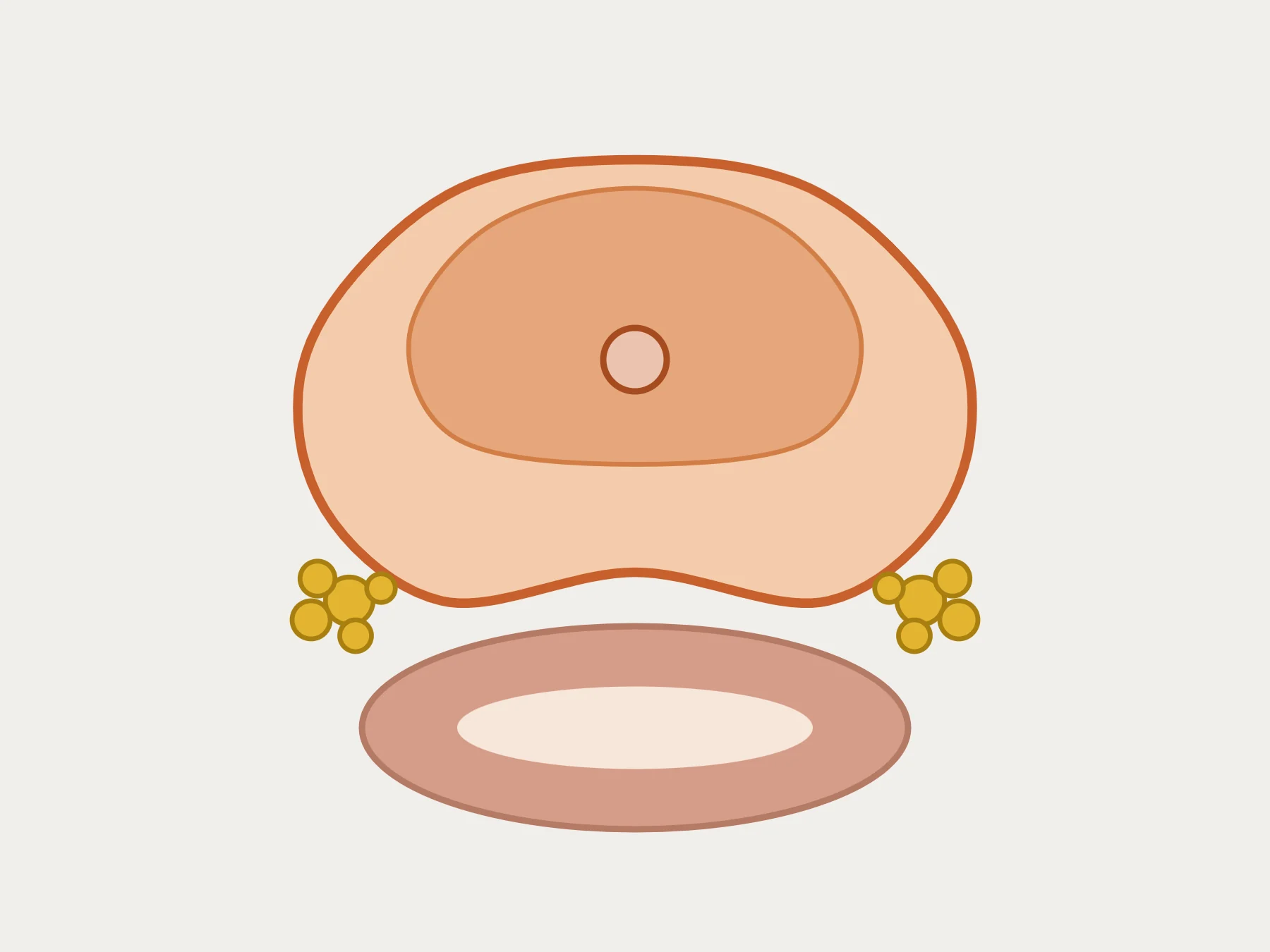
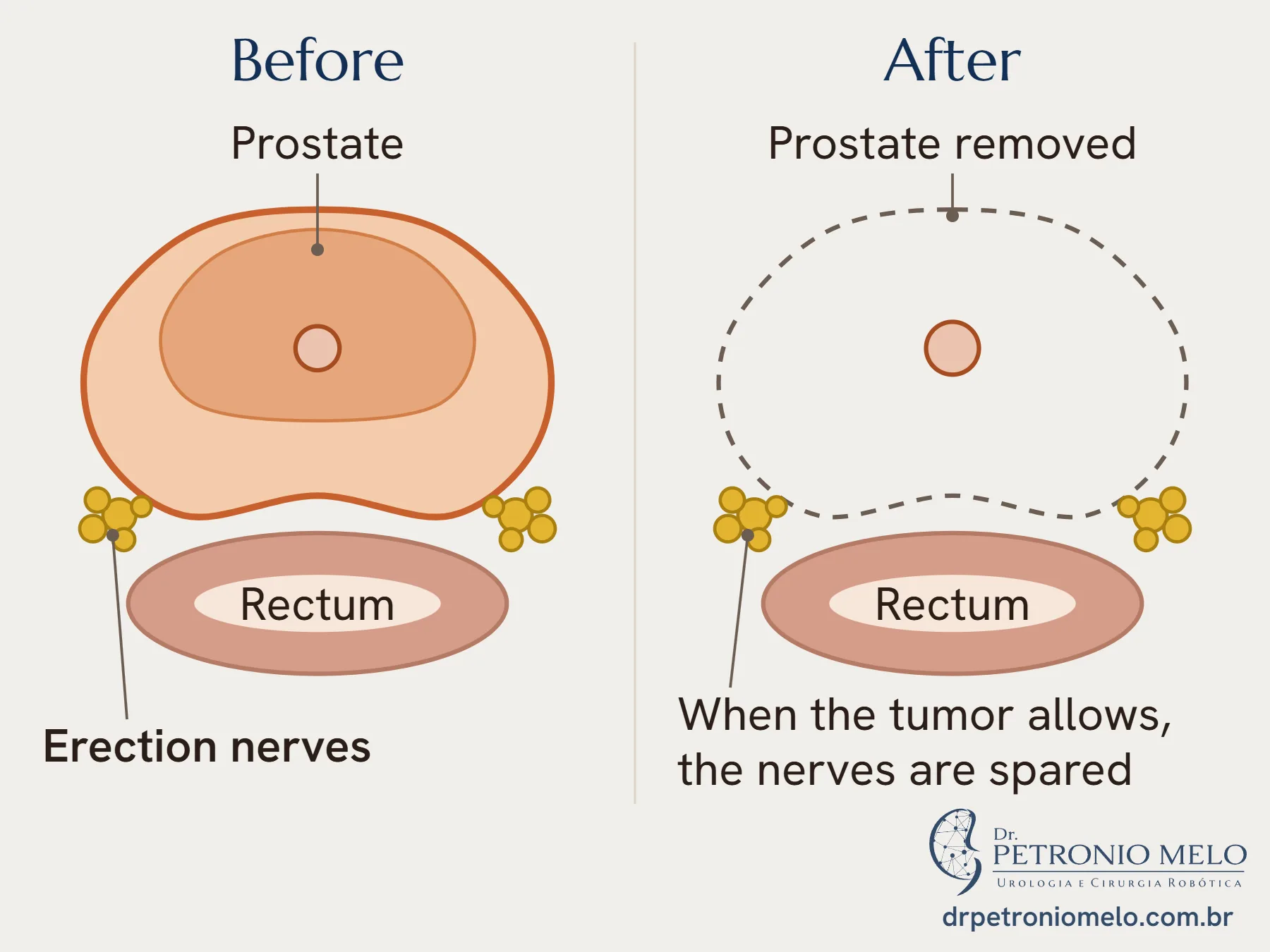
The nerves for erection run alongside the prostate. When the tumor allows, surgery tries to preserve them.4 Even so, erection difficulties are common after surgery.6
Recovery depends mainly on age, erections before surgery, other illnesses and how much of the nerves was preserved.3
What the numbers show
In the randomized study at the University of São Paulo, the return of erections in the first months was as follows:1
| Time point | With the robot | With open surgery |
|---|---|---|
| 3 months | 23.9% | 5.3% |
| 6 months | 30.6% | 6.9% |
Improvement continues after that. In a 2012 review of robotic series, erections had returned in 54% to 90% of men at 12 months and in 63% to 94% at 24 months.3
A 2026 review, with 27 studies and 38,530 patients, also found better recovery of erections with the robot than with open surgery.2
Erection rehabilitation
Research does not yet point to an ideal regimen.5 A Cochrane review, with eight studies and 1,699 men, indicated that scheduled use of tablets may have little or no effect on recovery up to 12 months.6
In a study of 628 men, vardenafil taken for intercourse improved erections during treatment. Two months after stopping, there was no difference between the groups.7
Pelvic floor exercises have also been studied. In a review of 12 randomized studies, four showed a benefit for erections and seven found no difference.9
Treatment options
The American guideline advises that men learn about all the options that are not contraindicated in their case, with the benefits and risks of each, together with their partner.8
- Tablets taken for intercourse
- Vacuum device
- Medication placed in the urethra
- Injection into the penis
- Penile prosthesis
The choice depends on your health, the time since surgery and what you prefer.
Ejaculation
The prostate and seminal vesicles are removed during surgery.4 After that, a man no longer ejaculates. An international consensus on sexual medicine lists this among the changes that can occur with any technique.5
The sensation of orgasm can continue.11 If you still plan to have children, talk about it before surgery.
Orgasm and other changes
One study surveyed men 3 to 36 months after surgery.11 The percentages for orgasm and urine during sex come from the 256 sexually active men, and those for the penis from all participants.
| What changed | Reported |
|---|---|
| Less intense orgasm | 60% |
| Orgasm takes longer | 57% |
| Shorter penis | 47% |
| Urine during sex | 38% |
| Pain at orgasm | 10% |
| Curvature of the penis | 10% |
| No orgasm | 5% |
A review of 43 articles indicates that these changes lessen over time.10
Leaking urine at orgasm is called climacturia. In a review of 13 studies with 5,208 men, it appeared in 27.2%.12 It is linked to urine leakage during the day, the subject of the continence page.10
How I approach it
In my practice, I ask about erections before surgery and explain what may change, including ejaculation and orgasm. When the tumor allows, I preserve the nerves. At the following visits, I ask about your sexual life and go over the treatment options with you, with your partner present if you wish.
When to see a urologist
- If your erections are not improving over time
- If you feel pain at orgasm
- If you leak urine during sex
- If you notice a new curvature of the penis
- If these changes are affecting you or your relationship
Frequently asked questions
Will I become impotent after surgery?+
Erections may be weaker at first, and the vast majority of patients improve. The result depends on age, erections before surgery, other illnesses and nerve preservation.3
How long do erections take to come back?+
The time varies, and recovery can take years.5 In the randomized study at the University of São Paulo, 30.6% of men who had robotic surgery had recovered erections at six months.1 In robotic series, the figure was 54% to 90% at 12 months and 63% to 94% at 24 months.3
Does a man ejaculate after the prostate is removed?+
No. The prostate and seminal vesicles are removed, and the absence of ejaculation is part of the surgery.4,5 The sensation of orgasm can continue.11
Does orgasm continue after surgery?+
In most men, yes, and it may change. In a study of 256 sexually active men, 60% reported less intense orgasms, 57% reported orgasms that took longer and 5% had no orgasm.11
Does robotic surgery help erections recover?+
In the most recent studies, yes. In the randomized study at the University of São Paulo, erections had returned at six months in 30.6% of men who had robotic surgery and in 6.9% of those who had open surgery.1 A 2026 review also found better recovery with the robot.2
References
- Nahas WC, Rodrigues GJ, Rodrigues Gonçalves FA, et al. Perioperative, Oncological, and Functional Outcomes Between Robot-Assisted Laparoscopic Prostatectomy and Open Radical Retropubic Prostatectomy: A Randomized Clinical Trial. J Urol. 2024;212(1):32-40. PubMed
- Suartz CV, Costa MSS, Matalani CFA, et al. Comparative functional, perioperative and oncological outcomes of robot-assisted and open radical prostatectomy: a systematic review and meta-analysis. Int Urol Nephrol. 2026;58(11):4575-4593. PubMed
- Ficarra V, Novara G, Ahlering TE, et al. Systematic review and meta-analysis of studies reporting potency rates after robot-assisted radical prostatectomy. Eur Urol. 2012;62(3):418-430. PubMed
- EAU-EANM-ESTRO-ESUR-ISUP-SIOG Guidelines on Prostate Cancer. European Association of Urology; 2026. EAU
- Salonia A, Adaikan G, Buvat J, et al. Sexual Rehabilitation After Treatment For Prostate Cancer-Part 2: Recommendations From the Fourth International Consultation for Sexual Medicine (ICSM 2015). J Sex Med. 2017;14(3):297-315. PubMed
- Philippou YA, Jung JH, Steggall MJ, et al. Penile rehabilitation for postprostatectomy erectile dysfunction. Cochrane Database Syst Rev. 2018;10(10):CD012414. PubMed
- Montorsi F, Brock G, Lee J, et al. Effect of nightly versus on-demand vardenafil on recovery of erectile function in men following bilateral nerve-sparing radical prostatectomy. Eur Urol. 2008;54(4):924-931. PubMed
- Burnett AL, Nehra A, Breau RH, et al. Erectile Dysfunction: AUA Guideline. J Urol. 2018;200(3):633-641. PubMed
- Akdagcik Z, Aybal HÇ, Karaaslan M, et al. Pelvic floor muscle training for erectile function in men undergoing radical prostatectomy: a systematic review of randomized controlled trials. World J Urol. 2026;44(1). PubMed
- Frey AU, Sønksen J, Fode M, et al. Neglected side effects after radical prostatectomy: a systematic review. J Sex Med. 2014;11(2):374-385. PubMed
- Frey A, Sønksen J, Jakobsen H, et al. Prevalence and predicting factors for commonly neglected sexual side effects to radical prostatectomies: results from a cross-sectional questionnaire-based study. J Sex Med. 2014;11(9):2318-2326. PubMed
- Ferrão JV, Becker AS, Bangemann GB, et al. The Prevalence of Climacturia in Patients after Radical Prostatectomy: A Systematic Review. Int Braz J Urol. 2025;51(1). PubMed
Would you like to talk about your case?
In the consultation, I go over your tests and your priorities.
Book a consultation