

Quick answer
After robotic radical prostatectomy, the hospital stay usually lasts one to two days, and you go home with the catheter, which stays for 7 to 10 days on average. Light activities return in one to two weeks. Once the catheter is out, there may be urine leakage and weaker erections at first, and the vast majority of patients improve over the months. PSA should become undetectable in about two months.3
Step by step
- In hospitalYou get up and walk with help and receive instructions about the catheter before discharge.
- At home, with the catheterThe catheter drains urine while the join between the bladder and the urethra heals.
- Catheter removalThis is when urine leakage may appear. Bring pads that day.
- Following monthsUrine control and erections improve gradually, each person at their own pace. The first PSA also comes in this period.
Average timelines
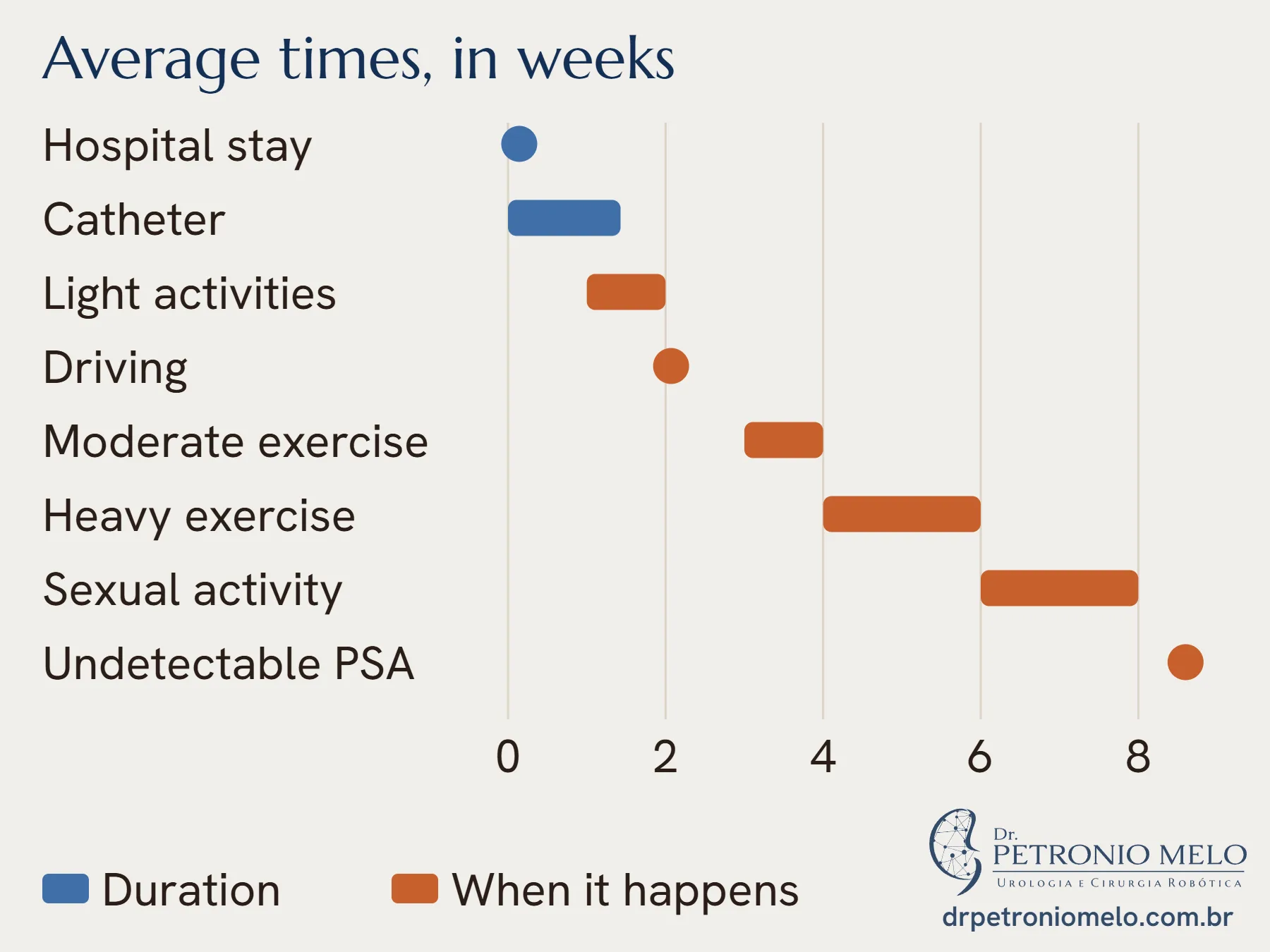
| What | When |
|---|---|
| Hospital stay | One to two days |
| Catheter | 7 to 10 days |
| Light activities | One to two weeks |
| Driving | Two weeks |
| Moderate exercise | Three to four weeks |
| Heavy exercise | Four to six weeks |
| Sexual activity | Six to eight weeks |
| Undetectable PSA | About two months3 |
These timelines are averages, and each recovery has its own pace. We agree on your return to work at the consultation.
What the robot changes
In the most recent studies, robotic surgery had a shorter hospital stay than open surgery.1,2 In a randomized study at the University of São Paulo, median blood loss was 250 mL with the robot and 719.5 mL with open surgery.1
Urine
Most men have some urine leakage after the catheter is removed.4 It is usually worse with effort and decreases over time. In the University of São Paulo study, 95.4% of men who had robotic surgery were continent at 18 months.1
Erections
Erections may be weaker at first, and the vast majority of patients improve. The time varies a lot. In the University of São Paulo study, at six months, erections had returned in 30.6% of men who had robotic surgery and in 6.9% of those who had open surgery.1 This number reflects only the first months, and improvement can continue after that.
PSA
PSA should become undetectable in about two months. After that, the European guideline advises a test every six months for three years and once a year from then on.3
How I approach it
In my practice, I explain these steps before surgery, with your family present if you wish. I teach pelvic floor exercises before and after surgery and set the dates for catheter removal and the first PSA. At the following visits, I follow your urine control and erections and adjust the advice to your pace.
When to get help
Get help the same day if you have:
- Fever
- Severe pain
- Blood with clots in the urine
- A catheter that has stopped draining
- Pain or swelling in one leg
- Shortness of breath
Also see your urologist if urine leakage is not improving over time or if your PSA does not become undetectable.
Frequently asked questions
How long will I stay in hospital?+
Usually one to two days. In studies, the stay was shorter with the robot than with open surgery.1,2
How long will I have the catheter?+
On average, 7 to 10 days. It drains urine while the join between the bladder and the urethra heals.
When can I return to my activities?+
Light activities usually return in one to two weeks, and driving in two weeks. Moderate exercise returns in three to four weeks, and heavy exercise in four to six weeks. The timing depends on your recovery and is agreed at the consultation.
When does bladder control come back?+
The pace varies. There may be urine leakage after the catheter is removed, and the vast majority of patients improve. In a randomized study at the University of São Paulo, 95.4% of men who had robotic surgery were continent at 18 months.1
Do erections come back?+
Erections may be weaker at first, and the vast majority of patients improve. The time varies and depends on age, erections before surgery and nerve preservation. At six months, 30.6% of men who had robotic surgery had recovered erections in the University of São Paulo study.1
When do I have my first PSA?+
PSA should be undetectable about two months after surgery.3 The date of the test is agreed at the consultation.
References
- Nahas WC, Rodrigues GJ, Rodrigues Gonçalves FA, et al. Perioperative, Oncological, and Functional Outcomes Between Robot-Assisted Laparoscopic Prostatectomy and Open Radical Retropubic Prostatectomy: A Randomized Clinical Trial. J Urol. 2024;212(1):32-40. PubMed
- Suartz CV, Costa MSS, Matalani CFA, et al. Comparative functional, perioperative and oncological outcomes of robot-assisted and open radical prostatectomy: a systematic review and meta-analysis. Int Urol Nephrol. 2026;58(11):4575-4593. PubMed
- EAU-EANM-ESTRO-ESUR-ISUP-SIOG Guidelines on Prostate Cancer. European Association of Urology; 2026. Follow-up chapter. EAU
- Sandhu JS, Breyer B, Comiter C, et al. Incontinence after Prostate Treatment: AUA/SUFU Guideline. J Urol. 2019;202(2):369-378. PubMed
Would you like to talk about your case?
In the consultation, I go over your tests and your priorities.
Book a consultation