
Quick answer
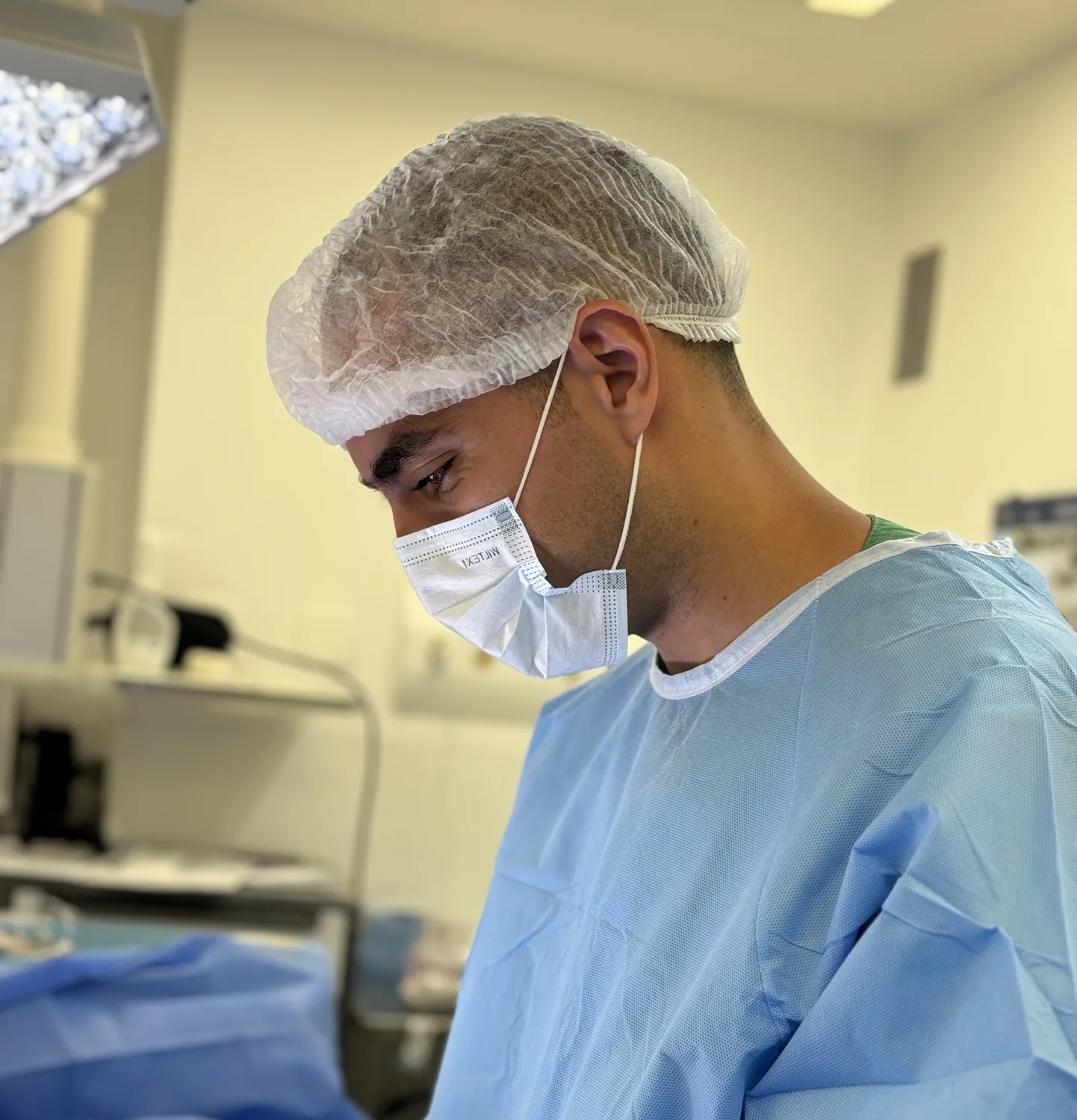
Before robotic prostatectomy, we review your tests and medications. You fast for 8 hours, with no bowel preparation. If you smoke, stopping before surgery reduces lung complications.3 The operation is done under general anesthesia, through small cuts in the abdomen, and takes 1 to 2 hours on average. You wake up with a catheter in the bladder, eat again the same day and usually go home in one to two days.
In the weeks before
- TestsI always order blood tests and a heart evaluation. Imaging is added when the case calls for it.
- MedicationsBring the full list, with doses. What to stop depends on each case.
- SmokingThe sooner you stop, the better. Stopping for four weeks or more reduced lung complications by 29%.3
- ExercisesWe start Kegel exercises before surgery and continue them afterward.
Training before the operation was assessed in a review of 16 randomized studies with 1,542 men. Incontinence was lower at one and six months, with no difference at 12 months. Erections did not change, and quality of life improved in the first months.4
The day of surgery
- ArrivalYou arrive after 8 hours of fasting, at the agreed time, and the team checks your tests and medications.
- AnesthesiaThe surgery is done under general anesthesia. You always receive an antibiotic before it starts.
- SurgeryIt takes 1 to 2 hours on average. The prostate and seminal vesicles are removed, and the bladder is joined to the urethra.
- Recovery roomYou wake up with the catheter and are watched closely until you go to your room.
The steps of the operation are described in robotic radical prostatectomy.
Care to avoid complications
For most urologic operations, the American guidance recommends a single dose of antibiotic, for the shortest possible time.2
Any pelvic cancer operation lasting more than an hour raises the risk of thrombosis. The European guideline advises considering a medication to prevent clots, often used for three to four weeks after the operation, following each country's recommendations.1 I always use compression stockings during surgery, and they stay on after discharge until the follow-up visit at the office.
In the randomized study at the University of São Paulo, complications within 90 days occurred in 11.1% of men who had robotic surgery and in 17.3% of those who had open surgery, with no statistical difference.5
After surgery, still in hospital
You get up and walk with help. Eating starts again gradually, on the day of surgery. Pain is treated with medication. Before discharge, you receive instructions about the catheter, which goes home with you.
The hospital stay usually lasts one to two days. What happens in the following weeks is in recovery after prostatectomy.
How I approach it
In my practice, I review your tests and medications with you before surgery. I teach Kegel exercises before and after the operation and ask smokers to stop as soon as possible. I explain each step of the day, with your family present if you wish.
When to let me know before surgery
- If you have a fever, flu or an infection in the days before
- If you start or change any medication
- If you have any question about fasting or your medications
Frequently asked questions
How long does the surgery take?+
On average, 1 to 2 hours.
Do I need to stop my medications?+
It depends on each case. Do not stop anything on your own. Bring the full list to the consultation, and we decide together.
Do I need to stop smoking before surgery?+
It helps. In a review of 55 studies, stopping for two weeks or more reduced lung complications by 27%, and stopping for eight weeks or more by 37%.3
Do I need to fast or prepare my bowel?+
You fast for 8 hours. There is no bowel preparation.
Will I wake up with a catheter?+
Yes. The catheter stays in the bladder while the join between the bladder and the urethra heals, on average 7 to 10 days. You go home with it.
When do I go home?+
Usually one to two days after surgery. In studies, the hospital stay was shorter with the robot than with open surgery.5
References
- EAU-EANM-ESTRO-ESUR-ISUP-SIOG Guidelines on Prostate Cancer. European Association of Urology; 2026. EAU
- Lightner DJ, Wymer K, Sanchez J, et al. Best Practice Statement on Urologic Procedures and Antimicrobial Prophylaxis. J Urol. 2020;203(2):351-356. PubMed
- Tang E, Rodriguez RM, Srivastava A, et al. Impact of short duration smoking cessation on post-operative complications: A systematic review and meta-analysis. J Clin Anesth. 2025;106:111967. PubMed
- Wan W, Shen L, Chang Y, et al. The impact of prehabilitation on postoperative outcomes in patients undergoing radical prostatectomy for prostate cancer: a systematic review and meta-analysis. Support Care Cancer. 2026;34(10). PubMed
- Nahas WC, Rodrigues GJ, Rodrigues Gonçalves FA, et al. Perioperative, Oncological, and Functional Outcomes Between Robot-Assisted Laparoscopic Prostatectomy and Open Radical Retropubic Prostatectomy: A Randomized Clinical Trial. J Urol. 2024;212(1):32-40. PubMed
Would you like to talk about your case?
In the consultation, I go over your tests and your priorities.
Book a consultation