

Quick answer
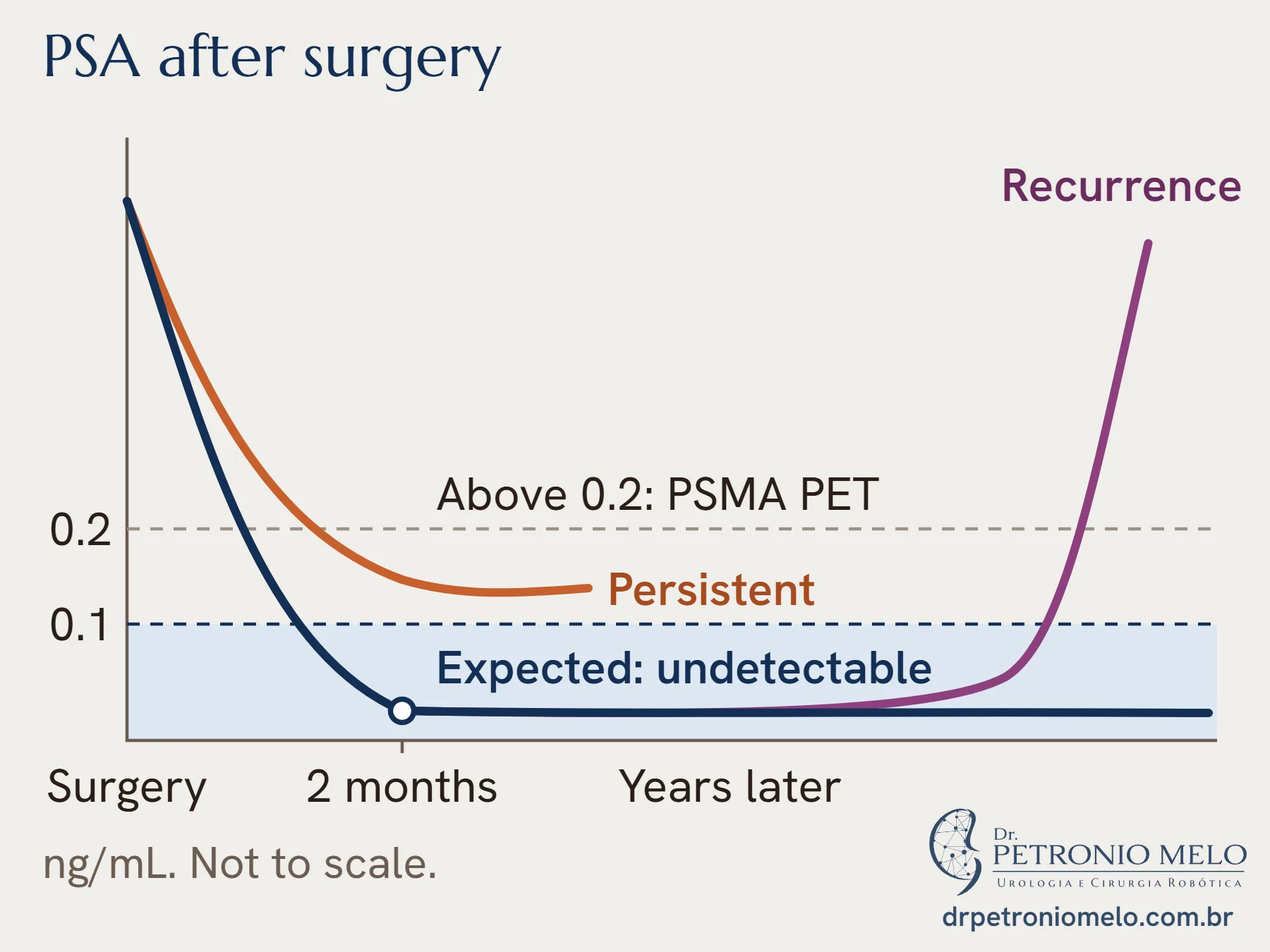
After radical prostatectomy, PSA should become undetectable in about two months. On most reports, that is a value below 0.1 ng/mL.1 If the test shows 0.1 ng/mL or more in the first four to eight weeks, we call it persistent PSA. If it rises again later, we call it biochemical recurrence, which carries a variable risk and has treatment options, including salvage radiotherapy.2
What to expect from the test
The prostate is the main source of PSA. Once it is removed, the test drops and stops being a marker of the gland. It then shows whether there are still tumor cells making PSA somewhere in the body.
That is why, after surgery, a number that would be low in a man with a prostate deserves attention.
How to read the result
| Result | What it means | Next step |
|---|---|---|
| Undetectable about two months after surgery | This is what is expected1 | Keep up regular PSA tests |
| 0.1 ng/mL or more, four to eight weeks after surgery | Persistent PSA, seen in 5% to 20% of cases2 | Individual evaluation: current data do not allow a single recommendation2 |
| PSA rising after having been undetectable | Biochemical recurrence2 | Confirm it, measure how fast it is rising and discuss tests and treatment |
In the European guideline, any rising PSA after prostatectomy counts as biochemical recurrence. The value that best predicts metastases is above 0.4 ng/mL and rising. Even so, the guideline advises not waiting for a particular number to start treatment.2
How often to repeat it
The European guideline advises a PSA test every six months for three years and once a year after that. The level of evidence for this routine is low, and the interval can be adjusted to your case.1
If PSA rises again
A rising PSA, on its own, does not say where the disease is. The risk depends mainly on two things:2,5
| Group | European guideline criterion |
|---|---|
| Low risk | Doubling time longer than one year and ISUP grade in the surgical report below 4 |
| High risk | Doubling time of one year or less, or ISUP 4 or 5 |
PSMA PET looks for where the disease is. The guideline suggests the scan with a PSA above 0.2 ng/mL, when the result may change the decision. It found lesions in 48% of cases with a PSA of 0.2 to 0.5 ng/mL and in more than 90% with a PSA above 2 ng/mL.2
Salvage radiotherapy
For men with two consecutive PSA rises, the European guideline advises offering early salvage treatment, which offers the possibility of cure. In some cases, hormone therapy is added to radiotherapy.2
Radiotherapy right after surgery is no longer routine. In the RADICALS-RT study, with 1,396 men, 85% of the adjuvant group and 88% of the observed group were free of PSA progression at five years. Immediate radiotherapy caused more urinary problems, and 33% of the observed men had needed radiotherapy by eight years.3
An analysis of three studies with 2,153 men also found no advantage for immediate radiotherapy.4 The European guideline reserves this option for selected cases, with ISUP 4 or 5 and tumor beyond the prostate, without involved lymph nodes.2
How I approach it
In my practice, I explain before surgery when the first PSA will be and what each result means. When the value rises, I repeat the test to confirm it and read the result together with the surgical report and how fast it is rising. Only then do we talk about PSMA PET and treatment. A small change can be frightening, so I show you how the tests have changed over time and what that indicates.
When to see a urologist
- If your PSA does not become undetectable after surgery
- If your PSA rises, even if the value seems low
- If you have lost track of follow-up and have gone more than a year without the test
Frequently asked questions
What is a normal PSA after prostatectomy?+
The expected result is an undetectable PSA about two months after surgery. On most reports, that means a value below 0.1 ng/mL.1
Is a PSA of 0.1 after surgery a recurrence?+
It depends on the timing. In the first four to eight weeks, 0.1 ng/mL or more is called persistent PSA.2 Later on, what counts is the trend. A PSA that rises on consecutive tests is biochemical recurrence.2
If my PSA rose, do I have metastases?+
Not necessarily. The risk of biochemical recurrence differs from one man to another. It depends on how fast PSA rises and on the ISUP grade in the surgical report.2,5
How often should I repeat the PSA?+
The European guideline advises a test every six months for three years and then once a year. Follow-up can stop when life expectancy is less than ten years.1
Will I need radiotherapy right after surgery?+
Most men with an undetectable PSA do not.2 In a study of 1,396 men, observing and treating only if PSA rose had results similar to immediate radiotherapy, with fewer urinary problems.3
Can biochemical recurrence be cured?+
According to the European guideline, early salvage radiotherapy offers the possibility of cure.2 The result varies from case to case, which is why follow-up has to be kept up.
References
- EAU-EANM-ESTRO-ESUR-ISUP-SIOG Guidelines on Prostate Cancer. European Association of Urology; 2026. Follow-up chapter. EAU
- EAU-EANM-ESTRO-ESUR-ISUP-SIOG Guidelines on Prostate Cancer. European Association of Urology; 2026. Treatment chapter. EAU
- Parker CC, Clarke NW, Cook AD, et al. Timing of radiotherapy after radical prostatectomy (RADICALS-RT): a randomised, controlled phase 3 trial. Lancet. 2020;396(10260):1413-1421. PubMed
- Vale CL, Fisher D, Kneebone A, et al. Adjuvant or early salvage radiotherapy for the treatment of localised and locally advanced prostate cancer: a prospectively planned systematic review and meta-analysis of aggregate data. Lancet. 2020;396(10260):1422-1431. PubMed
- Van den Broeck T, van den Bergh RCN, Arfi N, et al. Prognostic Value of Biochemical Recurrence Following Treatment with Curative Intent for Prostate Cancer: A Systematic Review. Eur Urol. 2019;75(6):967-987. PubMed
3D illustrations: BodyParts3D, © The Database Center for Life Science, licensed under CC Attribution-Share Alike 2.1 Japan.
Would you like to talk about your case?
In the consultation, I go over your tests and your priorities.
Book a consultation