


Quick answer
STIs are infections passed on through sexual contact, including vaginal, anal and oral sex.1 In men, the most common signs are discharge from the urethra, burning when urinating, and sores and warts on the genitals.1 Many infections cause no symptoms, which is why testing plays an important role.1 Treatment depends on the cause, and partners are part of the plan.1
Signs that call for evaluation
The Brazilian protocol organizes STIs by the signs they cause.1 Each group has different causes, and treatment changes with the cause.
- Discharge from the urethra. Usually urethritis, led by gonorrhea and chlamydia.1
- Blisters or sores. Herpes is a frequent cause. Syphilis and other infections can also cause sores.1
- Warts. Almost always caused by HPV types with a low cancer risk.1
- Burning when urinating. It may come with urethritis, but it can also be a urinary infection or another cause.1
Why many STIs cause no symptoms
People without symptoms can also pass on an infection. More than 90% of gonorrhea infections of the throat cause no symptoms.1 Many people with the herpes virus will never have an outbreak, and HPV usually gives no sign at all.1
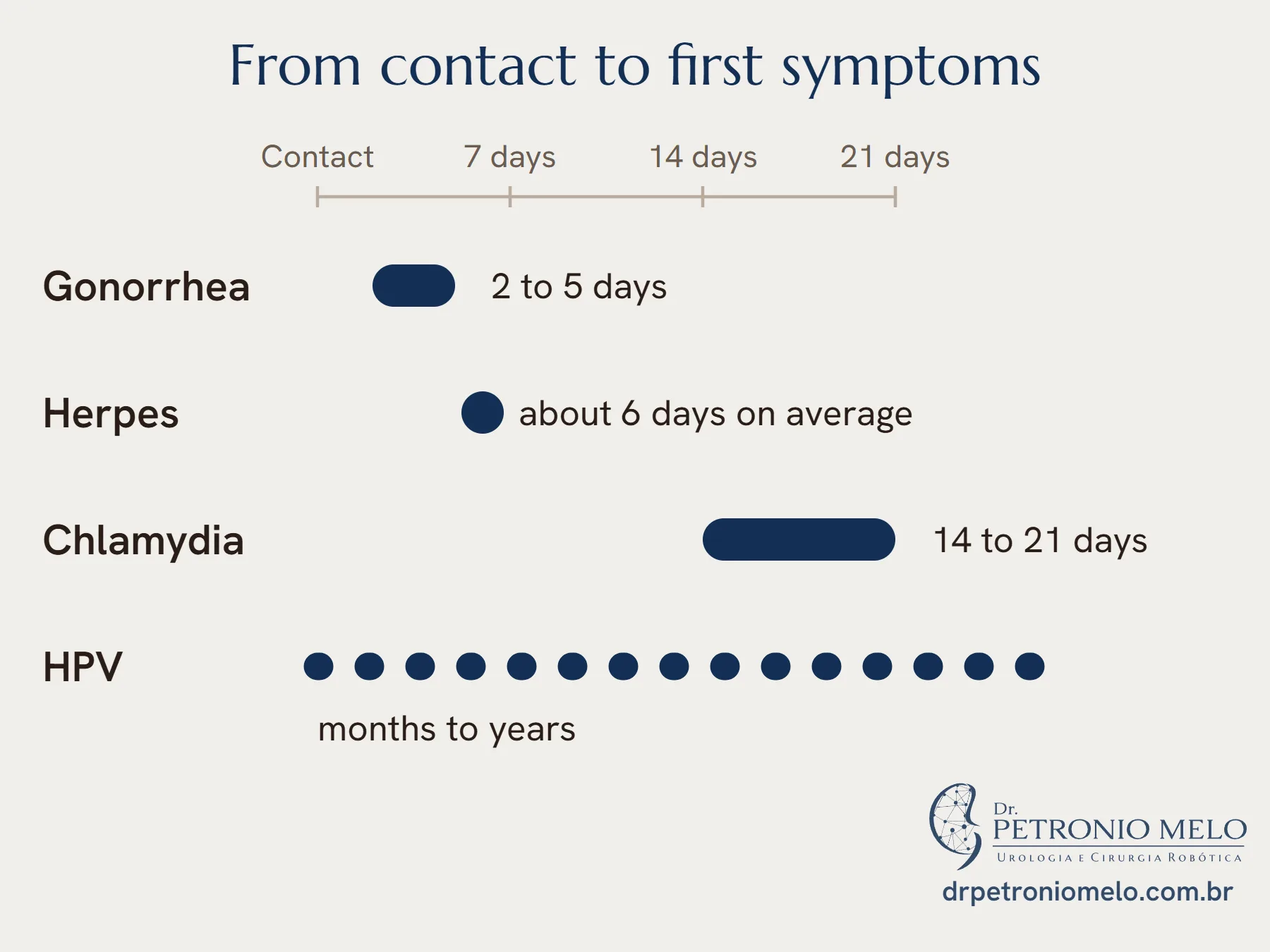
The time between contact and the first symptoms varies from one infection to another.1 This helps explain why it is not always possible to know when, or from whom, an infection came.
Oral sex
The germs that cause urethritis pass through oral sex.1 Gonorrhea can infect the throat, usually without symptoms.1 HSV-1, more often linked to sores around the mouth, causes a growing share of genital herpes.2 The Brazilian protocol includes latex barriers among the protective measures for oral-anal sex.1
Testing
The test follows the type of sex. For chlamydia and gonorrhea, the sample can be urine, genital discharge, or a swab from the anus or throat.1 The protocol sets how often to test according to each person's age and exposure, and calls for new tests when an STI is diagnosed.1
Anyone diagnosed with an STI should be tested for others, because one infection does not rule out another.1
Prevention
Condoms are an essential strategy but have limits, and the Brazilian protocol recommends adding other measures.1
- use condoms
- get vaccinated against HPV and hepatitis A and B, when indicated
- get tested regularly
- treat partners at the same time
Source of the list: Brazilian protocol.1
Partners
To stop transmission, partners need to be evaluated and treated.1 If only one person is treated, the infection can come back to them at the next sexual contact.1
The protocol provides for this communication to be confidential.1 An STI can bring insecurity to a relationship.1 The consultation is also the place to talk through these doubts.
Where to start
When to see a urologist
- If there is discharge from the urethra
- If sores, blisters or warts appear on the genitals
- If your partner is diagnosed with an STI
- If you have had an exposure and want advice about testing
Frequently asked questions
What are the symptoms of an STI in men?+
Discharge from the urethra, burning when urinating, blisters or sores on the genitals and warts are the most common.1 Many infections, however, cause no symptoms.1
Can I have an STI without symptoms?+
Yes. Gonorrhea infections of the throat and rectum, for example, usually cause no symptoms, and HPV is usually silent.1
Can oral sex transmit STIs?+
Yes. The germs that cause urethritis pass through oral sex, gonorrhea can infect the throat and HSV-1 from the mouth can cause genital herpes.1,2
How long after sex do symptoms appear?+
It depends on the infection. For gonorrhea, 2 to 5 days; for herpes, 6 days on average; for chlamydia, 14 to 21 days; for HPV, months to years.1
Which tests should I have after a risky encounter?+
It depends on the exposure, the type of sex and the time that has passed. Samples for chlamydia and gonorrhea, for example, are taken according to the type of sex.1 The consultation defines what to test for and when.
Do condoms protect against all STIs?+
They are an essential strategy but have limits, and the Brazilian protocol recommends adding other measures, such as vaccines and regular testing.1 With herpes, for example, they reduce transmission but do not eliminate it.2
Do I need to tell my partner?+
Yes, because partners need to be evaluated and treated to stop transmission. The Brazilian protocol handles this communication confidentially.1
References
- Brasil. Ministério da Saúde. Protocolo Clínico e Diretrizes Terapêuticas para Atenção Integral às Pessoas com Infecções Sexualmente Transmissíveis (IST). Brasília: Ministério da Saúde; 2022. Brazilian Ministry of Health
- Workowski KA, Bachmann LH, Chan PA, et al. Sexually Transmitted Infections Treatment Guidelines, 2021. MMWR Recomm Rep. 2021;70(4):1-187. Genital herpes chapter. CDC
Would you like to talk about your case?
In the consultation, I go over your tests and your priorities.
Book a consultation